The Challenge of Change

16 Jan

I lingered on a sidewalk that cut diagonally across Birmingham’s Kelly Ingram Park, looking back at where we’d come from. I regarded the back of a statue of Rev. Martin Luther King Jr., himself looking back at 16th Street Baptist Church, the plain, red brick church where, on Sunday, September 15th, 1963, a white supremacist bomb had killed four African-American girls. Addie Mae Collins, Denise McNair, Carole Robertson, and Cynthia Wesley had died not for being part of a protest, but simply for being among the children filing into the basement to prepare for the sermon, titled “The Love That Forgives.”

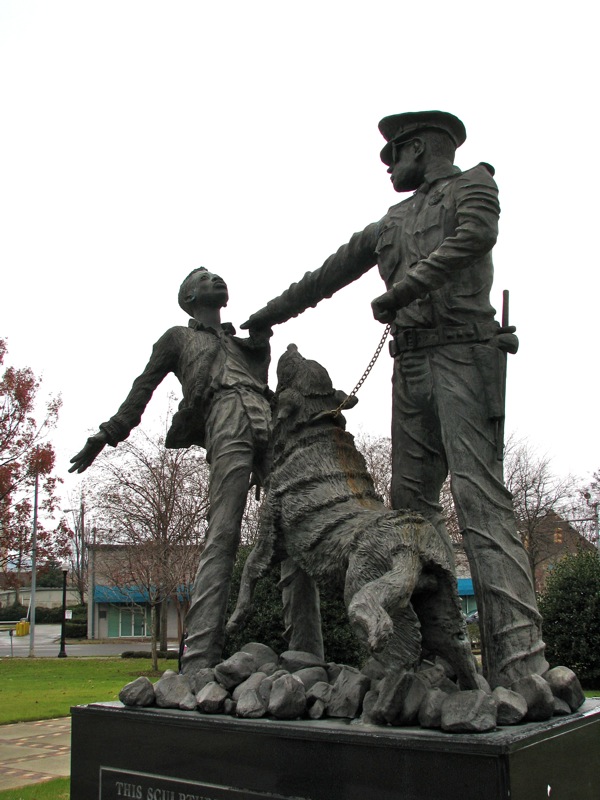
How could anyone forgive that? Let alone the scenes depicted by the other statues at the park, from a policeman commanding a dog to lunge into the face of a protestor to a canyon of other-worldly canine jaws, designed to threaten pedestrians into at least an echo of the fear protestors felt. The sidewalks also led us to pass between a fire hose and protestors leaning against a wall, bracing against an imagined impact – and between two children and the bars of their jail cell. Beneath the standing figures reads the inscription: “I Ain’t Afraid of Your Jail.”

But what exactly were our students feeling?

Assumption’s SEND volunteers were mostly quiet as they wandered in clumps. We’d been riding four days of good feelings, born of spirited work building the Habitat for Humanity house in Tuscaloosa, and this was our off day, a time to cut loose. But there were no goofy poses here, not in this spot, especially after touring the building across the street – the Birmingham Civil Rights Institute.

The museum opened in 1992. Birmingham had changed dramatically since 1963 – the city’s first black mayor, Richard Arrington had been mayor for 13 years; he would serve for seven more before stepping down. Still, the Civil Rights Institute faced opposition from those who, remembering the horrors of the past, thought it better not to bring up the past.
But if some Birmingham residents resisted the Civil Rights Institute because of profoundly painful feelings, this day I was more worried about the opposite problem. How would our Assumption College students – all white, all from the Northeast, all born within a year or two of the institute itself, respond? How deeply would it register, even among students so idealistic, they’d decided to spend their winter break serving others? How would I feel if I weren’t from here?

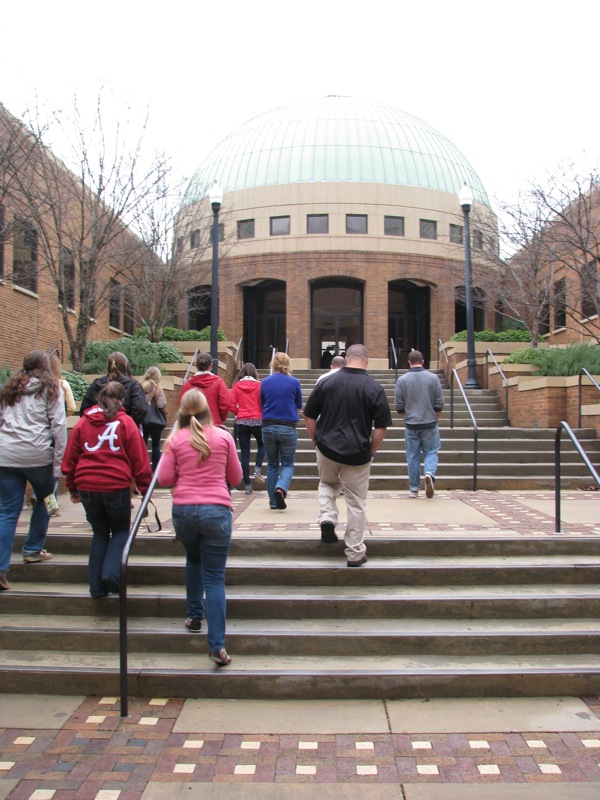
The Institute certainly does everything it can to reach across the gap of half a century. It shares an intersection with 16th Street Baptist and Kelly Ingram Park, but it’s so smartly designed, it would pack a punch anywhere it was placed. we were greeted at the base of the steps; we ascended only after a guide asked to respect the reverence of the exhibits by not taking photos or using cell phones. While the tour was self-guided, the space imposed the same sense of progression on all of us: A short documentary lay the groundwork the city’s post-Civil War history, industrial and racial, that led to segregation; the theater screen then rose, revealing the first of several rooms which contrasted “white only” and “black only” facilities. We’d wound past photos and videos, statues and artifacts; we’d heard the impassioned voices of both Wallace and King ringing with seemingly equal passion, and lingered long in front of the exhibit dedicated to the four girls who died in that horrific blast just across the street. We’d walked across to the church itself – the group reflexively, but wanly, smiled for a group photo – then, of course, the park itself, where many confrontations went down. One seasoned war correspondent covering the protests said he’d never seen anything as disturbing, and the statues did their best to remind us.
Still, time passes – and I don’t just mean the almost half-century since the bombings. There’s also the mere half hour after the exhibit. Our paying of respects to the past gave way to a request for designer coffee and fru-fru yogurt, and from there, a drive up the mountain to the statue of Vulcan, symbol of Birmingham’s steel mill legacy. We went  up into the top of the statue – some giggling over their fear of heights, multiplied by the see-through metal grate floor. The ride back to Tuscaloosa evolved into spirited singing of country music standards and smart-phone updates of how Tim Tebow and the Denver Broncos were doing against the Pittsburgh Steelers.  We watched the first half of the game at Dreamland Barbecue, a world famous black-owned ribs joint which made its reputation serving simply ribs, sauce, and a loaf of sandwich bread; white customers would flock to the gravel rural roads of Jerusalem Heights, then, and probably still, a mostly black neighborhood on the edge of town.

I was glad to have these positive examples of race relations, like our experience on the work site, to prop against the images of hatred. But as we headed home for the nightly reflection required for Assumption SEND trips, it all had me wondering what students absorbed from the day.

Once we settled down to talk, though, I was relieved to see that these issues registered far more than they let on. I had scribbled questions to pose, but they beat me to almost every one of them – including the troubling one of how they would’ve responded had they been born into the same culture in the same moment of history. Would they have been among those with the critical detachment to see the bigger picture – and the mind-blowing courage to act on it? No one seemed to imagine they would be a pathologically violent fomenters of hatred – one of the small minority who committed acts of violence – but some did have that uneasy feeling that they might’ve been on the wrong side of the issue … or, being on the right side, failed to act with the appropriate sense of outrage. Without being asked, they volunteered analogous issues facing us today, ones that went far beyond race itself.

When I asked them how their experience would influence their perception of Martin Luther King Day – at our college, a time of hustle and bustle, when students settle into their dorms before the first day of classes – a couple said they would think of the courage King and thousands of others showed in transforming a world deeply set in its racist ways. They also agreed the work was far from done.

After more than an hour of social critique and self-questioning reflection, it was time to wind them down  – they had a 7 a.m. shift on the work site Monday, followed by an evening of rooting for the mostly African-American stars of the University of Alabama football team. Searching for an upbeat benediction, I asked them what, if anything, was redemptive about this day of exploring the legacy of King, as well as the brave thousands who followed him.

“That,” one student said, her eyes moist, “people can … change!

Transformations

13 Jan

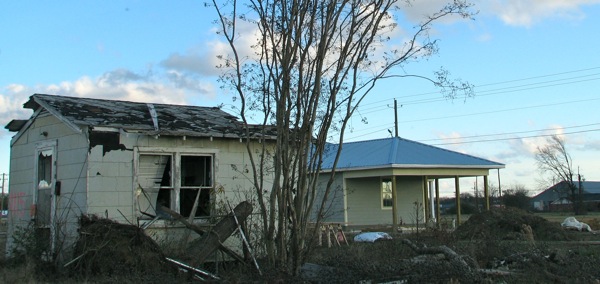
Tiny shack in ruins less than 100 yards from Habitat project

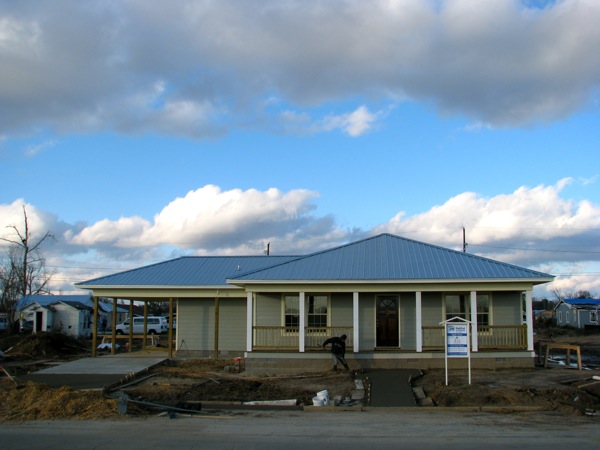
Thursday afternoon I weaved through the wasteland once packed with homes and businesses – razed by 1-2 punch of the April 27 tornado and eight months of debris removal – and pulled up at 118 29th Street, the future home of storm survivor Appie Jones.

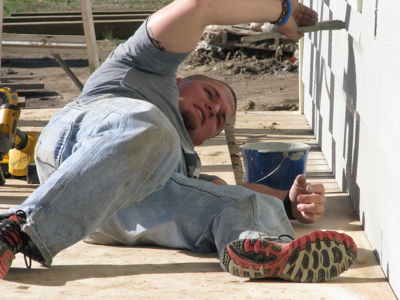
The Habitat for Humanity sign proclaims the house is sponsored by First Presbyterian Church and Nick’s Kids – but I’ll always think of this as the Assumption College house, where 13 big-hearted, hard-working students and escort Paul Belsito put in five vigorous work days. They caulked and sanded and puttied and painted, inside and out; they sawed and installed woodwork beneath the eaves, sheathed the porch columns, installed and stained doors.

Compared to that joyful commotion, the house seems lonely now, in the late afternoon light. The students flew out early Wednesday morning, on their way back to the frozen north while I lingered behind, getting in some quality time with family and friends. They had as productive and inspiring a week as anyone could expect from an immersion experience: Tuscaloosa isn’t known for its breathtaking peaks, but the students obviously had a mountaintop experience. I imagine a few of them might be wondering how to hold onto the high, perhaps even how much they have contributed in the grand scheme of things.

Out of sight, out of mind?

I wish they could see what I saw after they left – and what I’ll keep seeing, and feeling, every visit home, for the rest of my life.

Start with the house. It seemed quiet and modest enough when I cruised by, Habitat supervisor Dewayne Searcy either done for the day or working elsewhere, leaving only two guys pouring the sidewalk. But this single-story home stands tall against the backdrop – ravaged shacks a few hundred yards away, then a flat void where the tornado destroyed about 100 lower-income homes and killed six of the people who lived in them, then, still farther away, the gash that continued for miles to my right, exposing landmarks once unseen from this street.

The house, even amid the irrecoverable loss of 52 people and thousands of homes, has me thinking about something hopeful.

"Roll Tide Roll": My game-night uniform.

Something called transformation.

Transformation that is slow, transformation that is arduous, transformation made possible in large part by the fresh energy and enthusiasm of volunteers such as the ones who came to my home from Assumption.

Or perhaps I should say transformations, as some are conspicuously public – this particular house is easily seen from the thoroughfare of Greensboro Avenue –and profoundly intimate. It’s the latter that has me continuing to write this, on my mother’s kitchen counter, when I really should be packing for my own flight back to Massachusetts.

Bear in mind that while I am a native Tuscaloosan, for all practical purposes, I haven’t lived here since 1981. Three decades erode both the strength of emotional connections and the vividness of memories, paved over by newer experience that, I have told myself, are more relevant to who I am today.

But for the last 24 hours, I’ve felt a change. Yesterday I drove by a patch of campus I normally attach no personal significance to whatsoever – only now it’s the path we walked our first afternoon in town, when, despite exhaustion, the students were eager to see the University of Alabama campus, gawk at the massive stadium, and flood the bookstore – intent on buying shirts that would declare their allegiance to Alabama football and Tuscaloosa as a whole. While this might be dismissed as a typical souvenir-gathering impulse, it turned to predict a wholehearted investment on the work site, where they were anything but tourists. Meanwhile, the trip led me to places I’d never been myself. One example was the Birmingham Civil Rights Institute – barely built back when I left Alabama – which I will write more about in this space come Monday. Another was the restaurant where owner (and former Alabama and Miami Dolphin star Bob Baumhower) went against policy to provide reserve our students a table, allowing them to watch Alabama’s 21-0 crushing of LSU in an appropriate setting.

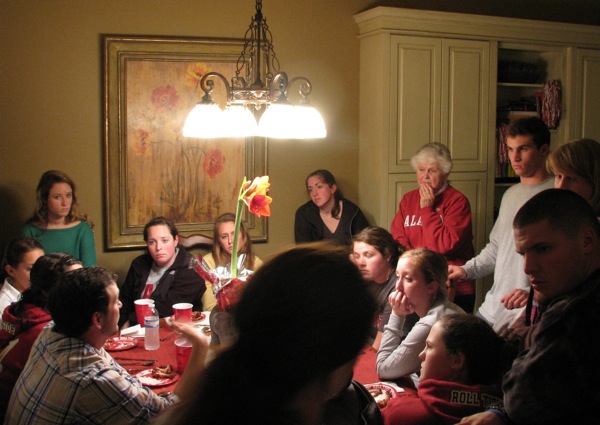
Other places transformed include the very kitchen in which I now sit. It’s a relatively new home – miles from the house in which I grew up – but behind the stool on which I sit, what was once a nice but unremarkable dining table is now the place where, on their last night in town, our students abandoned more comfortable seating to huddle around Habitat supervisor Dewayne Searcy and his wife Heather. I won’t visit this space in the future without feeling a bit of the deep warmth, humor, and appreciation shared by Alabamians and Tuscaloosans.

Students, along with Mom, listen to point made by Dewayne, bottom left

On that night Dewayne told how his friend James, a coach and construction supervisor who set up the Bauhower restaurant experience, had told Dewayne on Assumption’s first day that while most groups who come in have one or two stars, he could look into the eyes of “each and every person” and tell early they were all fully engaged. Dewayne said it more eloquently than this, but at that point in the proceedings, I was too moved to take notes.

Fortunately I do have the notes of students, a whole paper bag full of them, left over the course the week by students as the spirit moved them. The first night student leader Marissa Reis taped up a small paper bag for each group member, plus a bag marked “Land family.

I saved the reading of mine until two hours ago – spreading them on this counter so my mother and I could experience them together. We marveled for a good half hour, feeling some of that warmth come back all over again; Mom also allowed as how this gave her that much more insight on why I loved working at Assumption, what makes all that snow and ice worthwhile.

I suppose this week’s experience is just a moving reminder of something true all along – that our past always informs our present. In this case, it took a group of students less than half my age to help me see my hometown, and my life, in a fresh and affirming light. But what I hope the students take from this is that I’m just one local, in the loosest sense of the word; who knows how many thousands the SEND students impact over the years.

They may not get to come back to see the lasting impact, and even if they did, the subtler changes I feel this morning give no outward sign. But they have all done their bit to transform lives – including, this morning, my own.

Link

Telegram chronicles Assumption visit

10 Jan

Telegram chronicles Assumption visit

Pre-game Calisthenics

9 Jan


Tornado survivor Dowling (right) with (L-R) Brittany Wilson, Paul Belsito, Rev. Charlie Durham, and Marissa Reis.

As work on the Rosedale Court home of Appie Jones continued, the group received encouragement from a series of intriguing visitors – most importantly, Appie Jones herself.

The 82-year-old tornado survivor walked about her future home – including the window-less “safe room” installed in the center of every Habitat home during this recovery – and talked with the crew (an event I missed).

I was there, however, for another Habitat home owner – Dana Dowling, the recipient of the first post-tornado home here in Tuscaloosa. She shared with a few students her harrowing story – that of surviving the riding out of a storm in one of the worst places to be, a trailer park.

If I was inclined to project an evil consciousness on a climatological entity, the tornado would be a prime candidate – it knocked out the emergency center on its way into towns, taking out the alarm system in the process (as well as all of the trucks needed to rebuild). Combine that with the power going out in the Dowlings’ neighborhood more than an hour before, and they were left with no idea the storm had turned their way. When they did figure it out, the funnel cloud blocked their way to the nearest shelter.

Before hiding in a utility room, they looked outside and saw the funnel cloud. Her daughter asked if she was seeing a car in the cloud, and Dana looked. “There was a minivan 250 feet up in the air,” she said.

Most of their trailer was gone when the cloud passed, as well as most of the trailer park. Strangely, Dana noted, no one was killed in the trailer park – since they knew to evacuate – but five were killed in traditional houses nearby.

The silver lining for the Dowlings was that they became recipients of the Habitat home on which they were volunteering, and moved in months ago, even as friends are still on hold, waiting for insurance, or mortgage companies, or FEMA, or some combination of the three. “It’ll take five years to rebuild,” she said.

She was more optimistic about the major event to come on this particular cloudy afternoon – the Alabama-LSU game. She received a call Monday from a Sporting News reporter, following up on the tornado angle. “They asked who I thought was going to win,” she said. “Is that even a question?”

Pointing out that she erred by wearing a purple shirt, a few purple-clad volunteers nearby quickly came to her rescue. “She’s wearing Kenyon colors,” offered one of the crew, newly arrived for their own service stint.

Dowling was soon joined by Rev. Charlie Durham, pastor of Tuscaloosa’s First Presbyterian Church – which has sponsored the building of this house. The church is also where my father attends. “I should’ve known you were a Land,” he joked, “since you have a camera hanging around your neck.”

Durham was with the inspiring Karolina Lingyte, who volunteers for Habitat despite being bound to a wheelchair. That’s nothing particularly challenging for Lingyte, leading scorer on Alabama’s championship women’s wheelchair basketball team; she’d scored 30 in her last game before Christmas break.

Meanwhile, the sign for this Habitat house mentions one other major sponsor – Nick’s Kids, football coach Nick Saban’s charity, which has set the goal of building one new home for each of Alabama’s 13 championships.

“Let’s hope,” my father told me today, “they make it 14.”

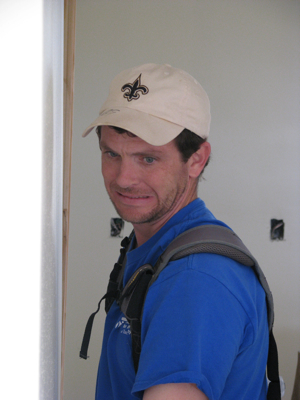
Habitat supervisor Dewayne Searcy checks paint job while sporting Saints cap autographed by New Orleans head coach Sean Payton

Sport as Service

8 Jan

SEND students careful not to tread on sacred circle in Bama locker room

Friday morning I was standing on the Habitat construction site, chatting with Assumption football captain Nick DiAntonio, when my father, Charlie, sidled up, his camera hanging from his neck.

When I started to mention Nick’s name, my father grinned; he’s already read the article about the Greyhound in the Boston Globe.

“Linebacker, math major, 3.8 GPA,” my father quipped, surprising Nick, and even me – although I shouldn’t have been. Of course Dad would’ve absorbed the key identifying information. Once a sports writer, always a sports writer.

My father knew Paul “Bear” Bryant from his arrival at Alabama through the glorious decade of the 1960s, and sports a national championship ring Bryant gave him after the 1961 season. Even more of a sign of how football pervades every part of life in Tuscaloosa, my father was the second person the students had met with a national championship ring – construction volunteer James Shackelford earned his as a safety on the 1992 team that upset Miami in the Sugar Bowl. “I saw Nick and I could tell he played,” James told me.

Working in a neighborhood where a tornado killed six people, is it frivolous to care so much about a game – or, in the face of such tragedy, is it spiritually healing to embrace whatever unites people in a sense of transcendent joy?

Tuscaloosa tends to suggest the latter – which is saying in a city still bearing the six-mile-long scar from last April’s tornado, which killed 52. As trivial as sports seems against such a backdrop, the normalcy of such diversions helped people keep their bearings: On April 28th, a little more than 24 hours after the tornado knocked out cable and internet at my father’s place, I called from a Worcester sports bar, reading the ESPN crawl summary of which Tide players went where, sure to note that with Mark Ingram going to New Orleans and Julio Jones to Atlanta, he’d get to see plenty of both in regional TV coverage.

As the weeks unfolded, University of Alabama athletes took earnestly their responsibility for helping with cleanup – after former Crimson Tide star Javier Arenas barely survived the tornado, he drove to Kansas City (where he plays for the Chiefs) and promptly returned with a vehicle filled with bottles of water and other supplies. Even Alabama’s opponents got into the action: Kent State football players helped clear debris last summer, earning an improbable ovation when they ran out onto the field to play Alabama that fall.  One unusual result: When Kent State ran out onto Bryant-Denny Stadium field that fall, Alabama fans gave the squad an ovation. (Gratitude couldn’t bridge the difference in talent; Alabama won 48-7.)

For this Tuscaloosan, the above is old news. The surprise, however, has been the ease with which Assumption students, New Englanders all, have adopted the Crimson Tide cause. What Assumption students have shown this week is how, once one learns to give one’s self over emotionally to being a fan, it’s easy enough to shift those sympathies to other teams and other regions – putting themselves into the shoes of others, if not their actual cleats. To this, add the outward-turned nature of students who choose to spend college breaks on service immersion trips – they’re eager to throw themselves into both the work and the culture.

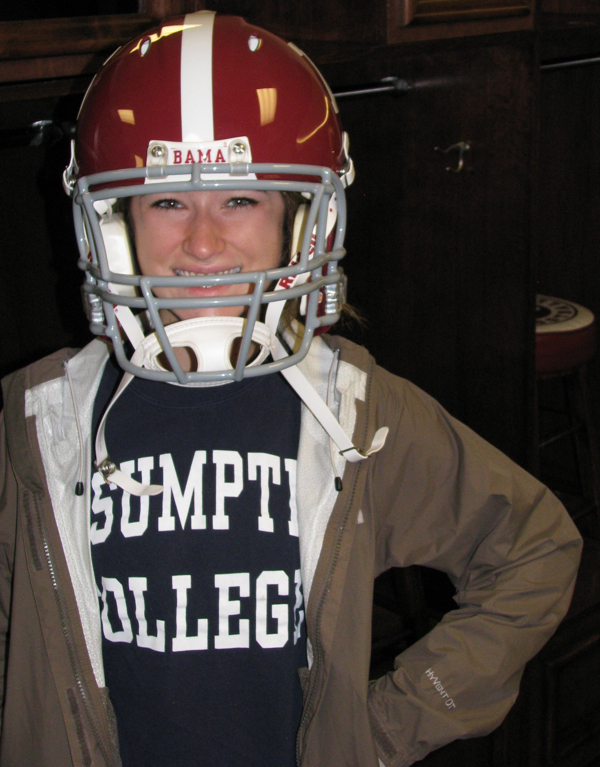
Margaux Finan sports helmet in locker room

I saw this more clearly Saturday, when Jared Patterson, project coordinator for Habitat for Humanity Tuscaloosa, gave Assumption students something any Tide fan would covet – a tour of the Alabama locker room and a run across the field of the 100,000-plus Bryant-Denny Stadium. Our students wandered through players lockers, posed by portraits, even made a giggling incursion into the showers.

Being our students, of course, they adhered to the one cardinal rule – not stepping on the large circular Alabama logo in the locker room. They wrote Assumption’s name on a dry-erase board – next to that of a Habitat group from the Midwest – and gawked at what a student called the “mind-boggling” scope.

But if the culture here – or anywhere in America – inevitably leads to sports, the reverse is also true. As Jared spoke to us in the north end zone, he pointed toward the opposite end, where he was standing when he saw the tornado. “When I was watching, it was probably right where you’re working now,” he said. Beyond that, though, it underscored that, as much a cliché as it is, Southern hospitality can really be a force – particularly when extended to a group of college students who have journeyed from Massachusetts to help rebuild a town. While we were busy working, Shackelford was working angles to get us coveted seating for Monday night’s game in Wings Sports Grill, owned by Bob Baumhower, former Bama and Dolphin defensive lineman.

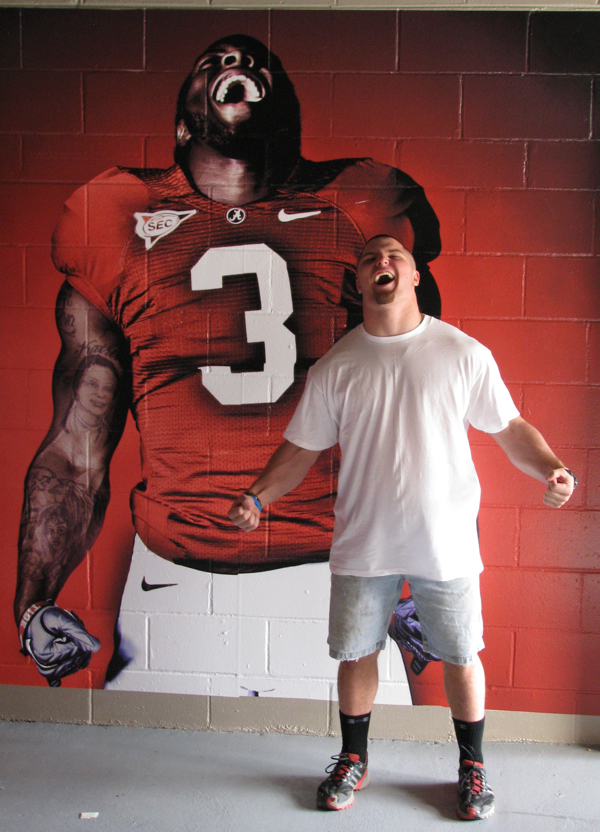
Nick DiAntonio mimics Alabama running back Trent Richardson

Someone asked where Patterson was watching Monday night’s game.

“Well …” he said, grinning.

“Oh,” I said.

Of course. Patterson would be watching the showdown at a little hangout called The Superdome. That’s right: The game against Louisiana State University unfolds in New Orleans, itself site of a greater but similar catastrophe. Despite the hoopla about Monday’s football rematch, these days Alabama and Louisiana share a similar sense of loss – and a sense of what it means to rally against obstacles that aren’t going away any time soon. The very organization that’s hosting us this week has only one other location – New Orleans.

Of course, the agency’s name, United Saints, yokes moral virtue and football. If getting back to the business of Mardi Gras was spiritually important, the night the once-lowly Saints won the Super Bowl was downright miraculous.

By sheer coincidence, my father and his wife were in New Orleans that night, seeing people run up and down the hotel hallways screaming in joy, then wandering into the packed streets in search of the action.

“Everyone,” my father told me later, repeatedly, “was so happy.”

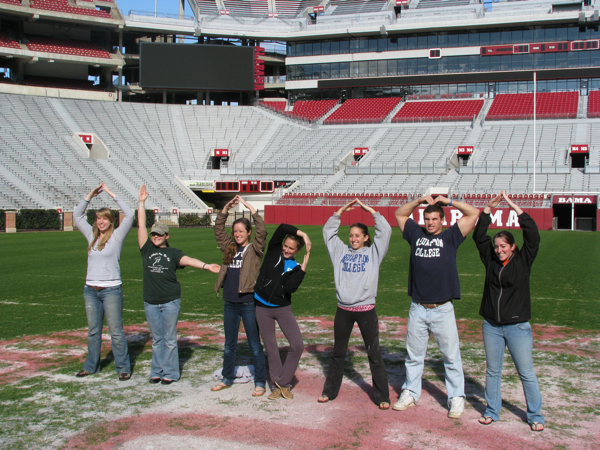
AC students trying spelling Alabama literally, as well as figuratively.

Stories one tells, and stories one can’t

6 Jan

Nick DiAntonio hits porch floor to do touch-up work

Thursday morning I stood in the front lawn of a Habitat for Humanity house in Rosedale Court, talking with a local volunteer.

My new acquaintance, it turned out, put in 10 years in Army artillery, and while he seems to have adjusted well to civilian life, he told me that the biggest adjustment in coming home was the sheer silence of the night.

That sense of quiet was disrupted on April 27th, when the tornado that took 43 lives here destroyed his home. He said he’d be willing to discuss his experience with Assumption’s students, but his girlfriend had other ideas, and for a very good reason: She was in the house when the tornado hit

“I’ll show them pictures I took,” she said, gesturing to the cell phone in her hand, “but I don’t talk about it.”

This is a common tension here, or, I suspect, any community where a large-scale traumatic event has occurred. Some people need to share their stories – and others need not to. Despite the narrative theme of this blog, I deeply respect both responses. The Royal Wedding, of all things, paved over the national story within 24 hours, footage of human suffering replaced by images of pomp and circumstance, but here the victims who need to share their stories have found compassionate audiences. Open meetings were held at local churches where people could do just that.

Even the night of the storm, amid the chaos of blocked streets, blaring sirens, and power outages, one rescue worker described, in the documentary Faces of the Storm, the need to set aside his sense of urgency just to hold a stranger and listen – and, he said, “why wouldn’t you?”

Meanwhile, we stand on the opposite end of the city from where the tornado destroyed his home. This is clear, open land stretching behind the Habitat home to the right, but that’s only due to the razing of wreckage after the tornado flattened 100 out of 188 units of Rosedale Courts, killing six – and when people saw more than dozen blocks of destroyed homes in this neighborhood, everyone was shocked the count wasn’t higher.

As a low-income housing development, Rosedale speaks to another story line here – in many areas of the city, affordable old housing likely will be replaced by stronger, newer structures that will be more expensive. Even if the insurance and/or FEMA money comes through, where do folks relocate after a tornado destroys 12 percent of a city?

But some stories are positive: My new friends – including their dog who also survived the storm – move into their new Habitat home in a matter of weeks; the dedication has been delayed by their schedules at work (and work, in this economy, is also a good thing). Meanwhile, here in Rosedale, the debris here has been removed, the sun has come out, and as students settle into the groove of their construction tasks – from spackling cracks and touching up the paint job to some earnest ladder-top carpentry and learning to use large power saws – there is good cheer.

The energy and optimism of youth  is a blessing, particularly when it’s youth guided by conscience. That night, when Marissa Reis asks her fellow students their hopes and fears during the nightly prayer and reflection, it’s clear they know there’s much more to be done – and understand, if, indeed, any of us ever can.

As one student stated, “I hope we get a real understanding of what happened down here, even though in the north we don’t get many storms like this … and I hope people here know that people in the North remember them.”

Brittany Wilson braves the scaffolding to spackle the carport ceiling.

Assumption in Tornado Country (Day 1)

5 Jan
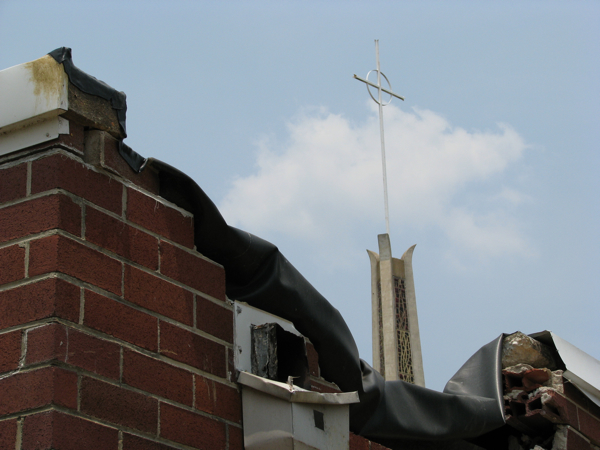
Damaged roof of my home church, Covenant Presbyterian, June, 2011.

Eight months after the tornado, we follow its path through a once cozy neighborhood of Tuscaloosa, Alabama – Forest Lake. The forest is mostly gone, the few standing trees bare of not only foliage but also any smaller limbs; instead of softening the landscape, these amputees have been rendered into jagged silhouettes, looming against the stark backdrop of a mostly house-less landscape.

As the van nears a corner of the lake, I point out the site where, last June, I fell in with a multi-generational group of volunteers from a Church of Christ up in Tennessee, lugging sawed limbs and planks from houses up to the curb in near 100-degree heat, taking shelter in the shade offered by a shell of a house – only to learn later that the house belonged to someone I knew.

But that feeling of connection pales in comparison to the bond I feel on this surreal day, because this time around, the students who ride behind me in this van are from Assumption College. Thanks to the coordination of campus minister Vinnie Sullivan-Jacques and the escorting of Paul Belsito, the college’s executive assistant for government and community relations, the New England college where I teach has come to aid my Deep South hometown.

Perhaps I shouldn’t be surprised. The college has a long tradition of mission trips during winter and spring breaks, as well as in May, when I’m escorting a group to Pine Ridge Reservation in South Dakota. The SEND – which originally stood for Students Exploring New Destinations – service immersion  adventures blend earnest service to communities in need with education about that region’s culture, as well as nightly spiritual reflection. Doing a SEND trip has been on my radar for a long time; when the massive tornado blew a mile-wide, six-mile long path through the center of my hometown – killing at least 43 people in the process – I suggested Tuscaloosa be added to the list, only to find out we were booked for the foreseeable future.

Then, in November, an hour before I was going to make my reservations to fly to Alabama and California for part of Christmas, Vinnie contacted me to say that another trip had fallen through. Could we make this work on such short notice? We quickly found an opportunity to build through Habitat for Humanity Tuscaloosa; it took another month to iron out the lodging, which finally, after much patience and persistence from Vinnie, came thanks to an organization called United Saints – a recovery project that started in post-Katrina New Orleans.

And now, surreally, here we are.

Despite the early morning departure from Logan, the students were almost chipper when they met me and the United Saints representatives at their lodgings. Soon after piling their sleeping bags into their new bunk beds, they were ready to go to the campus of my alma mater, where they could stretch their legs in the relative warmth of an afternoon in the high 40s. I walked them past Foster Auditorium – where Alabama Gov. George Wallace had made his symbolic “Stand in the Schoolhouse Door” against the integration plans advocated by President John F. Kennedy – and the President’s Mansion which had been saved from being burned to the ground by the pleas of the president’s wife, who softened the heart of the Union officer in charge. We compared our foot and hand prints to those left by the great Alabama football captains of the past, from Joe Willie Namath and Ken Stabler to Cornelius Bennett and Javier Arenas – the last of whom barely survived the storm, and then drove supplies back from Kansas City, where he now plays for the Chiefs. To my surprise, they had already decided as a group to throw themselves into the sports culture – it was clear that we had to buy their Crimson Tide t-shirts as soon as possible. They also made it clear that the cultural immersion aspect of the SEND philosophy mandated we see Monday’s national championship game with LSU at a public locale that captured the region. (We’ll see on that one.)

Students pose under statue of Alabama football legend Paul "Bear" Bryant

But the tornado eclipses even Alabama football. Following the storm’s path for a mile on the way home, students ask questions about growing up in a tornado zone, but mostly I just hear sighs and “wows.” Back at their new home, the mood  lightens as they make fun of my accent, listen as I claim that they haven’t heard an accent yet until they hear that of my mother – on her way across town, bearing the students extra pillows.

Sure enough, when I walk Mom into the living room and she says, “Well, hello,” students explode in laughter as if it’s the funniest thing they’ve ever heard. As I watch the good-hearted exchange, an extraordinary warmth sweeps over me – a deep gratitude to be serving a college where such cultural encounters are possible, involving young adults as special as these.

But I’m not the only one feeling grateful. My mother starts to say the routine thing – to thank them for coming – only then her voice fails her and her eyes start to moisten. “We’ve been through so much,” she says, then trails off.

Then we play the DVD documentary she’s brought, “Faces of the Storm.” We sit in the dark, absorbing the story of those who survived the tornado – and those who did not. We might well meet many of them before we leave.

And tomorrow we’ll take our place alongside them.

The Three Nicks: Finan (L), DiAntonio (R) and Saban

Roots and Resolutions

2 Jan

The first week of 2011, I found myself zigzagging down the lanes of hillside California homes, descending Mission Ridge into Santa Barbara proper, sun rising red-orange over the far end of the south-facing beach. I could learn to cherish this view if I lived in Santa Barbara, but, of course, this was the idealistic fantasy of the tourist: Living here day in and day out, I’d never be up this early.

I was only doing it today because I was catching a ride downtown with a friend, herself up only to lead a 7 a.m. yoga class – which happened to be located next to my favorite coffee shop, where I could write when not staring dreamily out the window at the Santa Barbara hills, glowing in a thick yellow light of morning.

Full of that new year’s optimism about life changes, I tried replacing the California morning mountains with the dawn view from my bedroom writing table back in Worcester: The sun appearing through the tree limbs, rising above the ridge of the city yard waste facility. (Hey, it’s prettier than it sounds.)

Even as I wrote in my journal that morning, I knew better than to formalize this early rising into a resolution. And a year later, as I looked back this weekend, even my actual resolutions – the usual ones about diet and exercise – fell apart the in the late going, amid the orgy of calorie consumption that is the holiday season. But I still find myself thinking back to that morning, in large part because of a gift last holiday season from my yoga-teaching friend.

That gift was Chakra Deck – a neatly packaged box of 50 cards, seven color-coded cards for each of the seven chakras. Written by Olivia H. Miller and illustrated by Nicole Kaufman, Chakra Deck follows in the tradition of other kits from Chronicle Books, with Yoga Deck and Stretch Deck two of the many.

Coming from a background steeped in not only Christianity but also a journalist’s love for specific, concrete evidence, I don’t know how firmly I believe in the seven chakras, with the rotating wheels of energy that, by definition, are undetectable by the scientific means I usually trust.

But it seems as foolish not to believe –especially when the yoga poses for each of the chakras, and the bodily and mental challenges they address, do make a certain amount of sense.

Especially the first chakra in the deck, the root, which, according to the deck, addressed addictions such as food and drink. While working on the obvious physical goals of all my yoga – strength, balance, and flexibility – focusing on the philosophy that went with the poses made me more aware this past year of the degree to which anxiety and insecurity drives my appetites, which then both pads my waistline and lightens my wallet.

On still deeper levels, I began to see a dichotomy in my daily existence – the cliché of the mind-body split. I tend to revel in abstraction – the dreamier aspects of religion and writing and romance, or even the idealized elegance of designing a class or a panel discussion – at the expense of the mundane daily discipline of running my life in the here and now. Chakra Deck has helped me focus on how the daily routine – the time one takes to tend to these body-spirit connections – is actually one more expression of the imagination.

Self-care does not have to be at odds with inspiration; instead, as Thoreau might say, it can build the foundation under those castles in the air.

How does this relate to this blog, with its concern for stories of service? Let’s just say that this box of cards helps dissolve another dichotomy – that between the individual pursuit of well-being and the need serve others. The truth is that when I live with more respect for the root chakra – transcending the anxieties that sharpen appetites and addictions – I cultivate mental clarity, physical energy, and even fiscal resources; in concrete terms, I have more concentration to give to both an individual student and the course I construct for all students, more energy to put into my work and into my interactions, and more money left over to donate to causes. So as we enter the new year, I hope we can accord resolutions, large or small, the measure of respect they deserve. At their best, such goals not only make us better for ourselves, but for others.

Meanwhile, when my friend came back around to the coffee shop a year ago, she said only one person showed up – meaning that her net pay for rising so early to teach was a whopping $3. But she would’ve done it anyway. Teaching yoga, she explained, was for her, a pastor’s daughter, a form of ministry.

As was, it turned out, giving me that box of cards, which a year later, I work from almost every day – the one resolution I’ve kept.

(You may reach Olivia Miller, author of Chakra Deck and a wide range of other card deck guides, at ohmworks.com.)

In Service of Santa

25 Dec

Last night I watched the eight-year-old girl sitting on the sofa next to her 15-year-old brother, himself clicking unseen links on his laptop.

I overheard him and his father discussing what NORAD stood for. Wondering how such an odd topic came up on Christmas Eve, I learned that this is how high-tech folks track Santa these days.

“He’s in Portugal,” the brother announced, pointing to the screen.

His sister nodded, then came to sit next to me on the couch, where she went to work building a Smurf house on an iPad.

As I watched her work, I contemplated the simple daily act of service the brother was performing. I don’t want to give anything away here, but let’s just say that  the brother’s views about Santa’s role in the universe was, I’m guessing, considerably different from his sister’s. Still, he played patiently along, with nary a complaint about how this was pulling him away from Madden football.

Years from now (and I think you’ll agree with me here) her views about Santa are likely to change considerably – as might her views of other mystical beings in whom she places her faith. There will come revelations and complications, disillusions and re-affirmations, in her views of how the universe works, which divine beings might be running the show, and whether those beings really are keeping track of whose naughty or nice.  But what I hope will stick are moments like the one she just had with her brother: Small instances of generosity, kindness and sensitivity that unfold between caring people willing to meet people where they are in their own journeys – or, in this case, Santa’s.

“Oh,” she exclaims to no one in particular, suddenly setting aside her iPad. “I’ve got to go to bed. Santa’s coming.”

To which I could only say, “That’s right!”

Wakeup Call, WCUW-style

17 Dec


One morning years ago, I drowsed in bed long after the radio alarm went off, listening to a lively Texas swing number. To excuse my laziness I told myself I would listen to the end of the song, hoping to catch the name of the band – maybe someday I could catch them at Nick’s, or Gilrein’s, or Club Passim.

Then came the bad news.

“That was a 1946 recording of …”

Such is the charm of waking up each morning to WCUW, 91.3 FM, right here in Worcester. I would never get an annoying song stuck in my head, if only because, almost every time, it was a song I’d never heard.

This year, however, WCUW gave me a different kind of wakeup call – a call to a different kind of community service.

Like most people, I frequently think of service in the form of helping people obtain life’s basic necessities of food and shelter, or the things that directly impact their ability to obtain them, such as education and employment. That’s especially true during the holiday season, when most of us are drawn to providing others the kinds of domestic comfort we associate with this time of year.

Less tangible, but just as important, are the needs that public radio stations such as WCUW – or Worcester’s beloved jazz and NPR station, WICN 90.5 – provide their listeners: Cultural enrichment that goes beyond just a rich range of music and news, to our sense of individual and community identity. The things, in other words, that makes these properly fed and sheltered lives meaningful.

A quick visit to WCUW.org proves the point. First, consider the mission statement: “Community stations” offer a “third model of radio broadcasting beyond commercial and public service. Community stations can serve geographic communities and communities of interest.” They provide “a mechanism for facilitating individuals, groups, and communities to tell their own diverse stories, to share experiences, and in a media rich world to become active creators and contributors of media.”

Including, as it turns out, my students at Assumption College. Thanks to station director Troy Tyree, my writing and mass communication seniors were given a weekly half-hour radio show, College Connection; each student team provided three shows, developing the ideas, finding the sources and conducting the interviews even as they were also learning how to edit audio and, of course, the many nuances of a quality radio broadcast that the listener never thinks of.

Despite all those challenges, and the inevitable narrowing of focus of a college theme, the students surprised in their range of topics. Programs ranged from what it takes to make it as a local musician and Halloween stories/events to visits to Occupy protests in Boston and Worcester. Thanks to WCUW, students went out to experience the diverse voices of Worcester, then added those voices to their own in pre-edited programs, finally sending them out into the world. The knowledge that it was going out into the air, into the public forum, served as a tremendous motivator for most of those involved. And while many were attending class as the show aired, others enjoyed the thrill – and the terror – of turning the radio dial to 91.3 and hearing their own voice.

Plus, in visiting the station at 910 Main St., students learned from tireless and patient station director Troy Tyree – the only full-time employee – about the diversity of offerings, the challenges of technology, and the passion of a virtually all-volunteer operation. They even learned how, in serving the local cultures that are outside the homogenized mainstream, WCUW reaches out to the world – the station has listeners as far away as Albania and Italy.

While WCUW’s programming is a powerful metaphor for community, so was this course. It was created by former Assumption professor Jody Santos, and could not have been brought back this year without the on-campus technological assistance of Tom Burke, Laurie Palumbo and Ted Haley – as well as generosity and patience of Troy and his staff. Like all volunteer efforts, the programs often had their jagged edges, but WCUW understands that inclusiveness matters more than technological polish.

So when we think of community service, please consider ways to support these on-air places where our community meets. Buy ads to support your own businesses or causes – they are priced very reasonably – or, like my students, join the rich variety of voices on the air.

And, above all, listen.

You never know whose song, or story, you’re going to hear.