Dewayne Part Deux

7 Mar

Dewayne Searcy hollered at me from the distance, then clambered up the rise to greet me with a firm handshake.

“Before I give you a hug, I want you to see what I’ve got on!” he said, pointing with pride to his sky blue Reach Out Center t-shirt, the one with the back that states, “We have FEET to walk on, HANDS to work with and (HEARTS) to serve.”

It was, of course, the t-shirt Assumption’s SEND students gave Dewayne back in January, during our simultaneously tearful and hilarious farewell at my mother’s house down here in Tuscaloosa.

Back then, Assumption students labored hard to help Habitat for Humanity Tuscaloosa nearer its goal of finishing the home of 82-year-old Appie Jones, who had survived last April’s killer tornado. That home, built near the start of the tornado’s six-mile path through my hometown, was dedicated last week. Now we’re standing near the opposite end of the swath of destruction, on 4th Avenue East in the Alberta City neighborhood.

Here, Habitat for Humanity Tuscaloosa is building four homes together, side by side and back to back, on adjacent streets. One is finished – it was dedicated last week – and beside it, volunteers from three Episcopal churches in Wilmington N.C. have joined forces with some Ohio folks to begin putting up the frame of the second house on 4th Avenue East. Meanwhile, Dewayne and I stand next to the four-block high square of concrete blocks, outlining the foundation of a third home; behind us, a fourth group is down in a network of trenches, shoveling out the water – courtesy of an underground spring the workers were surprised to discover the day before.

James Shackelford, another friend from our January trip, began conferring with Dewayne about the next move on the flooded lot. Then the pump started working again without warning – good news, if not for the way the hose came alive and snaked back into the trenches, spilling in more water before James, showing off his former Bama football skills in the trenches, jumped in and returned the rebellious hose to its proper place.

“You’ve got to have a sense of humor to do this job, don’t you?” I say.

“Yes you do,” he says, grinning.

Dewayne and James take a break.

As if to demonstrate, Dewayne, sporting his Alabama football cap, pointed to his student group from the University of Florida, home of the Tide’s rivals, the Gators. Dewayne yelled , extended his arms in the familiar Gator chomp signal, and exhorted, “do this!” Someone started to, and then he added, “Now say, ‘Roll Tide!’ ”

They immediately stopped, waving him off in mock disgust. It was good to see Dewayne, who motivates through good-natured abuse, back to his old tricks. In a way, he symbolized another source of humor – that of the local citizens, who, even as they’re glad to talk of the storm, resist the stereotype of mere victims.

After putting in a few hours slinging clumps of concrete into a dumpster on Tuesday, I came back the next afternoon. Since Dewayne had nothing in particularly suited to the skill set of an English professor, he told me to shoot photos and keep “documenting” the effort.

Half-completed roof of North Carolina group's house.

So I settled into talking with the Episcopalians down from North Carolina. They represented a group of Episcopalian churches – St. James, St. Andrews on The Sound, and Church of the Servant – along with a few from Closer Walk Methodist. I mentioned having just been in New Orleans, and it turned out that in a past year, this contingent had done work there as well. Rev. James Mazingo told me, “I went down there expected to be sad at all the devastation, but we had a really good time. The people there made it a fun.”

A group of parishioners joined in the conversation as they sat on the pile of lumber, waiting to pack up. One woman said the same thing was true here – and even in the Dominican Republic, where the group has twice visited.

There, in that much more impoverished setting, there were far more reasons for discouragement – ranging from less reliable supplies of electricity and water to the obstacles that the local citizens faced – but, one woman said, “it was actually fun! They were fun!” So much so, she said, she couldn’t fall into the trap of feeling sorry for the people they were helping.
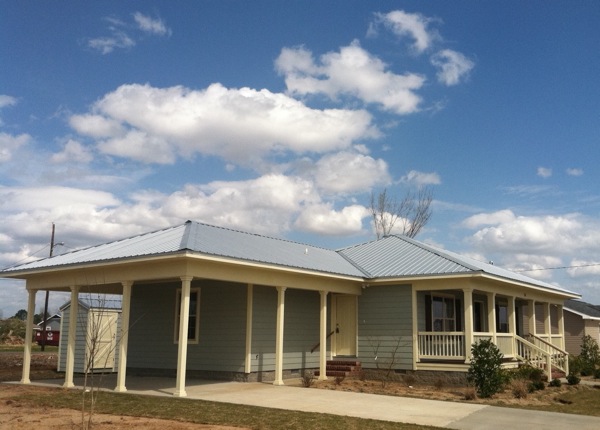
The house on which Assumption worked, pictured this Wednesday, a few days after dedication.

It was, several agreed, a two-way ministry. Particularly when you get to go to the place – whatever place you choose – and take it in.

“If you go to a place and open your heart to it,” a man named Goose told me, “then the check-writing will come later.” Connections, he said, go on for years.

Certainly that seems to be the case for Dewayne and Assumption, remarkable considering that, in March alone, Habitat Tuscaloosa has seen 380 volunteers from out of town. When I told a volunteer from Texas that I’d come down with a group from Assumption, he grinned in recognition.

“Oh, Dewayne loves those guys.”

Once the Episcopalians said their closing prayer and moved out, I sauntered back to the lot tended to by the Florida students. With the students clearing out, Dewayne seemed to be enjoying a solitary moment of quietly smoothing the drying concrete atop a chest-high square tower – the foundation for the future safe room Habitat is putting in every post-tornado house.

“It’s like a house inside a house?” I asked.

“Yep.”
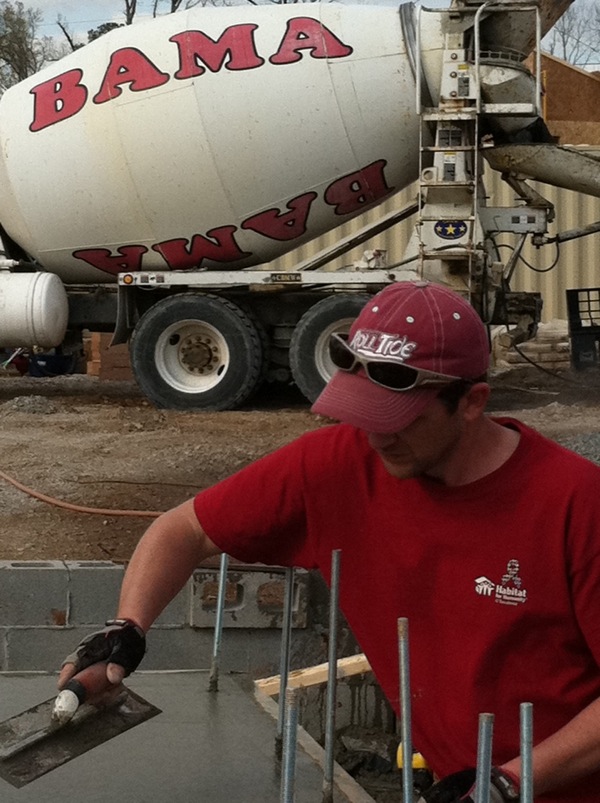
Dewayne smooths concrete base of safe room, while mixer turns in the background.

Which tempts me to pad the stats and double the number of houses built here this year – but Habitat and all the outside volunteers have plenty to brag on already in these parts.

Meanwhile, Dewayne – who had already texted a photo of the two of us to the SEND group – told me to relay a message to the crew.

“Tell them,” he said, “I miss ‘em.”

Appie's porch and chair.
Link

Habitat for Humanity Tuscaloosa update: March 6

6 Mar

Habitat for Humanity Tuscaloosa update: March 6

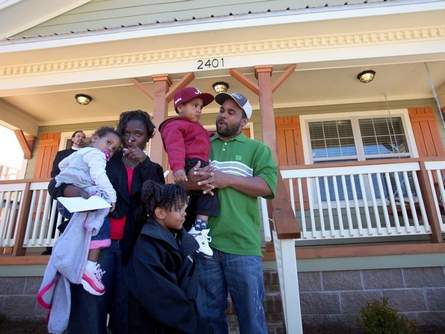
The Hall-Matthews family at dedication of new home Monday. Photo by Dusty Compton of The Tuscaloosa News.

Amid the stories of the latest tornado-related losses around the country, two rays of hope: Habitat for Humanity Tuscaloosa has dedicated two homes for tornado survivors in the last five days.

Last week Habitat dedicated the home for storm survivor Appie Jones.Monday’s dedication was for the new home of Amie Hall and Keith Matthews; last April’s tornado lifted and moved the entire house with Hall and their three children in it. See the link for more.

New Orleans Revisited

5 Mar

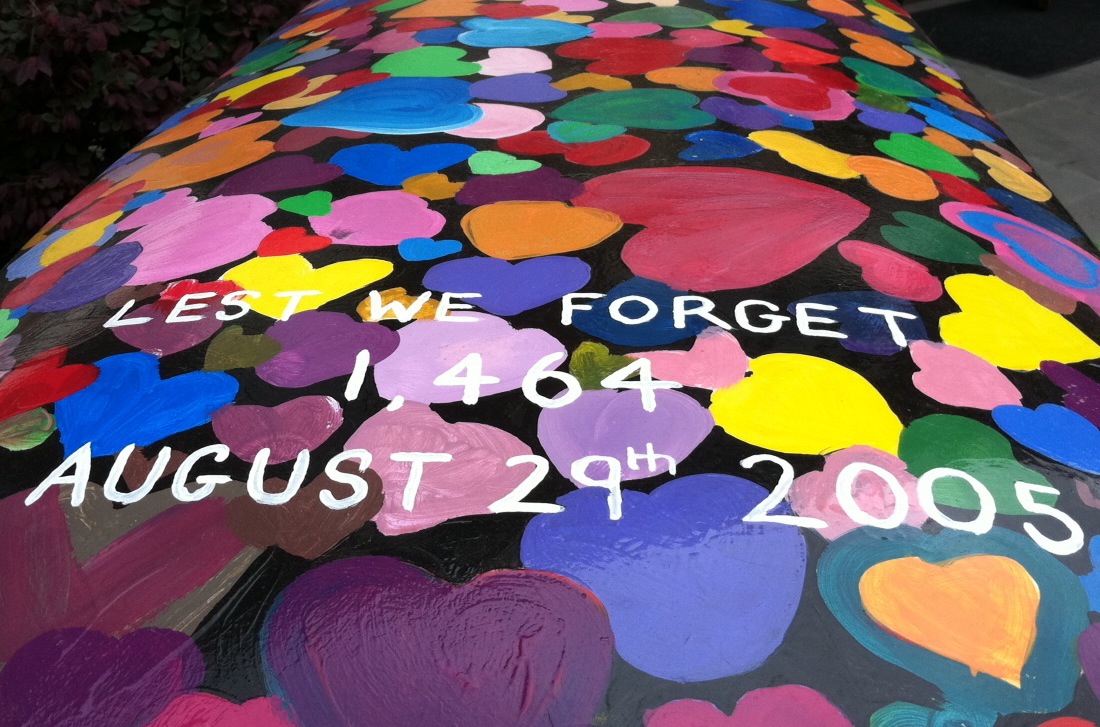
Katrina coffin memorial at Rampart visitor center.

We round the corner of Louis Armstrong Park and meander up St. Philip, turning our backs on the traditional tourist mecca of the French Quarter and heading into the quieter Treme. I would say this marks my transcendent rejection of the tourist mentality, but since this itself is a tour, well, you know.

It must count for something, though, that my tour guide, a former anthropology major named Hope, focuses less on what’s in Louis Armstrong Park – the statues paying tribute to the birth of jazz at Congo Park, the big chief Mardi Gras culture, Louis Armstrong and Mahalia Jackson – as what’s not here.

Meaning the hidden costs of urban renewal. Meaning the former residents, mostly African-American, who were moved to housing projects without compensation to make the park possible. Or the once thriving black businesses along Basin Street, wiped away by Interstate 10.

Or, of course, those lost to Hurricane Katrina.

We’re passing a series of small old wooden homes – unremarkable in that my tour guides don’t bother remarking on them – when I see something that makes me bring the entire tour to a stop.

I’m their only customer, so I have that kind of power.

FEMA-marked window on St. Philip.

What I see is the familiar spray painted X on the window of a small brick home, with figures written in each wedge. I’ve seen those X’s, part of the FEMA making system for damaged structures, up in Tuscaloosa, Alabama; disaster workers left them all over my hometown after the April 27, 2011 a tornado mowed a six-mile long path through the city, killing 52 people. It was a system born here, amid the aftermath of Katrina, which left 1,464 confirmed dead in Louisiana – and far more unaccounted for.

I’ll only learn later that the 3-505 to the left signifies the inspector – in this case the Alpha Company, Parachute Infantry Division, 82nd Airborne – and that the NE on the right means No Entry. We do feel sure about the bottom symbols – “0 D” translates, my guides say, to “zero dead.”

Meanwhile, the top symbols – time and date of the inspection – are inscrutable, but we’re talking more than six years, regardless.

In all this time, no one had replaced the window; instead, a tenant or tenants chose to see the world through this grim scrawl of a reminder.

Conscious statement? Weary resignation? Poverty plain and simple?

Or just an abandoned building?

Tuba Fats Square, site of Treme neighborhood music celebration, with I-10 in background.

Deciding the latter, I raise my camera and press the button – only to have the barred door beside the window swing open. A black man, athletic and attired in nice sports wear, emerges; as he walks to his car; he could be anybody. Reflexively I lower the camera, but it’s too late. I feel like a looter – even if all I’m stealing today are images, along with, just maybe, some inspiration.

This moment – both my intrusion and the FEMA-provided grid through which this young man must stare – brings me back to questions that have been swirling in my mind the last few days.

Do the people in New Orleans feel overly defined by Hurricane Katrina? Are they tired of questions from strangers with no deeper investment in the city, even if those strangers come here to help? If so, will the people up in Tuscaloosa come to feel the same way in years ahead?

No one person can offer a definitive answer to this question, and, as it happens, my tour guides – about half my age – did not grow up here. But they do come at my questions from a deeply analytical perspective – Hope, my official guide, brings the full force of her anthropology major to detailed mini-lectures on 200 years worth of multiracial culture in New Orleans, and her friend, a history major who created this tour, lived through Katrina and its aftermath. Amid their detailed series of lectures on the rich African-American culture of the neighborhood, they are quick to note the negatives – the mixed results of gentrification, for instance, particularly when new residents who swooped in on post-Katrina bargains then come into conflict with the neighborhood’s sometimes spontaneous parades.

Hope, my official tour guide, in the brightly colorful and up-scale Cafe Treme.

Since it’s just the three of us talking – and, since it’s their own tour, there’s no civic party line they have to toe – I believe it when they say the long-time residents still seem more appreciative than annoyed by the attention.

Similarly, I believe my guides when they say that they’ve heard few complaints about the HBO television series Treme – the inspiration for this tour. Created by David Simon and Eric Overmyer, the series is a thorough and realistic portrayal of how a wide range of people­ – musicians and cops, bar owners and chefs – grapple with the vexed questions and staggering challenges of recovery. Hope says the series has brought more jobs to New Orleans – which already attracts more than its share of filmmakers – and has raised the national profile of local mainstays such as John Boutté, who sings the series’ theme song.

In addition, the show’s painstaking approach to the subject matter has surely sensitized visitors to the subtler aspects of post-Katrina life in these parts. This seems to be suggested in the minor nature of the objections my guides have heard about the series. What they perceive as glitches in the fiction only reinforce the grimness of the facts. For instance, my guides didn’t doubt the realism of a character being beaten by frustrated and exhausted police; however, they did question the idea that the victim would have gotten treatment afterward in a “brick and mortar hospital.” One of my guides had a tetanus shot administered on a sidewalk; the other’s boyfriend got his glasses at the zoo.

Home sports a mural in Treme.

Ironically, their tour, as under-attended as it is, reminds me that this city has had its share of troubles for centuries – and its ways of transcending them. One way being, of course, through music. After I bid a fond farewell to my guides, I cut back through the French Quarter, grabbing a muffeletta in some dark bar near Bienville, and stay in my hotel room just long enough to make notes and search the internet for a fitting way to end my four nights in New Orleans.

I find what I want, then stride the length of Royal, past all the thriving art galleries and antique stores, and into d.b.a. – the bar where, this very night, one John Boutté would in fact be singing. It turns out to be right next to Snug Harbor, where I’d spent the last two nights, listening to the cutting edge New Creative Collective on the first night, and Ellis Marsalis on the second. Sitting perhaps 10 feet from me the second night was none other than Henry Louis Gates, the distinguished scholar of African-American Studies back up my way, at Harvard.

Whereas Marsalis was an easily justifiable 30 bucks, Boutté is a miraculous 5. Soon I discover why – when they swing open the doors to the performing space, people rush into a mostly furniture-less room. Some locals know just to drag in a barstool; I wind up out of position and simply settle for leaning against a bicycle rack that, for some reason, is near one end of the stage. I point out the bike rack’s advantages to a woman in front of me, and soon I have two new friends, Robin and her husband Tim. They’ve moved down here from Jackson, Mississippi because their oldest is attending Tulane.

Like my tour guides, they’re not natives, but Tim and Robin are warmly and intelligently conversational folks who’ve been living here a while now. So I ask again the question that’s on my mind: Are folks hear feeling overly defined by Katrina? They agree that, if anything,people are glad to share their memories and reflections. Maybe, six years later, it’s actually easier for folks to talk about a trauma that, after all, they’ll never forget. They also suggest that, at the same time, New Orleans is still more defined by the richness of its culture – including the music we’re about to hear.

Proof of that soon arrives on stage. Boutté, slender and unassuming, radiates a powerful stage presence. He sits alongside his musicians for the most part, but that only adds drama when he chooses to stand, learning forward with the microphone as he makes love to the song he’s singing, rendering slow and soulful even such rock ‘n’ roll standards as Neil Young’s “Southern Man.” The set is almost all covers, but he makes them his own – just as New Orleans makes its own almost everything, including the way it will transcend its losses.

During one interlude, he announces he wants to share a story: This very day, he was sitting at home when he heard the Treme brass band playing out on the street. That was all the story there is … but somehow it’s enough. We can fill in the significance around the edges.

Shortly before sliding into his last number – of course, the theme to Treme – Boutté speaks softly to the crowd.

“It’s such a beautiful city,” he says in a heartfelt manner.  “We’ve got our problems … but I’ll still take our problems over other people’s. I’ve been other places, man.”

Boutte snapping fingers to the beat.

Not being from here, I wouldn’t presume to agree, or disagree. But I believe that he believes. After I bid farewell to Tim and Robin – we actually exchange emails before they jump into a cab – I wander a half-block to the corner bookstore, where I ducked in and asked for a book my tour guides had recommended if, they said, I wanted a glimpse into the New Orleans post-Katrina psyche. Chris Rose’s 1 Dead in Attic gets its title from a note that, like the FEMA X earlier today, was spray-painted on the side of a house. In the store, I thumb through the prologue, “Who We Are,” dated 9/6/05, nine days after the storm.

           “When you meet us now and you look into our eyes, you will see the saddest story ever told. Our hearts are broken into a thousand pieces.

            “But don’t pity us. We’re gonna make it. We’re resilient. …

            “And one more thing: In our part of the country, we’re used to have visitors. It’s our way of life.

            “So when all this is over and we move back home, we will repay you the hospitality and generosity of spirit you offer us in this season of our despair.

            “That is our promise. That is our faith.”

Wedging Rose’s story into my jacket pocket, I step out onto the crowded corner where, just the night before, I saw half a dozen young men blowing that distinctive New Orleans brass sound, wild and exultant – while a middle-aged black woman with distinctive high cheeks danced slow in the middle of the intersection, drawing cheers from pedestrians and honks from cabbies.

Clearly, more than six years after Rose’s words, the people of New Orleans are holding up their end of the proposition.

I hope we hold up ours as well.

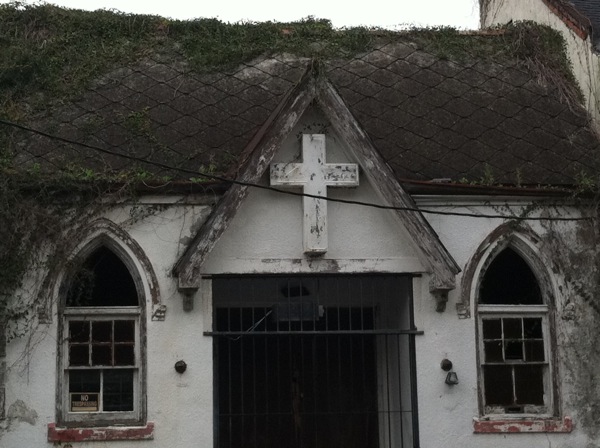
Church in Treme.

Turbidy Lived The Balance

26 Feb

Bob takes measure of things while Brian Daley observes.

Bob Turbidy waited patiently as our Literature of Social Responsibility class gathered in the kitchen of a half-done duplex early one Saturday – well, early by the standards of college students, if not by those of Bob.

I, meanwhile, waited for Bob.

Anxious to get my students moving, I nevertheless knew that this was not my classroom, but Bob’s. He’d taught many hundreds of construction novices, so he knew that when it came to rookies, haste truly made waste. To take it slow was to get it right.

In a few minutes, Bob quietly commenced class.

Today’s lesson: Window installation. He walked them through one, asking for one student to serve as volunteer. Maggie Hanley, then a first-year Assumption student, gamely raised her hand. Soon she was peering in at us from a ladder, caulking around the edges of the window frame. I noticed that some students homed in, while others seemed restless. Glancing at my watch, I wondered how we were going to reach our goal: Install all of the windows on the two-story duplex.

Maggie puts in first window frame.

But in another quarter hour, Maggie was finished with her window, and Bob was spreading the students in pairs and trios around windows throughout the first floor. By noon a third of the windows were installed; by the end of the workday, we’d installed every one, upstairs and down. We left with a feeling of accomplishment, knowing we’d done something specific and concrete, thanks in large part to Bob giving us the room to do our jobs instead of taking over.

There is a true art to being a Habitat construction project supervisor, only half of which is the actual house. The other dimension is building within all of the constraints of guiding a complex mix of professionals, rookies, and everything in-between. The best – and Bob was one of them – not only had a carpenter’s level in his hand, but another in his mind, striking the balance between inclusiveness and efficiency.

While knowing his stuff through and through, Bob had the gift of working well with people of all ages, which he did with quiet guidance, encouraging them even as he corrected them. Without fanfare, he facilitated the kind of fulfilling experience that is at the heart of a successful Habitat affiliate – making people want to come back for more. Bob Turbidy mastered both the craft of carpentry and the craft of collaboration. There are a whole lot of people in the world who can’t do both. (I’m one of them.)

Bob mounts siding with care.

This weekend I’ve been reflecting a lot on the example of Bob “The Builder” Turbidy, who passed away on January 30th after a short illness. Saddened by his passing, I reviewed the obituary in The Worcester Telegram — as well as a profile of Bob by one of my students, Emily Johnson. The pieces combined to portray the rich life of a man who, after serving three years in the Navy, ran arts and crafts businesses from Cape Cod and Providence to Santa Cruz, CA. After marrying Ruth Ann Schnable, Bob abnd his wife built their own house in Quebec, where they started a construction business and raised their three children; upon coming back to Worcester in 1987, Bob created a temporary employment service called “Job Link of Worcester” until 2002 – when he signed on as Project Manager for Habitat. Meanwhile, he was active in cross-country skiing, running, and organic gardening, as well as local environmental efforts. As the obituary notes, he “was well liked by everyone he met and admired for his dedication, positive attitude, and unflappability.” Well-phrased; I never saw Bob lose his patience with a volunteer in all the many days I was around him, whether on a work site or in a meeting.

Turbidy takes to roof.

Then I began scanning both my photo folders and those of the official Habitat web site (http://www.habitatmwgw.org), and I found that my photo collection and Habitat’s had one thing in common when it came to photos of Bob Turbidy – there weren’t many of them.

My own pictures tended not to focus on Bob, but on the volunteers toward whom he was turned; he seemed far more intent when photographed unknowing, in action, than he does in any of the few shots in which he actually posed. Even in his obituary photo, I can see beams in the background.

Bob advises AC's Marek Kulig and Brittany Ford at Stowell.

Which seemed appropriate for a man who planned to work his entire life – with a lot of that work devoted to serving others.

This much was clear in the end of Emily Johnson’s profile of Bob, published in Finally Home: The First 20 Years of Greater Worcester Habitat for Humanity. (The piece can be read at http://www.assumption.edu/habitat.)

As Emily wrote:

      Turbidy often pokes fun at his friends who have retired by now.

      “I don’t envy them at all.  I like to take vacations, it’s nice to get time off, but I like my work, and I like keeping involved.”

      And, as long as “Bob the Builder” is around, houses for low-income families will be built.  Turbidy states, “I don’t have any intention or interest in retiring. I like working, and I love working with Habitat. As far as I’m concerned, I would be happy to keep working until I can’t work anymore.”

Many Habitat families – and thousands of volunteers – are glad he did.

Even as now they – including me – very much miss him.

A Different Katrina

18 Feb

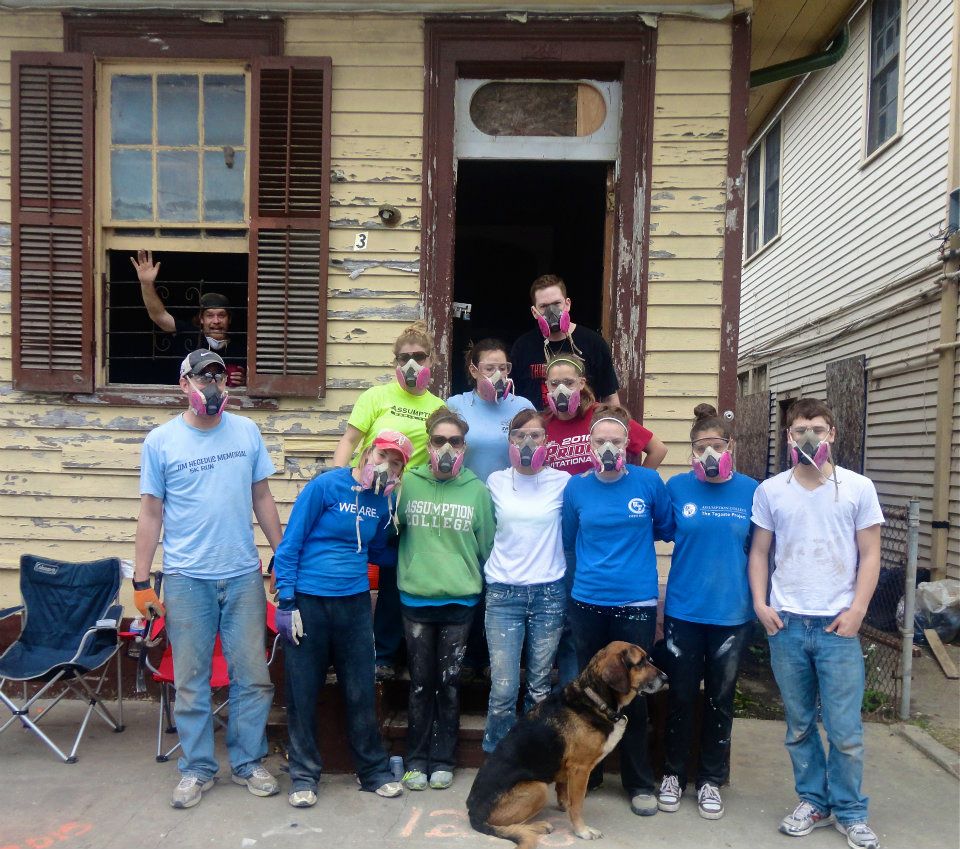
2012 NOLA SEND crew with local canine rep

Even six-plus years after Hurricane Katrina left an official death toll of 1,464 people in Louisiana – with other estimates ranging as high as 4,000 – a mission trip to New Orleans was bound to make a powerful impression on Assumption College students who went there to do community service.

But for Katrina Mitchell, the expedition’s student leader, the January visit was just the latest chapter in a relationship that began in 2006, less than a year after the hurricane hit New Orleans on Aug. 29, 2005.

Katrina did her first mission trip to the Big Easy as a high school sophomore, thanks to a project sponsored by her church, Seekonk Congregational in Seekonk, Mass. “We were assigned to restore a donated building for volunteers to stay at while doing community service in New Orleans,” she wrote me.

Katrina at work on 2008 mural

Two years later, as a high school senior, she returned. “We worked with local neighborhoods on restoring their spirits.  Our first assignment was to create a mural for a pre-school in a run-down area.  Then, we did a walk with residents in this same area to advocate for safety in the neighborhoods and on surrounding streets by doing away with crime.” Then, in 2011, came a third New Orleans venture, through SEND (Students Exploring New Destinations). “We worked with Operation Helping Hands at three different houses that needed scraping, cocking, priming, and painting.  We also went to a local swamp to plant vegetation and a dog park to plant trees.”

These intense but short service encounters have their limitations. A critically intelligent writer whom I’ve been fortunate enough to teach in the English/Sociology course “Literature of Social Responsibility”, Mitchell certainly knows that neighborhood walks, in and of themselves, aren’t enough to dramatically change crime rates, just as she probably also knows that there are larger structural problems that can only be addressed on the governmental level. But now that I’ve seen firsthand the college groups who impact my hometown of Tuscaloosa, I see that each of those trips brings fresh energy and young bodies to the long, slow grind of recovery – as well as reminding the locals that people elsewhere haven’t forgotten.

Certainly, that’s the case for Katrina – who decided that even three visits to the Big Easy weren’t enough.  So she signed on as student leader of the January expedition. “The most interesting experience I had … was seeing the reactions of my friends.  Last year’s group of students was all seniors with the exception of myself.  Therefore, when I returned home it was hard to communicate my experience with my friends because they hadn’t had the opportunity of visiting Louisiana themselves.  So this year I was especially excited to share such an experience with people that I already enjoy spending time with.  It made me happy to see them doing the same work that I was so passionate about.”

2012 group rises to challenge

The work this time involved two structures. They did a lot of scraping, priming, and painting on the home of an elderly woman who had just lost her husband. Then, in an abandoned flood-damaged structure, the group tore away walls and floors and stripped away old paint. The group even helped remove Christmas decorations from a park after a community celebration.

When it comes to the educational component of mission, Katrina’s work in New Orleans has dealt with concerns ranging from housing and crime to ecology and children – and more. Meanwhile, what strikes her most, seemingly, is what she’s learned about the city of New Orleans.

“The spirit of the people is what keeps me going back to New Orleans,” Katrina told me. “Their resilience is amazing and inspiring.  The city has quickly come back to life since the hurricane and its devastating effects.  Yes, Rome wasn’t built in a day, but because of the thousands upon thousands of volunteers that have come to help, New Orleans grew back stronger than ever.  I am in love with the city and its people.”

2012 crew takes break

Her experience underscores the value of leaving one’s home region.

“As a person who has always lived in the Northeast, nothing is more refreshing than the true Southern hospitality that remains consistent between each and every individual that you run into from the area, whether it’s in the streets, on a trolley, at the French Quarter, or wondering along Bourbon Street.

“Everyone is all smiles all the time.  They may appreciate the work that volunteers do, but they do not realize how much we appreciate them for what they are able to show us through their warmth and compassion in accepting and welcoming us to their community.”

2012 group enjoys Bourbon Street

Immigrant Views

11 Feb

Artist Valkeria Pinheiro with her work

Even from hundreds of yards away, I could see throngs of strangers milling in the dusk, disembarking in the D’Alzon Library parking lot. I stopped long enough to watch the dark shapes, some tall and some small, find their way into the light of the library entrance, then vanish inside.

When I followed them into the exhibition space, I found myself surrounded by immigrants, people who had journeyed from far-flung continents to build lives in the United States. Some were hugging and laughing, some were talking earnestly – and some were simply quietly staring at the walls, covered in the photographs they themselves had taken, all part of Immigrant Perspectives of Life in Worcester.

Absorbing my surroundings both visually and emotionally, I knew then that my words in this blog weren’t going to do this occasion justice.

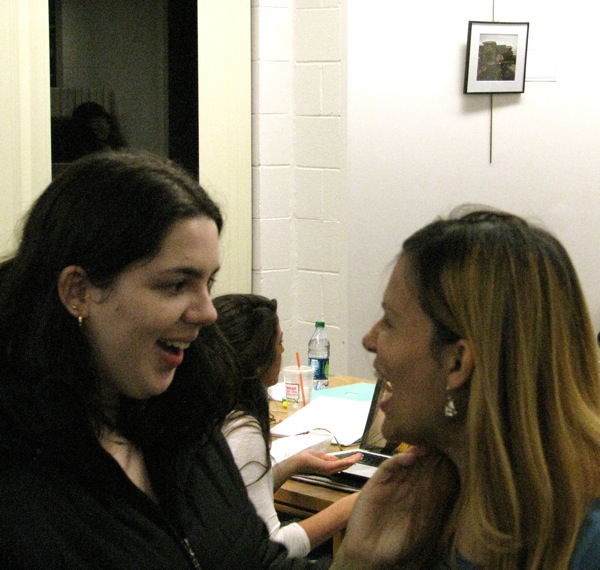
Julita Barbosa (left) and Valkeria Pinheiro both came here from Brazil.

What I didn’t know was that Esteban Loustaunau, whose Spanish 381 students had collaborated with Training Resources of America (TRA Inc.) to create this “literacy through photography” project, was facing a similar problem. Having worked tirelessly on every aspect from the original project and approaching the library to framing the photos and coordinating the effort to get the clients to campus, now he was the victim of his own success. People were coming at him from all angles, socially as well as spatially: College colleagues and students, TRA Inc. staff members and, of course, the photographers themselves. When he finally addressed the crowd, he would forget to use an anecdote from the last college that employed him.

But what he said, with his usual warmth, was plenty powerful.

“This is for you. This is your space. This is your home.”

Elena Medvedeva, originally from Turkmenistan, and daughter with exhibit organizer Esteban

People then spread out among the exhibits, which ran a wide range from the work place and family to the courthouse and landscapes. Taken with disposable cameras that Assumption had provided the TRA Inc. clients, the photos weren’t artfully cropped or digitally manipulated. They were simply what the immigrants saw when asked by their teachers to take one photo that symbolized their life in Worcester – and, in a way, their life in America. In their TRA Inc. courses, they then would give a short presentation in English, explaining their photo and why they shot it.

Some opted for strikingly picturesque landscapes or cityscapes, reminding again of how an artistic eye isn’t limited by language. Some, such as the person working a forklift, focused on work. Some took family pictures, either at home or around town, at their favorite places to visit. One took a photo of a Starbucks at night, expressing surprise at how much some Americans spend on coffee. (Guilty.)

Cityscape

Sadly, the conversations I attempted with the artists were short, limited by both my linguistic shortcomings and their own. Certainly, with most, there was no way to go into a jargon-steeped discourse on photographic composition. Finding your way through a still foreign world, trying to learn what you can in the little time you have between the demands of work and family, is a continuing journey.

But that made the exhibition, which is on display through April 13th, all the more extraordinary. Standing below a series of family photos, TRA Inc. administrator Cynthia Vlasaty told me that her biggest obstacle in explaining the exhibit was her clients’ plain and simple disbelief.

“They kept asking, ‘They are doing this for us? Why us?’ They couldn’t understand. Why would a big institution like a college want to show their work.”

Assumption's Victoria (left) has reunion with Val

Of course, educators can tick off any number of reasons, ranging from both the Catholic sense of mission and the secular version of civic engagement to the incalculable value of experiential education, especially when it comes off campus, in a world almost as foreign to college students as the college might seem to TRA Inc.’s clientele. Even as I talked with Cynthia, I could spy one of our most dedicated CSL minors, Victoria Flynn, carrying on intently with a female TRA Inc. client, who occasionally touched Victoria on the arm as they conversed, a reminder of the connection they’ve made.

But philosophizing aside, on this surreal and inspiring night, what I saw – both on the walls and between the walls – was justification enough.

As one TRA Inc. staff member told me, “This will go down in their history.”

And, of course, our own.

Roman Medvedev of Turkmenistan shot hillside park

SEND in Ecuador

28 Jan

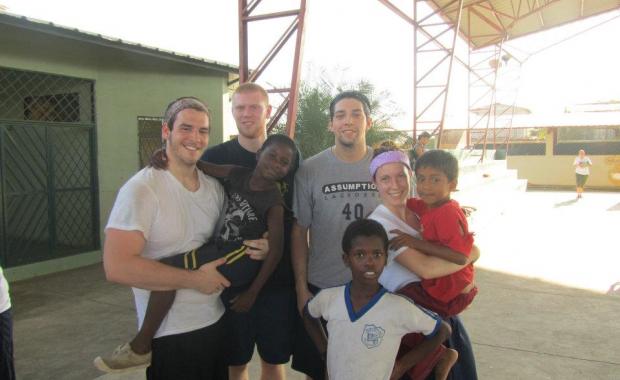
Nick and new friends in Ecuador

I began this blog with the hope of it being a place where others could share their own stories of community service – whether they be inspiring or disturbing, sad or funny. I suspect that the more memorable service experiences are some combination of the above, if the people involved just take the time to observe.

Such a keen observer is one Nick Frazier, who is on the verge of completing a double-major of Writing/Mass Communications and Graphic Arts. He’s excelled in the latter despite a considerable obstacle – Nick is color blind. But that hasn’t stopped him from pursuing his artistic interests – just as strange terrains don’t stop him from serving others. Last spring he was part of the Paul Belsito-led SEND trip to Pine Ridge Reservation in South Dakota; less than a month ago, he left the country altogether, following Vinnie Sullivan-Jacques and classmates to Ecuador.

Below is an excerpt from one of Nick’s Ecuador entries; to read Nick’s blog, “Young and Just a Little Reckless,” try http://youngandjustalittlereckless.wordpress.com/

It’s a terrific combination of visual art and story-telling, informed by the social conscientiousness and bold spirit of Nick himself.

Here is one of my favorite passages from Nick’s work:

     It was a sad realization when it dawned on us that these little kids don’t receive this kind of love or attention at home, so we agreed to pick every single one up. BIG MISTAKE. When you lift them up once they want it again. And again…and again. Nonetheless when we got inside the gate of the school a little boy named Leontel ran over to me and jumped. Luckily I had put the crate of bananas down because it was so unexpected that I was glad I caught him.

            He was small but a tough kid. He had a revolver belt buckle which made him awesome in my book. He pointed and shouted something I didn’t understand but I just decided to follow in the direction he pointed and it seemed to please him. When we walked into the stadium area, there were kids, EVERYWHERE. They all just starred at us. Pointing and whispering as if they had little secrets about the aliens that just walked into the room. We were asked to line up so they would follow our example and they did. Then we had to introduce ourselves, our favorite color and our favorite food. When it got to me I said,

            “Me llamo Nicholas, yo favorita colore es rojo y yo favorito food es burrito.”

            I immediately realized that again, I sounded like an idiot, and it was really stereotypical of me to think that since I am in South America saying burrito would make me sound cool…it didn’t it made me look like an ass. Regardless, we finished and the man running the program whose name was Ricardo, who would end up being awesome, released everyone to the big kid’s activity, the little kid’s activity or the homework room. The Rostro volunteer named Molly came over to explain what was happening and told us that she would split us into groups to help facilitate the kids in each area. She had us all sit on the bleacher where the little kids were assigned to go to and the second I sat down I had Leontel on my shoulders and two other little ones in my lap. The kids were beyond the cutest little beings I had every seen.


            What we didn’t know when we would walk in was that each of the kids would watch us walk in and immediately choose a favorite without knowing anything about us. So when we all started getting split up into groups, the little kids would chase after their favorites or cry out in desire to be with them. When the other Rostro volunteer began splitting the kids up to get into groups with each of us, the little kids clutched on to the arms of the Gringos that they wanted to stay with. When she got to Leontel he literally attempted to tackle my upper body. I guess this was body language for wanting to stay with me because when she allowed him to stay next to me he put out his fist for a bump.  This kid was awesome.

            Our group had about 10 little ones in it. It was the leader of our trip and me. We were given a book to read to the kids and have them pick out little fun facts in it. Finally my 3 years of Spanish started to kick in when I was able to read to them. After which we gave out paper and crayons. They begged for more crayons but we had to restrict them to 4 each. Do you know how hard it is to say no to a small child that you know has nothing in their life and all they want in that moment is one extra crayon? It is impossible. Sorry Rostro volunteers if I left the kids wanting extra crayons, but I gave them the entire bag and watched their smiles burst and their little hands fight for the ones they wanted.

            What happened next was one of I think 3 major moments during the whole trip which will forever be imprinted in my mind. The volunteer Molly came over to check on us. She asked how we were doing and we told her that despite the language barrier, we were surviving and seemingly doing well. She smiled and said “good”. All the kids wanted was attention. This was the only place they really got it. I looked over to see a little girl sitting on a bleacher alone. She was in a pretty little dress and was just sitting with her elbows on her knees and her chin resting on her hands starring at a little boy who was running in circles in front of her. The little boy was tiny. He had an adorable little striped shirt, a tiny had and tiny little shorts. Neither had shoes. I asked if I should get them to come over and join the group. Molly said, “It’s ok, we kind of let them do their own thing”. I asked why. She told me it was a difficult story.

            My first thought, “shit, here it comes”. She explained that there were three of them. The tiny boy was 2, the little girl was 7 and they had an older brother in the homework room who was 9. The older sister and brother took care of the 2 year old because they had no family. I asked her to explain and she said that was it. They have no family. They have a mother that stops in once maybe twice a week and drops off a little bit of food. But the three of them are alone the rest of them time. When they would come to Semillas, the 7 and 9 year old would take turns doing homework and watching their little brother. Then afterward, they would walk home, in the mud, without shoes, make dinner for the little one, sometimes they got to eat and go to sleep. Then do the same thing the next day.

            I fought back tears hearing this. But Molly continued on. They usually do not let kids under the age of 5 to come to the program because they keep it as constructive as possible but these three little ones they made an exception. Especially what had happened a few weeks before. We asked what had happened. She told us that a 7 year old and 4 year old were in the exact same situation. About 3 weeks before our arrival, the older brother was making the younger brother dinner and a fire started and burnt down their house and the two adjacent houses. The 7 year old got out.

            The 4 year old did not.

            Three weeks before I was at a Christmas party eating cookies and opening presents. Puts quite a few things in perspective. This 7 year old was now homeless and without a brother. I never got the chance to meet him. But I wish I could have.

Frazier exhibiting some of his work.
Link

Young and Just A Little Reckless, by Nick Frazier

28 Jan

Young and Just A Little Reckless, by Nick Frazier

http://youngandjustalittlereckless.wordpress.com/

Link

More tornadoes hit Tuscaloosa County

28 Jan

More tornadoes hit Tuscaloosa County

Fortunately, the system that spawned eight tornadoes early last week did nowhere near the damage of the storms of April 27th, 2011. But two people in central Alabama were killed by the latest round of tornadoes. See the link.


Following through

22 Jan

Dewayne with gift from SEND crew

Tuesday Assumption College started its spring semester in typical fashion: With snow on the ground, a chill in the air, and students and faculty alike bundled up as they trod through sub-freezing weather. All of which is usually made easier to bear by the sheer adrenaline surge this extrovert feels when it’s time to throw himself into the mix of colleagues and students; after several weeks of being on my own, it’s usually a sweet relief to be back.

This past week, however, stacked up to be a different challenge. Instead of being away from Assumption students over the break, I’d spent a week with 13 of them, down in my hometown. I wasn’t the escort of the trip – official escort Paul Belsito was with them 24 hours a day; I’m guessing my average was closer to eight. But, of course, that was still more hours with students than the 48-50 I spend teaching any single three credit-hour-a-week course – and in the latter case, the students aren’t wandering my hometown, hanging at my mother’s house, or breaking out my four-decade old game of Battleship.

So how, I wondered, was this first week going to feel different from the first weeks of past semesters? Would I just ride the high of being with some of our most motivated students into a similarly fulfilling semester? Would the grim business of education – all that required reading, police work and grading – make my normal pedagogy a joyless business?

And, above all, how would bonds formed down in Alabama carry over into the semester, let alone translate into future service?

Our group, after all, was succeeded by other college crews, and there will be thousands more in the long rebuilding process in Tuscaloosa. As for the students, while part of a SEND trip’s appeal is the chance to throw one’s self wholeheartedly into a single intensive task with a single group in a single community, we all come back to scattered demands of our multiple communities, ranging from courses and committees to family and friends. And for our seniors, add to that the machinery of applying for post-graduate jobs.

Even though a week is too short a time to measure, I saw encouraging signs. One student managed to catch me at the office amid the turmoil; Nick DiAntonio talked for 20 minutes before my 1 p.m. class, and told me he still planned to take up a volunteer’s offer of tickets to an Alabama game next season. Other students stopped me around campus for handshakes and a few half-hugs; students who didn’t even go on the trip brought up rumors they’d heard about the Tuscaloosa adventure. On Friday afternoon, at the Living Learning Center Interest Circle initial gathering in Hagan, Erin and Kate showed up sporting their Crimson Tide hooded sweatshirts – of course, anyone actually from Alabama would have found them far too thin for the New England cold – and the three of us talked enthusiastically. They gave me the news that Dewayne Searcy, our foreman in Tuscaloosa, and his friend James Shackelford, who got us the reservation at Bob Baumhower’s restaurant for the title game, were still talking about a road trip north when things get a bit warmer.

They also serve who laugh: Dewayne renders yet another touching moment into hilarity.

But even more important than the relationships themselves is the inspiration and information the bonds continue to convey. Example: Erin and Kate showed me a text from Dewayne – which included a picture from the house on which we worked. It turned out Dewayne is texting daily photos of the house into which 82-year-old Appie Jones will move. (Never having texted Dewayne directly, I hadn’t seen them, although I got numerous Facebook messages from the man.) Dewayne taking the time to keep groups updated, letting them know they are remembered, is a classic example of how to meet the challenge that comes after the mountaintop experience has ended – the challenge of following through.

In some ways this is an individual task, which each person has to engage in his or her own way. Those ways might include individual volunteer work, keeping the communication lines open, and/or making donations, modest as they might seem, to an agency’s continued work. But Assumption also works hard to follow through on a communal level. As part of that,  Vinnie Sullivan-Jacques – the architect behind all these SEND trips – and I invite all the SEND students (and their escorts) to share their own service stories. Those stories need not be polished; they might be as simple as a single humorous or moving incident on a single day, or the story of a trip and what it meant to the writer. I do recommend you send some our way sooner rather than later, while the details are still fresh in your mind – but at the same time, I figure that every student who has engaged in service has come back with a few memories that will stick for a long time to come. (We’d also love selected photos, particularly ones that come with place and people identified.)

We may have left the geographic locales in which we first merged in the act of serving, but, despite all the distractions of our busy springs, we can find places in our lives to share memories, and build on the same.

This space is one of them.

Come by any time.

Tuscaloosa SEND crew, plus Dewayne and, yes, Mom