Archive | Uncategorized RSS feed for this section

A Serving Nature

31 Aug
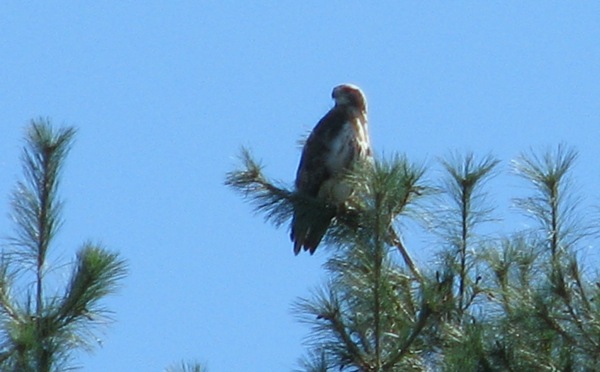
Redtail Hawk crop Acadia 8-24-13

Red-tailed hawk perched atop pine at Arcadia Audubon parking lot.

The sign outside the Arcadia Mass Audubon Visitor Center said the center was open, but the desk was closed.

This could spell trouble. Waking up feeling a bit directionless and disconnected, I’d driven an hour from Worcester to Easthampton to see something I was sure would lift my spirits: an American bald eagle nest.

Inside, I noticed only an older gentleman, stooped over a rather basic broom and dust bin, intent on cleaning duties. Just the same, he turned as I walked past to the restroom, asked if he could help.

“Yes,” I said. “Where’s the restroom?”

Coming back out, the man was still sweeping. At the counter, I grabbed the Arcadia Mass Audubon map. Trails were named for all manner of flora and fauna except the bird I was looking for – possibly because only this year did a bald eagle couple hatch and raise its young.

Clearly, I was going to have to trouble the guy who was probably just trying to finish cleaning up. “Excuse me,” I said. “I’m looking for the eagle nest.”
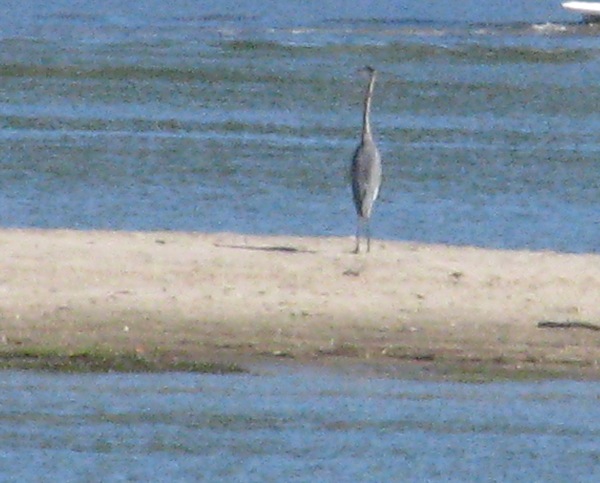
Great Blue Heron on sandbar of the Oxbow, which branches off the Connecticut River.

Great Blue Heron on sandbar of the Oxbow, which branches off the Connecticut River.

He quickly set aside his broom and dustbin. He started giving directions that were, well, nature-specific, right down to the sumac that might be blocking the view so late in the season. Sensing I needed the visual aid, he circled the spot on the map – then cushioned me for disappointment, reminding me there was no guarantee I’d see eagles right now, since the young had fledged. I was clearly in the presence of a birding expert; he was, in fact, a card-carrying naturalist. (He would hand me said card after our conversation ended.) But his love of nature and birds led him to do cleanup duties two days a week.

I felt like Jim Carrey in Bruce Almighty. In that film, Bruce is surprised when God, played by Morgan Freeman, disguises himself as a janitor, only to then knock the disbelieving protagonist across the room with an infinitely long file drawer of records on humanity. Only this man’s drawer was in his head. Sometimes his tours stall right outside the door of the visitor center, if only because he could see or hear  25 bird species in the parking lot.

The Morgan Freeman Effect would multiply a few minutes later, after I run into a woman and her two young nieces, all toting binoculars. She’s driven from Boston – twice the distance I traveled – and picked up her nieces, hoping to get them into the natural world. They’re focused on what’s either a redtail hawk or an eagle, sitting large and still atop a pine. Unable to resolve the issue, I look inside for our expert, whom I find whistling as he sweeps a back room. He comes out to help, then, instead of going back to finish up, says, “I wonder if we have a scope inside!” Rushing back  inside, he emerges again with a telescope with tripod, and uses it to educate us on the subtleties that tell him it’s a juvenile redtail hawk.

The woman pulls out her paperback Sibley Guide to Birds, with its lush illustrations of birds from various angles and stages. They commiserate. “People will say they saw five different kinds of seagulls,” he said, “and it’ll turn out they just saw one kind, just in five different stages of development.” At no point does he talk down to her, or her to him – and, in a more transcendent accomplishment, they both avoid talking down to me, the novice.

After a quarter hour of connecting, and swapping of contact information, we go our separate ways. I feel I’ve already gotten more than I’d hoped for from my trip; my spirits have risen from sharing a passion with others, even if I didn’t know them an hour ago. But their enthusiasm energizes me further, so I still drive out to the spot he suggested, park the car and walk across a wide field of mown hay, trying to find the nest, which is supposed to be visible in spots through the tree line. At a great distance, I think I see an eagle – I note the suggestion of the white head – but it’s flying along the road, giving no clue on the nest.
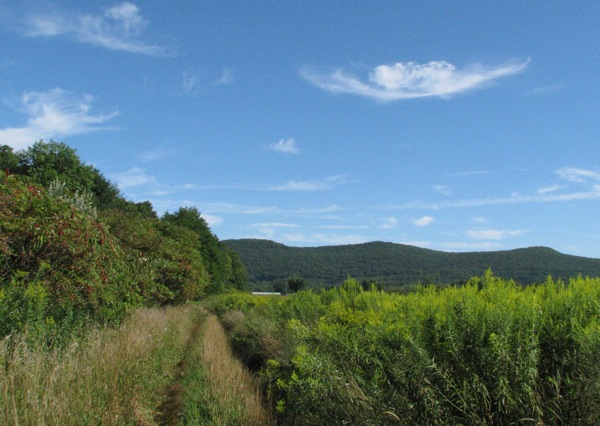
Acadia path 8-24-13

Trees and marsh to left, grasslands to right, Mt. Tom dead ahead.

I see no trace from the field, so I walk back to my car, edge down a road by a crew club; the Oxbow of the Connecticut River glitters perhaps a hundred yards away, and I note a heron on a sandbar.  I note a second path running along the shade of the tree lines, and realize this was the turn my friend had suggested. So I parked again, walked down the tree line, got to what I was guessing was the spot – and looked in vain through the tree trunks and the sumac. Oh well, he’d warned me that the sumac might have grown in too much.

I give up, but as I approach my car, an earphone-wearing, power-walking man waves hello; encouraged by the friendliness at the visitor center, I ask about the nest. “Here! I think it’s this way,” he says, going back down the path I just left.

At first I think he’s just going to walk a dozen or so strides, then point me onward, but he keeps going.

“You don’t have to interrupt your walk,” I holler.

“It doesn’t matter which way I walk, as long as I’m walking!” he yells.

Along the way we learn we’re both college professors – only he in the considerably headier subject of artificial intelligence. He shows me a coupe of subtle spots where folks have cut branches off through the brush toward the marsh, and leads me part way, but the remaining brush seems to wall us off. We part ways, and I start to head back to my car –  only here comes one more man, toting a small scope, so yet again I ask. This one leads me back yet again – only he helps me bushwhack almost to the water’s edge.

“Watch out for the stickers in this one spot,” he warns over his shoulder, but he’s the one who gets nailed by the plant. (I’m the one who gets stung by a bee.)

None of which seems to matter a lot when he points across the water and through some trees. I don’t see it at first, but he’s patient. Finally I find the nest – with the juvenile bald eagle sitting so large and still, I mistook it for the top of a dead tree trunk. My guide hangs around long enough to talk herons and eagles, and the effect of one on the other. We don’t exchange names, or occupations, or any of the other superficial information we use to pigeonhole one another – and yet I feel a kind of connection as we gaze, vegetation pressing in from all sides.

In Nature, Ralph Waldo Emerson wrote of the spiritual delight of the woods, arguing that the “power to produce this delight does not reside in nature, but in man, or in a harmony of both.”

Me, I’m certainly feeling more, well, harmonized. I migrate on down the road into Northampton, intending to celebrate my outing at an outdoor beer garden. I perch on a stool in the shade, continuing to observe birds and humans – happily waiting for the next sighting, and the next connection.

Juvenile eagle across marsh in its nest, likely awaiting a parent with some food.
Juvenile eagle across marsh in its nest, likely awaiting a parent with some food.

Kitchen and Bridges

26 Aug

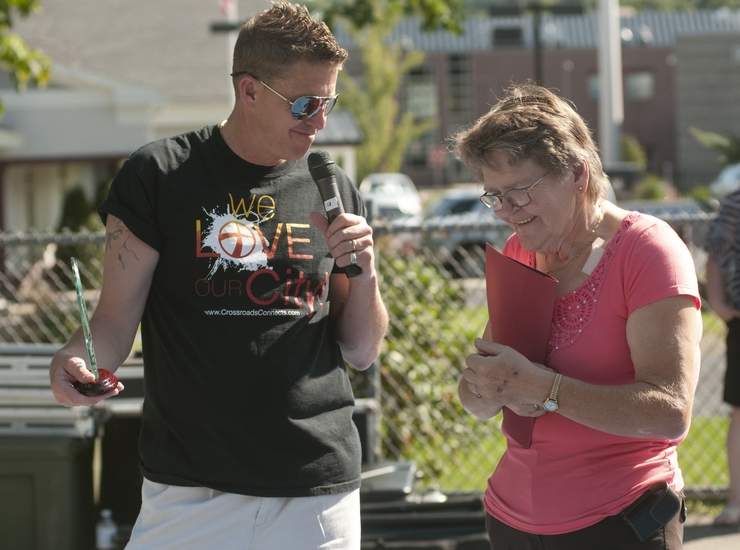
Ginny White with Rev. Bryan A. Tomes of Crossroads Community Church at annual cookout to support her homeless outreach program. (Photo by Betty Jenewin, Telegram.)

In an intriguing progression of kindnesses, Ginny White of Leominster somehow went from cooking for her children to feeding residents of a rooming house above her kitchen who could smell her cooking – which led to her feeding folks sleeping under bridges in Fitchburg.

For the rest of the remarkable story of Ginny’s ministry to “guests of the street,” please read the article by Gail Stanton in the Monday Worcester Telegram.


On Nick Hornby and Neighborliness

20 Aug

Hornby window

Most people probably know the novels of Nick Hornby through the witty  films they have inspired. In High Fidelity, John Cusack plays a record shop owner who responds to a breakup by visiting past girlfriends, trying to understand the path to where he’s wound up; in About a Boy, Hugh Grant portrays a charming rogue who befriends a boy and pretends to be his father, in order to impress a woman. As in most comedies, redemption comes for protagonists almost despite themselves, with plenty of levity to ward off even a hint of corniness.

While I’m fond of both films, this summer I finally got around to reading two of Hornby’s novels, given to me a while back by a friend. Well, by “a while,” I mean “years ago,” and by “given,” I mean one was definitely a present, and the other might’ve been lent – and I sincerely hope the one I cluttered with scribbles and underlines was the gift. (If not, it is now.)

While Juliet Naked is a satire of the on-line personality cults that form around obscure rock musicians – to be too well-known would make a musician unworthy of such fans’ attention – How To Be Good is more obviously relevant to the theme of this blog. I am a believer in avoiding spoilers whenever possible – I’m the type who closes his eyes during overly detailed movie previews – so I’ll strive to avoid that sin here. Suffice it to say that someone in a troubled marriage does a sudden midlife crisis reverse-course and becomes consumed with doing as much good in the world as possible, turning the life of the family upside-down in the process. It’s dark and hilarious and darkly hilarious, and brings into the light every bit of guilt and doubt any reflective, caring person harbors about whether their lifestyle goes far enough in helping others. As the great satirists always do, Hornby’s verbal wit and comic staging does more to delve into the issues than the deadly earnestness of the average sermon.

So there. Go read it.

The point of this blog, however, is the circumstances in which I read the last third of. How To Be Good – sitting outside in a collapsible canvas chair, the kind people usually tote to the beach. Only, where their feet might’ve  been sunk in sand, mine were digging into cedar mulch. In front of me was a short trim shrub, behind me a larger one, and behind that the apartment of one of my neighbors, whose name I didn’t know.

Why was this happening? Why was I now proceeding down the road to becoming the crazy old man of the complex, and getting there 20 years earlier than planned?

Perfectly logical. The lock on my mailbox was broken, so I had no choice but to sit outside, in the only shade available, waiting for the postman to come.

The first day, he didn’t.

This is what happened instead. For a while I read my Hornby, mostly about a quest to talk neighbors into taking in homeless children – the first obstacle being the fact that the organizers didn’t even know their neighbors’ names. The irony was just too obvious, so I actually broke from the reading to talk with my own neighbors. A young couple had a mattress strapped to the roof of their car, and a child atop the mattress – clearly hoping he could talk them into letting him ride there. One lady talked with me from her balcony about nothing in particular. A younger woman I’d never seen popped her hood to pour in some coolant, and since she was far more nicely attired in her work clothes,  I lent my services and my funnel. In the process I learned that we shared the same mailbox issue.

Finally, a fiftyish man, bald but wiry and energetic, arrived in a pickup and carted a box up to the front door, pausing there to find his keys. He glanced over and said hello; it dawned on me that I had on my hands not only a new neighbor, but one whose first impression of me would forever be that of the eccentric who reads novels amid the shrubbery.

Some level of offsetting social engagement was required, and, since I could not very well ignore my neighbor’s move while reading  How To Be Good, I toted him several armloads from his pickup truck. Promisingly, two boxes I toted were his home beer-brewing kit and the corresponding equipment for wine-making – he promised samples from both. He turned out to be my next-door neighbor, so I showed him into my apartment, so he could see my own approach to the layout.

It occurred to me that most neighbors never trod in these walls – something that, despite bouts of loneliness, I rarely thought of doing. And even though I’m friendlier than most, when the newcomer asked the names of a couple across the hall, I couldn’t help him.

Despite being disappointing in that regard, I must’ve made an impression, because my new friend – wow, I guess I can call him that now – promised to give me the bird feed from his old house. (I would find the bird feed, if not the beer, on my doormat four days later.)

By the time he took off, it was clear enough that I’d missed the postman –which meant having to do this whole routine again the next morning. But that was all right. I was actually looking forward to it. I would read more about “how to be good” – and visit with my neighbors, who would remind me that so often, goodness starts with connection.

Hope Floats

13 Aug
Nick Finan at work on 2011 Habitat house, smiley face courtesy of his co-workers.

Nick Finan at Habitat house, smiley face courtesy of his co-workers.

One thing about working on a college campus: Just when you think you’ve seen everything – and a few too many times at that – a student comes along and throws you a much-needed curve.

Take letters of recommendations. After 21 years, I’d come to think I’d  crafted them for every imaginable context: No letter left to write that I haven’t written already.

Enter Nick Finan – who this month gave me my first-ever opportunity to recommend a student to (are you ready for it?) the International Yacht Restoration School.

Given, my qualifications to evaluate someone’s potential for building seagoing vessels is, to put it kindly, limited. On a good day, I can drive every other nail straight; as for the water, this is the guy who, in Boy Scouts, flunked canoeing merit badge twice in three weeks. “I don’t know,” the counselor said with a tone of empathetic sadness that was somehow worse than the failure itself,  “you just can’t master the J stroke.”

But Nick had his reasons for asking – and they’re the same reasons I am writing about him in this blog. For Nick twice came to my hometown of Tuscaloosa as part of the Assumption SEND program, each time spending a week helping the local Habitat for Humanity affiliate rebuild a town struck by a devastating tornado that killed 54 people.

Service often gives students the valuable chance to explore possible vocations or avocations, while also exploring ways they can serve their communities. In Nick’s case, helping build houses tapped into childhood tendencies that had since been relegated to the back burner. Take the time that, as a child, he wanted a bow-and-arrow set: “In fifth grade I decided to attempt to make a ‘real’ bow rather than just a stick bow and arrow. It was to be made of a bass tree trunk. The project took me at least four months using mostly a hatchet, hand plane and chisels. When it was finished, it was stained and varnished.”

Nick smiles at autographs on board at construction site.

Nick smiles at student autographs on board at Habitat Tuscaloosa construction site.

A decade later, Nick found the same joys in working on the Habitat homes in Tuscaloosa. “Actually, my service in Alabama, especially this last trip, did sway me toward boat building in one way or another. Obviously there is a technical aspect of building houses when it comes to carpentry, just as boat building requires a high level of technical skills.” The first trip he worked under the supervision of Habitat’s Dewayne Searcy; the next time around, this January, he learned the craft of cabinet installation from Peter Salemme. On the second trip, he was a semester from graduating, and therefore all the more curious about the life paths of others – particularly those in construction.

“After working on hanging cabinets with Peter Salemme for most of the week, he asked me to work with him on a special project at the camp installing the electricity for RV docks. I learned how he had a family back home with a wife and three sons, but somehow he felt he needed to be with Habitat for Humanity working with volunteers to build houses for those in need. I thought that was interesting that he made a life changing decision to do what he felt he was called to do rather than what was expected by others.”  At the goodbye barbecue at my mother’s house, Nick got to talk with another Habitat worker, Steven, who had made a similar change.

This all gave Nick pause for thought, and not just about the need to serve others. “There’s something to be said about making a living doing what you are good at and are passionate about. Last summer while taking a solo trip on my dad’s boat, I thought about how I would love to start a boat-building business where I would design, build and sell relatively small boats. I dismissed this idea as far-fetched, for I had no idea where to start and was working on an unrelated degree.”

But with no job in his field in sight, Nick resumed his line of inquiry. “I found that many amateur boat builders use the stitch and glue method where you start with a plywood core and laminate the whole boat in resin and composite material. The result is a high-performing boat that is relatively quick to build in comparison to completely wooden boats. Although materials are slightly expensive, I decided to go for it. Even if my business idea was off, I would still end up with a boat – and much more knowledge about boat building.”

This led to his discovery that Newport, RI was a center for yacht-building, as well as home to the IYRS.

Nick says that, among other things, his Habitat for Humanity experiences “re-sparked that interest in creating something useful and beautiful out of nothing.”

Despite a challenging job market, it sounds as if Nick Finan is well on his way to doing that yet again.

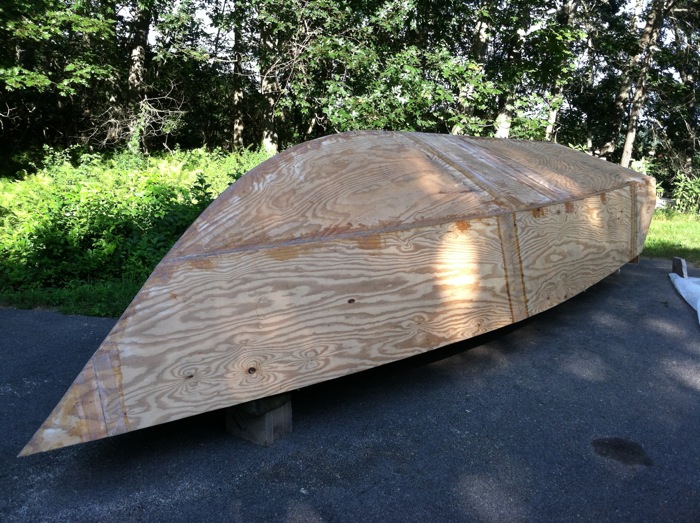
Nick Finan's summer project.

Nick Finan’s summer project.

How CSL Can Test A Teacher

8 Aug

Careers First Person Illustration #2

I hope I’ve come a long way from my early Community Service Learning days at the University of Missouri to teaching CSL courses here in Massachusetts 18 years later. But this pedagogy, like all approaches to the classroom, can test a prof’s convictions now and then – as my column in today’s Chronicle of Higher Education indicates. To read how, try this link.


On Harry Potter, Amnesty International and the Moral Imagination

21 Jul
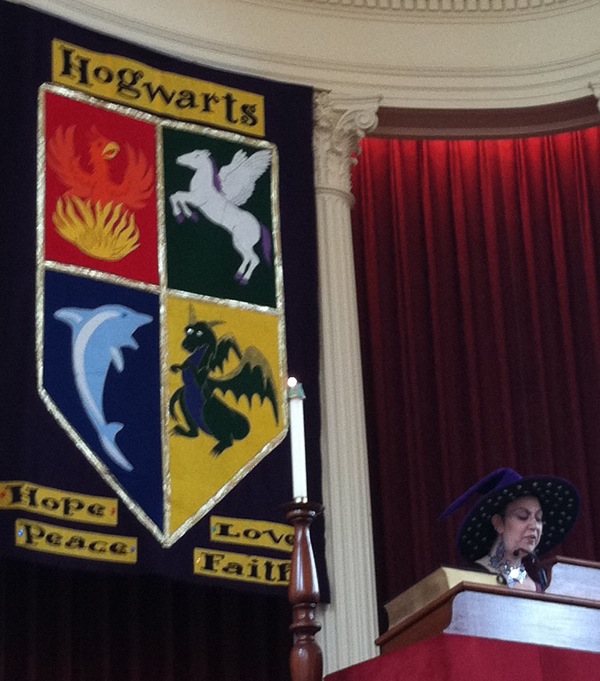
Jessica Gray – a.k.a. Iris Imaginoria – uses her own wand to lead the service.

Jessica Gray – a.k.a. Iris Imaginoria – leads the Harry Potter-themed service.

I settled in my usual pew for the Sunday service at First Unitarian – and that was the only usual thing about it. From the pulpit hung four colorful banners, each featuring a creature – dolphin, dragon, phoenix and “wind horse.” Many children and adults were in costumes that connoted magic; they waved their glowing wands in unison at key moments in the service. The offering was collected by people with elf ears – after it was explained that ELFS in this context stood for “Enriching Life through Fun and Service.” A few rows ahead of me, the back of a youth’s t-shirt stated the theme on the order of worship: “It’s better to light a wand than curse the darkness.”

Such was the climactic service of the two-week Harry Potter-inspired “Hogwarts School of Fun and Magic.” Kids from First Unitarian and elsewhere in Worcester participate in the camp, while many of the counselors come from as far away as Baton Rouge, the previous home of Jessica Gray (a.k.a. Iris Imaginoria), director of faith development ministries at First Unitarian. Even though I hadn’t read the Harry Potter books, I knew enough from the films to sense how the books could be read as spiritual texts – preoccupied as they are with good and evil, light and darkness, with faith and self-sacrifice.

Of course, I also couldn’t resist because, face it, what’s the point of even being Unitarian Universalist if you can’t get a little goofy.

Little did I know that for Jessica – excuse me, Iris – the second point folded neatly into the first. When she took the pulpit for her sermon, “Let Your Light Shine,” she referred to humor as one form of light to hold against the darkness.

Erin Vignes as Professor Irene Morgant, one of the heads of the house of WaveRider.

Erin Vignes as Professor Irene Morgant, one of the heads of the house of WaveRider.

Nor could I know that among the activities in the church basement turned castle was the assembly of hygiene and school kits for Syrian refugees.

Nor, finally, had I gleaned the back story of why all this was profoundly appropriate. The “light a wand” was, of course, a play on “It is better to light a candle than to curse the darkness,” the Chinese proverb that inspired the  logo of  Amnesty International; the candle in barbed wire, according to the organization website, reflected the hope that Amnesty “would shine a light in the darkest of places where human rights abuses go unpunished.”

What does this have to do with Harry Potter? Only that his creator, J.K. Rowling,  worked for Amnesty International in early adulthood;  Jessica’s sermon referred to Rowling’s 2008 graduation speech at Harvard University, in which she addressed that period of her life in detail.

In that speech, Rowling talked extensively about her experiences at Amnesty, from reading “hastily scribbled letters smuggled out of totalitarian regimes by men and women who were risking imprisonment to inform the outside world of what was happening to them” to seeing “photographs of those who had disappeared without trace, sent to Amnesty by their desperate families and friends.” Many of her co-workers were former political prisoners, living exile, forever scarred by brutal experiences; once walking down an office hallway, she heard a scream; it was the reaction of a young man being told that his mother had been executed in response to his own speaking out against injustice. This continual exposure to the darkness of the all-too-real world informed the moral universe Rowling created for her fantasy hero, the young Harry Potter.

Rowling powerfully connected the role of imagination with the call to witness and serve.  “Though I personally will defend the value of bedtime stories to my last gasp, I have learned to value imagination in a much broader sense. Imagination is not only the uniquely human capacity to envision that which is not, and therefore the fount of all invention and innovation. In its arguably most transformative and revelatory capacity, it is the power that enables us to empathise with humans whose experiences we have never shared.”

As for those who think they’re happier not having to engage such horrors, Rowling doubts that this is so. “I might be tempted to envy people who can live that way, except that I do not think they have any fewer nightmares than I do. Choosing to live in narrow spaces leads to a form of mental agoraphobia, and that brings its own terrors. I think the wilfully unimaginative see more monsters. They are often more afraid.” Whereas her Harry, of course, takes on the monsters, using his light – and more than a little faith – to beat back the darkness.

The Muggles amongst us, meanwhile, need not worry; they don’t need a wand to follow this link to Amnesty International USA. And for further inspiration, try the video of Rowling’s eloquent, witty, and, of course moving speech.

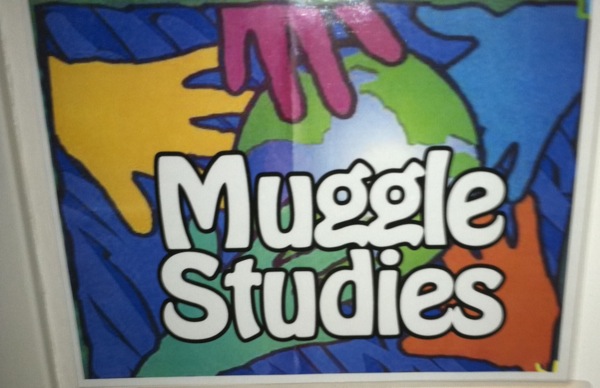
Classroom sign in the basement "castle" at Hogwarts camp.

Classroom sign in the basement “castle” at Hogwarts camp.

Lives of Service, Cut All Too Short

15 Jul
Amanda Mundt two years ago, working at a school in Les Cayes, Haiti.

Amanda Mundt two years ago, working at a school in Les Cayes, Haiti.

The automobile accident could have happened to anyone, anywhere, with the same ensuing sense of deep pain and tragic loss.

But this particular happened to people who had the sympathetic imagination and moral commitment to see and help those in need not just in their New England backyard, but in Haiti. And when their minibus and a truck collided in southern Haiti last Wednesday, three of those volunteers lost their lives, as did their Haitian driver. Three, either directly or indirectly, had Worcester connections. Amanda Mundt, 22, was a student at Clark; the minibus was returning from a Haitian school where she had established a summer program in 2011. Her aunt, Dianna Mundt, also died in the crash. Meagan Bell was the adult daughter of David Bell, the interim director of Clark’s International Development Program. Her father was seriously injured in the accident, as was Amanda Mundt’s father, Kenneth, who was flown to a Florida hospital.

While fatal car accidents seem to happen almost daily in central Massachusetts, this does underscore the risks people take when they choose to put not only their money, but their bodies, where their mouths are. For those of us who believe that all lives matter equally, such news creates a profound conflict in our souls – or, at least in mine. Even though I didn’t know them, the painful truth is that this particular news invokes a particular grief. As a Worcester Telegram editorial states, “It hurts extra hard when people die or suffer while striving to be of service, whether locally or on the international stage.” This is particularly true for the young, whom one could easily imagine making the world a better place for so many years to come – and for whom you wish every joy life has to offer.

But even as the loss and suffering of all weighs on my heart, I have to admit their example was a relief from another bleak week of news, in which I was reminded again and again of the brutal indifference and outright evil lurking in our culture. It’s harder to wallow in despair and discouragement when reading of people who make serving others such a central part of their lives.

The Telegram editorial quotes Brian Concannon, director of the Boston-based Institute for Justice and Democracy in Haiti, who said of Amanda: “She’s just an extraordinary person. It was kind of amazing for someone her age to care so deeply.” Hopefully the examples of those lost or injured will, in the long run, inspire us to make that kind of commitment less unusual, both for individual volunteers and for our government. Meanwhile, my prayers are with the family and friends who knew Amanda, Meagan, Dianne, and that unnamed Haitian driver, survivors grappling with the void left by the absence of special individuals.

(For more, refer to both the Telegram editorial and original story, as well as this article from the Clark University website.)

Revelry That Serves The Soul

8 Jul
Helping led the way.

Defying categorization early in Santa Barbara’s mind-bending Summer Solstice Parade.

A few weeks back, a friend and I wandered Bourbon Street in New Orleans, ultimately climbing to one of those second-story wrought-iron verandas from which people study the comic hedonism unfolding below, pretending they are above what they see below, even as they obviously aren’t.

My friend fixated on the silver man: Lean and angular, he’d painted himself silver from the toes of his shoes to the hair on his head; since he was shirtless, that would mean a lot of scrubbing later.

This sacrifice I had to respect.

His one talent, however, turned out to be simply standing on a platform and extending his middle finger in a defiant “up-yours” – hoping people would not only take photos, but throw a few dollars into his box. Unfortunately, people did the first, but not the latter. His action only picked up slightly when two other “performers” – two young women who got away with their topless-ness because of the body paint spread over their breasts, belly and back – joined him. Even then, the money went mostly to the women, happy to pose with male tourists already drunk at 5:45 on a Saturday evening.

When we descended into the stench and noise of Bourbon Street, we gave money to neither. Instead we veered off Bourbon to Royal, lined with art galleries and antique shops, where we finally tipped generously a single young man on a stoop, playing steel guitar and singing old delta blues songs with the heartbreaking authority of a true artist. We sauntered on to a splendid evening of great and diverse music in the smaller and more subtle clubs on Frenchmen Street.

Don’t get me wrong. While Bourbon Street is hardly my favorite part of New Orleans, I do honor this hedonistic acting-out as part of a celebrated wackiness that I generally approve of.

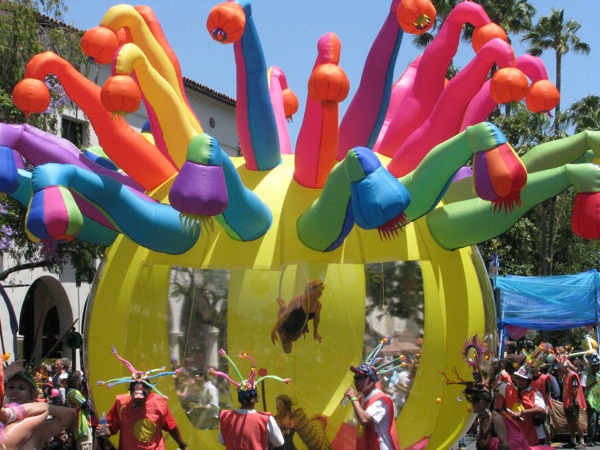
One annual tradition is this float containing acrobat dancers.

One annual tradition is this float containing acrobat dancers.

As evidence of how dearly I value such silliness, I cite where I found myself less than four weeks later: Even though I had just arrived in Santa Barbara, where I could hike seaside cliffs or just sit with my friends on their deck and stare out at the Pacific Ocean, I instead insisted they drop me me off at an event they wouldn’t be caught dead at – the annual Summer Solstice Parade.

Even though the “negative energy” of the silver bird-shooting man was a few thousand miles away, I couldn’t help thinking of the City That Care as I hustled to the legendarily comic and creative proceedings – which is claimed to bring about 100,000 people to the city every year. (How they would count this is anyone’s guess, since many of the participants wear costumes designed to conceal their membership in the human race.)

As soon as I hit State Street, I found a retired gentleman positioning himself behind a row of mailboxes and newsstands, perfect for preventing onlookers from blocking his camera’s view of the proceedings. Learning I was from Massachusetts, he immediately identified himself as a former Bostonian, a software engineer, who “woke up one day in February with a foot of snow and ice on the ground and said, ‘What am I doing here?’” While perhaps his New England reserve kept him from being in the parade, he’d shot it faithfully for 20 years. He gave me the impression that the city draws more of a line between liveliness and depravity, even if these are obviously subjective terms. He told me that in the 1990s one year there was some nudity, which the civic leadership then tried to rein in a bit, since this was a family event. He related this with seeming respect for family concerns, but then shrugged. “I don’t know: It is Santa Barbara, after all.”

The Creatures From The Black Lagoon, mother and son.

The Creatures From The Black Lagoon, mother and son.

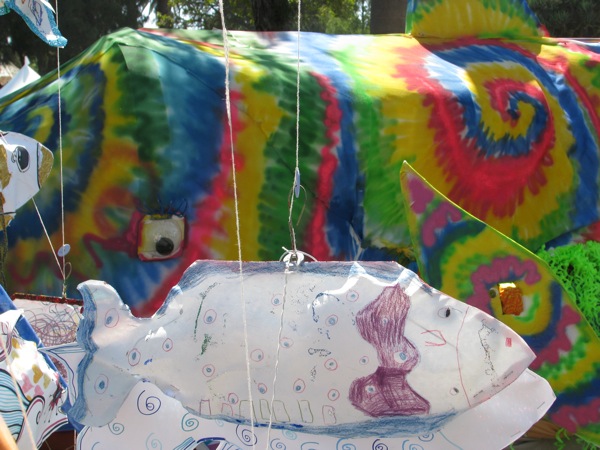
Of course, Santa Barbara, like New Orleans, is more than one thing – so much is in the eye of the beholder. My particular lens found no topless women – and no signs of angry defiance. But the Summer Solstice parade made the colors of Bourbon Street seem pale in comparison. From the sidewalk chalk wishing the sun “happy birthday” and the scores of observers wearing fairy wings to the imagination and hilarity of the costumes and floats, my surroundings kept me in alternate states of wonder and amusement for two solid hours. The parade’s theme was “Creatures,” and there certainly were some, from Mrs. Creature from the Black Lagoon (cradling her Baby Creature from the Black Lagoon) and a rooster fish to a colorful lost whale shark and the Wizard of Odd. True, there was also joy in the recognizably human forms, particularly the pulsating bodies of dancers, moving mostly to festive Latin beats, while working in some gymnastics along the way. But the happiest moments came when the parade transcended the realm of the identifiable – floats and costumes that were such flights of fancy, I couldn’t easily name them, or guess the rationale behind what I was seeing.

Which I think gets at the difference between the revels of State Street during Solstice and Bourbon Street during, well, almost every night of the week. The latter simply doesn’t serve the soul as well as the former, because many of the aspects of Bourbon Street are all too easy to label – you could cite the list of the seven deadly sins and be done with it. Indeed, perhaps Bourbon Street is simply a cheerful admission of our sinfulness, before folks go back to the grim gray business of being good Christians in their respective towns.

But the communal revelry of Solstice feels fundamentally different. Instead of embracing traditional categories of sin, Solstice seems to shrug off notions of normalcy altogether. Sure, Bourbon Street gives me permission to carry an open container of alcohol – but Solstice tells me it’s OK to wear fairy wings and a rooster head while playing the accordion. (Not that I’m planning on it.)

Big fish, little fish pass in the parade.

Big fish, little fish pass in the parade.

And in this I couldn’t help but feel there is a broader social vision informing the Solstice Celebration. In celebrating every kind of creature the volunteers could possibly conceive and construct, there is an obvious argument for tolerance. There also was a more overt social consciousness: Roughly 70 percent of the float materials are recycled, and every float is propelled by walking humans, part of the thousand or so volunteers who make Solstice happen. Some even sneaked in social messages; the mermaids, for instance, reminded us of the need to respect the ocean.

Everywhere I looked, I saw more than mere entertainment – I saw a celebration of the richness of a community.

Of course, New Orleans has this thing called Mardi Gras – a more appropriate comparison of forms of community expression. Indeed, I neglect it here simply because I’ve never been. Ironically, Santa Barbara’s Solstice Parade suggests that maybe I should give that a try, too.

Mermaids with a message proceed down State Street.

Mermaids with a message proceed down State Street.

Ocean For Life – and Peace

2 Jul
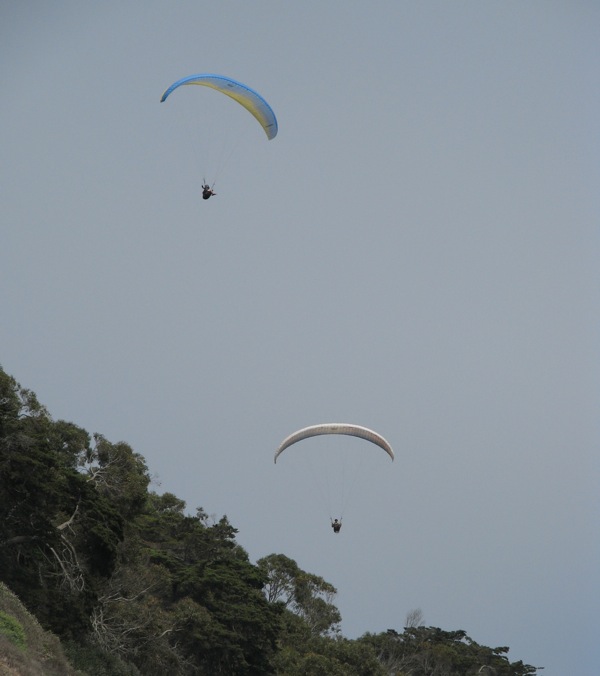
Hang glides off cliff above burro beach.

Hang gliders off cliff above burro beach.

Dolphins arch through the ocean; behind them, 20 miles out in the Pacific Ocean, the Channel Islands rising in a bluish/purple blur. Closer to where I stand, dogs crash into the surf, beneath cliffs where hang-gliders float.

But these things mark almost every visit I’ve ever made to Santa Barbara’s Arroyo Burro Beach, a place I’ve visited annually since two of my best friends had the good sense to mWhat draws my eyes instead are a mass of young people in dark blue t-shirts, gathered above the steps that descend to the beach, listening to a woman shout instructions.

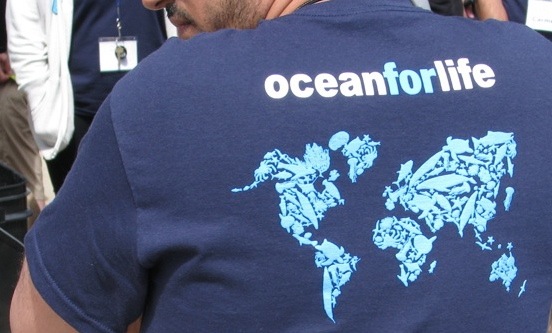
Puzzled, I edge closer, study the t-shirts.

Ocean For Life, they tell me.

Ocean Shirt cropped

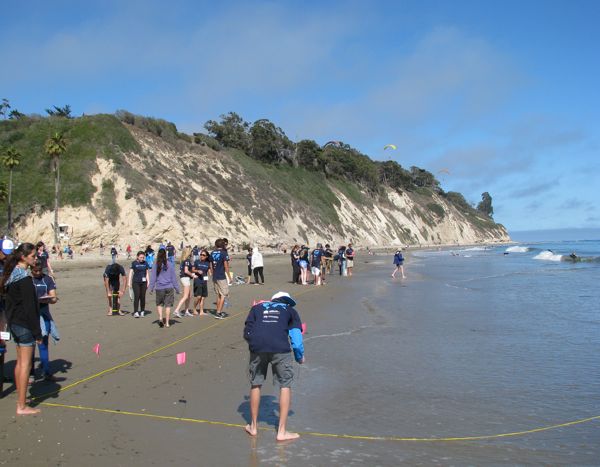
My friend arrives and we visit over a drink, but when I see the same group sectioning off the beach, my curiosity remains. I approach a lanky college-age man, ask what they are doing.

“Digging core samples to check on mole crabs!”

For the moment, I’m less interested in the mole crabs than the young people – who are decidedly un-mole-like. It’s a mixed group of 30 high school students from the Middle East and the United States – and, like many forces for good in this world, it has its roots in tragedy. Three victims of the Sept. 11, 2001 Pentagon plane crash were three District of Columbia high school students, three of their teachers and two National Geographic staff members, all of whom thought they were on their way to this idyllic stretch of California coast.

Three years later, Ocean for Life sent its first group of students here to the Channel Islands National Marine Sanctuary – with the goal of affirming our sense of connection to both the sea and to other human beings. Nine years later, the group I beheld included 15 students from all over the U.S. – and 15 Middle Eastern students representing Bahrain, Egypt, Lebanon, Pakistan, Qatar, Saudi Arabia, and Oman. The entities sponsoring the program were similarly diverse.

Or, as the organization’s web site puts it, “Diversity is a strength in the ocean world. So too in ours. … Our lives depend on close connections to the ocean — and on the close connections that link us all.”

Sectioning off beach before digging core samples.

Sectioning off beach before digging core samples.


Service, Spontaneity and a Stroll Through the Woods

15 Jun
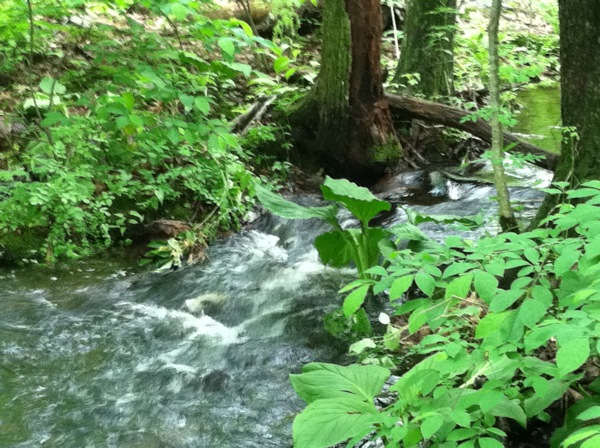
Fast-flowing water through fast-growing ferns.

Fast-flowing water through fast-growing ferns.

I frowned when I first saw the pickup truck, sitting smack dab in the middle of the path that runs alongside the Troiano Brook marsh in Broad Meadow Brook Audubon Sanctuary. After our week of torrential downpours, I was here on Friday afternoon to reconnect with nature, not navigate traffic.

But as I slipped past the blue intruder’s bed, I noticed neatly stacked boards, and as I glanced across the marsh, I could see a tall broad-shouldered man winding his way back toward the truck, perhaps to get more of them.

Out of habit, I kicked up my pace in the name of an elevated heart rate, got perhaps a dozen strides down the road – and then stopped.

What in the world was I doing?

Here I was, a regular user of the sanctuary, in the name of both nature and exercise – and yet I was so rigidly stuck to my routine, I was ignoring a chance to honor both by helping someone who, ultimately, was helping me. I felt the same discomforting irony I had experienced when I once ignored a stranded motorist because I was running late – for church.

Not this time. Reversing course, I arrived at the truck the same time as the man I’d glimpsed. He confirmed that, as I suspected, they were working on a new boardwalk across what has notoriously been the swampiest single stretch in the preserve. “Can I give you a hand?” I asked, and he arched a brow in mild surprise. “Sure.”

Trading my hiker’s pouch for six boards, I followed him back through mostly soaked terrain, my usual skipping from stone to stone complicated in a pleasing way by the lumber I was toting.

“Thanks for doing this,” I called out, “but you know I have always enjoyed jumping from rock to rock in this stretch.”

My companion laughed. “You know what I’m going to enjoy? Walking across this board walk when we’re done with it.”

We rounded a bend to the new boardwalk, shining in the newly emerged sunlight; beyond that lay some old lumber, arranged to further extend the bridge toward the tree line and the dry ground beyond.  A second man crouched over the screw he was drilling into the walk.

“Hey, we picked up a volunteer!” one called out.

“I’m Mike.”

“Joe,” the crouching man said.

“Mark,” the other said as he moved farther down the walk.

“Since I lack your carpentry aptitude, you want me to haul the rest while you work on this?” I was happy to hear them consent. If my resume featured a category for Construction Skills, there would only be skill listed: Carrying Stuff. (Preferably doughnuts.)

Foot log fern 6-14-13

Notch cut out of log to make Sprague Trail hike easier.

It only took five minutes for me to tote all they needed, and then, well, my work was done. This simple act of connecting had only taken 15 minutes, and, as far as I know, cost me nothing. Who knows? If I hadn’t been delayed, maybe I wouldn’t have seen that fair-to-middlin’ muskrat cruising through the murky high water, or the red-winged blackbirds squawking while perched in a particularly picturesque manner – or, rarest of all, a rose-breasted grosbeak, the first I’d seen in scores of hikes at Broad Meadow Brook.

Meanwhile, maybe the delay kept me from seeing something scarier. Amid all this, I also encountered a silver-haired hiker headed in the opposite direction; he slowed to ask, “Excuse me, but how good is your knowledge of native snakes?”

This was perhaps the best opening line of a conversation ever – at least by Broad Meadow Brook standards – and after I simply shrugged, I asked what he’d seen. “Two big brown snakes and one garter.”

The quiet joys of the hike continued, even in rain-soaked forests and fields. Nonetheless, I kept walking in the direction from which he came, found no snakes, but more birds, rabbits, and squirrels, as well as small streams overflowing their banks, the road of the water echoing through the lush trees and ferns. I hiked for more than an hour, taking in a screeching red-tailed hawk along with some less identifiable fowl, weaving back and forth on various trails – at one point passing the Barbara Walker Butterfly Meadow and bench, dedicated to the late Broad Meadow Brook volunteer and leader. At this spot, where I often sit on the bench built as a memorial by her family, she had studied butterflies, as noted in a previous blog.

This time, I kept walking, but I thought about this volunteer I never knew – and about the extractable lessons of my latest foray.

Extractable Lesson 1: Service doesn’t have to happen by appointment. There are quiet opportunities to help here or there every day – and with them comes the opportunity to shake ourselves out of our usual routines and traps, to engage some person we’d never have met otherwise, and enjoy the encounter.

Extractable Lesson 2: While not as compelling as helping the homeless or curing a disease, the benefits of connecting children and adults to the natural world – away from the immediate gratification and sensory bombardment of our artificial entertainments and soul-numbing work places – offer restorative powers that then empower us to go back into the fray more calm, more centered – even, on the best of days, more enlightened.

Perhaps because of the peepers and bullfrogs sounding in the overflowing marshes and vernal pools, my mind drifted to George Orwell’s “Some Thoughts on the Ordinary Toad,” which moves from a hilarious description of frogs mating in post-World War II London to an exploration of why, amid tragedies such as world wars and atomic bombs, it’s still vital to take joy in nature. He argued that if we put more time and energy into appreciating our small place in this natural world, we might be less inclined toward will-to-power and other human sins.

Or, as Orwell put it, “The atom bombs are piling up in the factories, the police are prowling through the cities, the lies are streaming from the loudspeakers, but the earth is still going round the sun, and neither the dictators nor the bureaucrats, deeply as they disapprove of the process, are able to prevent it.”

And, thanks to volunteers at Broad Meadow Brook, people can more easily access that wisdom-inducing, spiritually soothing splendor. I descended Cardinal Trail, first through a field and then through a line of trees, and found myself face to face with the new boardwalk.

As I expected, my new friends, having used up their lumber, were gone. But their handiwork remained, and as I took the 15 long, easy strides over wood instead of mud and water, I decided Mark was right – in this particular spot, I didn’t miss the skipping from rock to rock one bit.

Board walk 1 6-14-13

Completed board walk waiting near end of the hike. 

Those wishing to volunteer at Broad Meadow Brook have opportunities every Wednesday (10 a.m. to noon) and the first Saturday of each month (9 a.m. to noon).

For more information or to sign up in advance, contact Deb Cary, Sanctuary Director, at (508) 753-6087.

To read more about Broad Meadow Brook opportunities, try this link.