Archive | Uncategorized RSS feed for this section

Return of the Return of the Blog

31 Dec

vermillion card

In 2014 I rambled from East Coast to Gulf Coast to West Coast, interviewing folks about the role service plays in their lives. Always a quick study, it only took about a hundred interviews for me to decide that, hey, business cards would be a good idea.

In fairness, I’d figured this out as early as New Orleans – but it took until Santa Barbara, a 10-minute walk from the Pacific Ocean, for me to settle in one place long enough to design and order these cardboard tokens of professionalism. I sat in my friends’ living room, playing with the abundance of possibilities in Vistaprint – 500 for 10 bucks, by the way – until I created a design that told recipients who, at that point in my journey, I thought I was.

Who I was, in part, was a person in profound denial about the fact he had an actual job, with actual responsibilities, waiting back on the East Coast.

Understandable enough. I was six months into my research sabbatical. So it was only natural that I rejected Assumption College blue and white for the earth tones of brown, beige and green, and that I ignored the school seal for an impressionistic swirl of mountains and forest. The image suggested not only my love of hills and woods, but also the blur of my year so far. Meanwhile, while the font was sharp enough, my employer and job title were in smaller, blander type than my blog – servingthestory.com.

But a month later I was back in Worcester, and a month after that I was back in that job – teaching English and directing a community service learning program. Slowly but surely the symbolic typography of my life shifted to a reality in which my paying job was accorded 24-point bold status, while the importance of this blog shrank down to agate – the microscopic type of baseball box scores.

But my business card isn’t entirely a lie. I’ve blogged precious little because, for the last year and a half, I’ve been working on a book-length account of my service road trip. With each revising I’m also reliving – remembering again the extraordinary kindness of the people I met along the way, and the opportunities they gave me to see, in an often brutal world, the better angels of our natures. The Whole Service Trip, as I call my project, is actually more than a trip – for a trip implies an end, and, after that end, a return to some norm in which one serves less. Whereas these folks, well, they’re lifers.

Their stories, and so those of so many others I’ve met since, still deserve telling. As do various facts, insights, and links.

And lest I be tempted to forget, there’s the reminder of this card, which I still hand out to strangers. On the off chance that one of those strangers actually acts upon the information on business cards, well, I should be there to greet them.

So, to the folks who are visiting Serving the Story for the first time, welcome (and sorry if, being a Southerner, I seemed overly friendly). To the rest of you, well, you already know that about me, and you stuck around anyway, so thanks. There is so much to share – so many stories of people thinking, and feeling, and acting, beyond the immediate sphere of their lives, hoping to make the world a kinder and fairer place for people they don’t even know.

If you’re reading this, you’re probably one of them.

So thank you for what you’ve done in 2015  … and for what you, and others, figure to do in the year to come.

365Z Honors Ford’s Acts of Kindness

24 Jul
Brittany with late brother Zach, the inspiration for 365Z.

Brittany Ford with late brother Zach, inspiration for 365Z.

One day last week, my California friend Charmaine Coimbra, a Friend of the Elephant Seals, woke my blog from its eight months of book project-inspired hibernation with her column about volunteerism in her local paper, the Cabrian Times. The next day, I opened my own local paper, the Telegram, to discover former student Brittany Ford and her family featured in Telegram Towns. The Fords were there because of their work with 365Z – an organization the Fords created to honor the many acts of kindness of Brittany’s dearly departed brother Zachary.

While the newspaper article focuses on all the recent accomplishments of 365Z, Serving the Story talked in depth with Brittany about her brother, loss, and how to help people heal through yoga in an April 15, 2014 entry, “Kindness in Unkind Times.” The work of 365Z also came up when I talked with Joe McDonough about how the loss of his son to leukemia led to the family forming B+, which has raised hundreds of thousands of dollars for families of kids with cancer.

That second conversation occurred in a coffee shop in Newark, Delaware, on the second day of last year’s three-month-and-a-week community service road trip. I made the contact only because of Betsy Price, a friend who I hadn’t seen in 16 years; she also was kind enough to host me on my first two nights on the road.

I mention this because acts of kindness such as this occurred again and again on my journey; my nearly 12,000 miles of driving alone were dwarfed by the enormous gaps between my volunteer opportunities, putting my project at risk again and again. But those voids were filled, again and again, by suggestions from folks I met along the way – performing their own acts of kindness by pointing me to like-minded folks in the next town down the line.

Here’s hoping that more and more people respond to the message of 365Z, in the spirit of Zachary Ford.

Charmaine Has Her Reasons

23 Jul

E Seal Charmaine 6-25-14

Editor’s Note: Charmaine Coimbra is not only an official Friend of the Elephant Seals of Cambria, California, but also a friend of last year’s community service road trip. She recently quoted me in her volunteerism column for the local newspaper, The Cambrian; the column also includes 10 reasons to volunteer. You can read her column here — and below you can read more about her reasons in an adapted excerpt from my manuscript about the road trip.

A year and a month ago, I’m driving up California Highway 1, following my friends Ted and Chella up the gorgeous two-lane alongside the sea from San Luis-Obispo to Monterey. We’ve agree on three places to both pull over, but we’re such creatures of habit, I could’ve predicted the first just based on past history — the Elephant Seal Beach near Cambria.

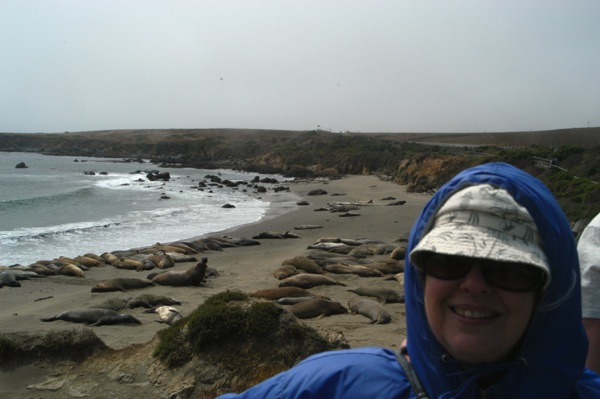
By the time we get there, in one of those crazy California coastal shifts, the weather has changed from sunny with a gentle breeze to a light fog being blasted over us by stiff winds. A local woman who knows the ways of this weather, the volunteer ranger is well-prepared; Charmaine Coimbra is bundled up in a purple hooded jacket, beneath which is tucked a round-hat that comes down to her side sunglasses, leaving only her pink cheeks, chin and lips exposed. I see so little of her, I don’t know if I’d recognize her indoors.

Even her voice is altered; she’s practically yelling above the wind to answer the questions of the hundreds of tourists who have pulled over to gawk at the scores of elephant seals, who have traveled a long way themselves. They migrate clear from Alaska every year to mate and mote. The first, with all its raucous competitiveness, is over – but the second is still in progress. As the massive seals loll side by side in the sand, even in the grey light, it’s easy to see the golden brown outer coat peeling away to expose grey slick flesh beneath. Most rest, but a few flap about a bit, and two young bulls rise up and play-fight, emitting a few deep howls in the process, practice for mating seasons to come.

E Seal 2 6-25-14

While many of the seals are so inert as to appear dead, Charmaine proves quite lively. She gives me a new appreciation for what they seals have gone through to get all the way down here every year. During their long landless swim, they lose bone density; the prolonged time on this beach rebuilds their skeletal support. Paradoxically, this healthy instinct comes at the expense of exercise – so they also fast. They thus adjust diet for their exercise level – which is one way that even the two-ton elephant seal has healthier habits than this human.

Charmaine tells me that she didn’t wait until retirement to start volunteering – her career in community service began at age 3, when she accompanied her father in tap-dancing to “Me and My Shadow” at a Grange fundraiser. She’s been involved in various forms of volunteer work in the decades since, and upon retirement, it didn’t take long for her to focus on her beloved elephant seals. “I’m a California girl,” she tells me, “and I love the sea.”

When I line her up for a picture, and she jokes about not exactly looking her best, a woman behind her interjects, gesturing toward the seals. “Hey, don’t worry – we all look beautiful compared to these guys!”

Charmaine doesn’t exactly rush to defend her seals’ attractiveness. When I ask if she has a favorite, she laughs.

“To tell you the truth, they all look alike to me!”

Charmaine is more helpful than she knows. When this tandem drive up the central coast is over, Ted and Chella will head back south, and I’ll be on my own again, with very few friends waiting to see me on the way home. But Charmaine reminds me of all the trip’s earlier blessings, all the conversations with strangers who come something like friends, sharing one of the best sides of their selves – their desire to serve something larger than themselves. And while those encounters are fleeting, sometimes something sticks. Within 24 hours, Charmaine will friend me on Facebook, setting the stage for her to treat me, along with her other Facebook friends, to a steady stream of wondrous scenes from California Highway 1.

My Fellow Writers

6 Nov
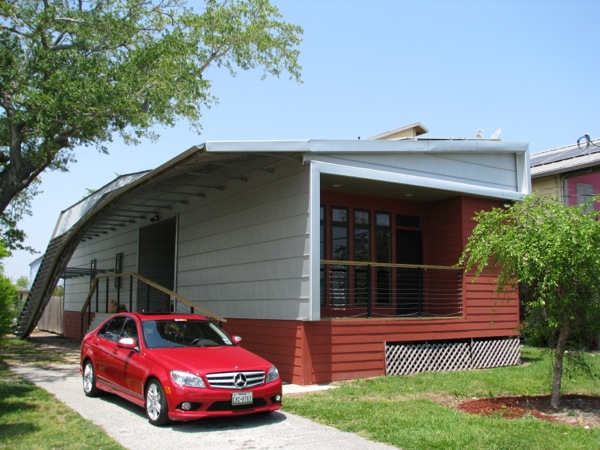
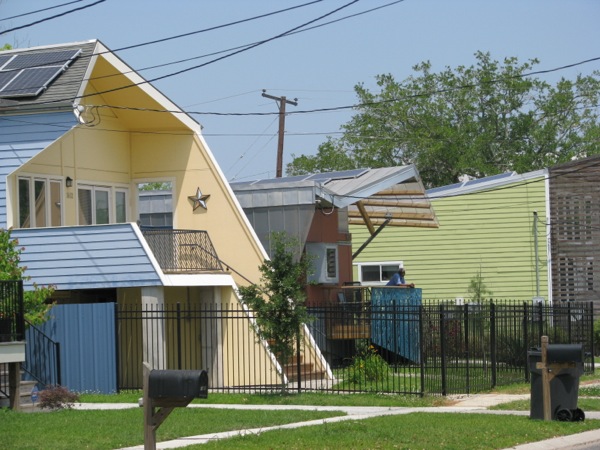
Three of the homes built by Brad Pitt's foundation in New Orleans Lower Ninth Ward.

Three of the homes built by Brad Pitt’s foundation in New Orleans’ Lower Ninth Ward.


I hustled into the downtown Starbucks and hunkered down in a plush leather seat in the corner – between two windows, back to the wall, an abundance of space between me and the nearest customers. For all these reasons, and because of superstition based on past performances, this was my lucky writing chair – and today I was going to need all the luck I could get.

It had been one of those weeks when the writing came anything but easily. I was working on a book project about my community service road trip, and right now that means writing about my visit to New Orleans. Normally New Orleans is a pleasant enough direction to let my mind wander, but now I’m struggling to shape all the good times into a coherent series of chapters, built on interviews only partly transcribed and facts only partly gathered.

Given that problem, it was understandable that my Thursday off-campus was not going to yield the explosion of memorable prose I’d been praying for this week. Instead, a review of what I’d written revealed that my entire plan for New Orleans was wrong – what I thought was one chapter needed to be two. Worse, one reason it needed to split in two was that one of the agencies merited more research, including more interviews that, of course, I’d then have to transcribe. An hour into my would-be writing session, I accepted this. I sent an email to one agency – the New Orleans Musicians Clinic – asking for things as large as setting up an interview and as small as the architectural style of the agency’s offices.

So fine. At leaset now I could move on to my half-chapter about Common Ground Relief, set up in the Lower Ninth Ward so severely flooded by Hurricane Katrina. A description of the environmentally correct – and festively colorful – homes built by Brad Pitt’s Make It Right Foundation should be easy enough to turn around. Only a quick bit of on-line research quickly revealed a New Republic article about criticism of Pitt’s noble effort. (Sigh.) The clock told me I was running out of time. My writing self would have to rush to my 3 p.m. Thursday volunteer gig without the satisfaction of closure.

At least I could take a break from the writing.

ACE chalk 9-25-14

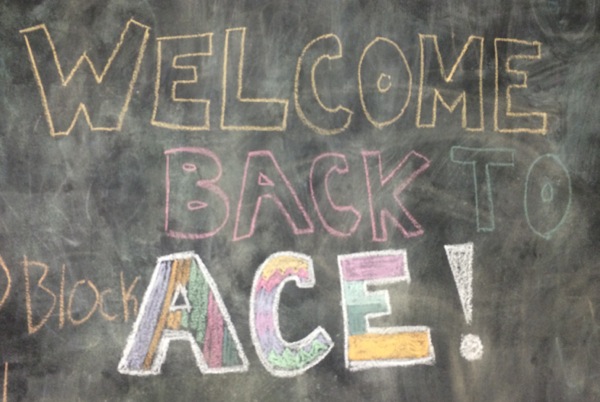
Again, I was wrong. When I walked into the basement classroom of African Community Education, it wasn’t long before I was pulled – with gratitude – from a student’s high school algebra assignment to two people working on my writing –which, until my ill-fated trip to Starbucks, I considered my forte. In a new twist, I was tutoring two students at the same time, about two very different assignments. The young writers sat opposite me; I moved back and forth between them, feeling like the pedagogical version of a bartender. (“Ma’am, can I freshen that essay for you?”) The multi-tasking reminded me of my earlier frustration at the coffee shop; what could possibly come of all this hopping back and forth.

Only I felt more locked in to their respective missions than my own. Maybe it was the knowledge of what these students – African refugees who endured difficult transitions to America after even harder lives in conflict-ridden homes abroad – had gone through just to be here today, gamely seeking to climb another rung in a ladder I’d never even had to negotiate. Or maybe it was my thwarted desire to complete my own chapter earlier. I was urgently concerned that someone finish something today – and, given what was at stake, I’d rather it be them. I felt we were nearing the goal – only then the girl, a senior from the Central Republic of Africa, threw me for a loop. She was two paragraphs from completing – only now she was doubting the validity of her assertion two paragraphs earlier. She shared with me her new insight, and I had to agree, but I feared for her, just the same – this was looking to be her version of my Brad Pitt boondoggle. I wanted to spare her – who only began learning English four years ago – my rhetorical lostness.

But listening to her, I had to agree she was right – and I could only cheer her on as she erased half of the second paragraph and rewrote it in her careful pencil, a handwriting I could never duplicate at any age. She moved on from there, consulting me on every sentence, but every idea her own. She finished only a half hour after her male counterpart, who only had to write one paragraph. That left time for her to tell me about her home country, her schooling, and her plans for community college. She and walked out at the same time, hung with the kids waiting out front for their rides home after a long day of schooling.

My earlier frustration seemed to have dissolved into the cool misty night air. Sure, my work will be harder to complete – and yet my professional path is so much easier than the series of obstacles these kids have hurdled. One possible conclusion of such volunteer moments is the familiar one we may experience when we look in a bathroom mirror and say, “Hey, stop yer whining.’”

But that has a negative spin, as if I’m supposed to pity the lot of these kids compared to my own. It doesn’t ring true to what I really felt – inspiration. How, after all, could we not be inspired by a group of motivated immigrant kids, earnestly writing their way sentence by sentence into a new language in a new country? The next time I struggle to push through to the end of a chapter, I’ll remind myself of these young writers – making their own luck, regardless of the chair life gives them.

It Takes All Kinds

28 Oct
Though from opposite ends of beauty scale, horse and pig both have their place at Return to Freedom wild horse sanctuary.

Horse and pig both have their place at Return to Freedom wild horse sanctuary. 


So, sure, my blog this time at Verge Magazine isn’t about pigs, or horses, or my week at Return to Freedom American Wild Horse Sanctuary near Lompoc, California. And, OK, my blog at Verge Magazine has a different title and photo – if only because I didn’t think of this until after the deadline.

But if you happen to read the Verge blog, I think you’ll sense the connection.


http://www.vergemagazine.com/volunteer-abroad/blogs/1362-crisis-of-faith-in-one-s-own-self.html

Back to School for ACE (and Me)

28 Sep

ACE chalk 9-25-14

Marie Ebacher leads me up the stairs, down a hall and into a classroom. I see several children, all African immigrants, working quietly on homework as a veteran teacher, Gladys, observes them.

“This is basic math,” says Marie, a student of mine back in her Assumption College days. “So you should be able to do it.”

Marie’s not trying to be ironic, or reveling in some “the student has become the master” moment – although that is certainly the case this afternoon, my first as a volunteer tutor for African Community Education. Instead, Marie, ever considerate, is merely addressing the anxiety I’d expressed an hour ago. An English professor by trade, I had made it abundantly clear to Marie that I was among the math-impaired. This was at least a little hypocritical: As the director of Assumption’s Community Service Learning program, I constantly utter the cliché about the value of “getting out of your comfort zone.” I can’t help smiling at the irony that now it’s my turn. I’m a sucker for poetic justice, even when I’m its victim.

I settle down next to a slender African girl in full Islamic garb, from the scarf on her head to the ankle-length skirt – the same clothes she wore on the basketball court when I was happily helping her shoot, something I could teach without fear of unwittingly undermining her academic future.

Now, though, I am staring at a worksheet of 20 or so numbers, most of them in the millions. Her job was to identify the slot in which a certain digit rested. For instance, if asked where the “7” was in 1,407,429, she was supposed to say the “one-thousand” slot. Marie was right – I could do this – but that begged other questions. For instance, what was the exact title of each slot? I don’t want to be just guessing its name, only to find out the hard way that her teacher has a different lingo. She allays this anxiety by producing a second sheet listing the terms.

Then there was the deeper question: How do I know what I know? Back in the early ‘60s at Northington Elementary, was this how I learned that the thousand came before the comma? As far as I can tell, this fundamental knowledge was just downloaded into my brain from The Cloud. (For certain, clouds were involved, if only in my memory.) I’ll never know. But my new friend helped me get past these issues; before long she had completed the entire sheet, and it was time to go back downstairs to a group activity.

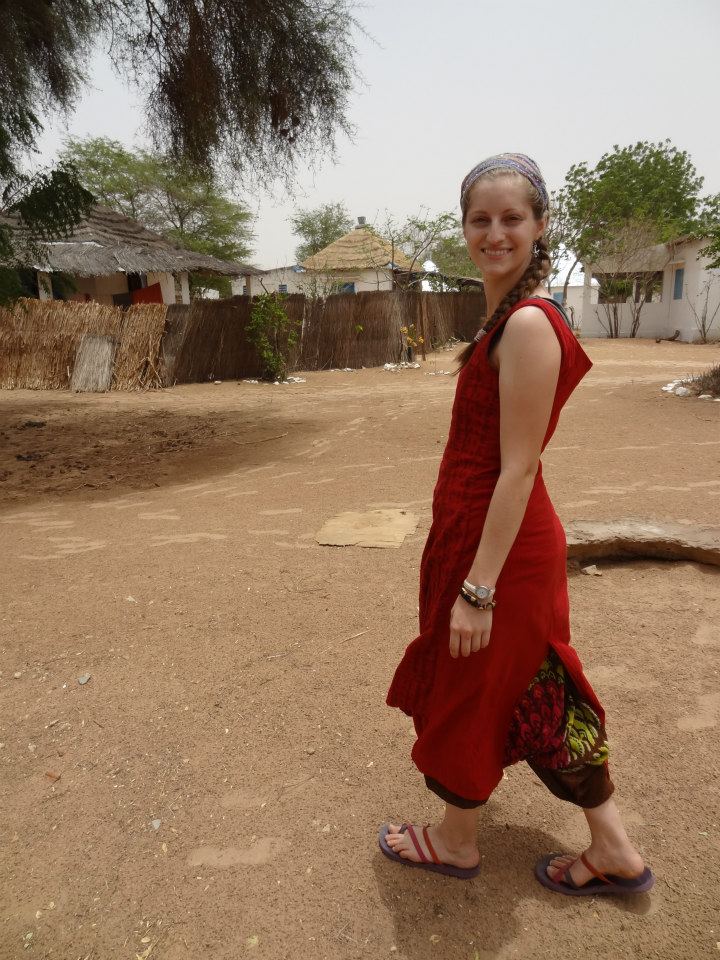
Marie Ebacher at commune in Senegal.

Before becoming a Commonwealth Corps Service Member on the staff at African Community Education, Marie Ebacher learned about Africa firsthand.

The next morning it was my turn to be tutored. Colleagues Sarah Cavanagh and Jim Lang met me at NU Café for the latest meeting of our writing group. Each of us are working on books, and their manuscripts are in one way or another about the psychology of learning. Sarah’s is particularly intriguing, since she’s a professor of psychology – which I might’ve majored in if not for, yes, that whole math obstacle. Somewhere in our discussion, it comes up that emotional engagement enhances learning – and that learning, even when you potentially ruin it by making it your day job, can be pleasurable.

My mind flashes back to the afternoon before at ACE, a classic example of both. It doesn’t take long to get emotionally involved with kids period, especially immigrant kids who have come so far just to be here – and yet, in many cases, have so far to go in terms of catching up with lifelong English speakers from homes more affluent than their own. That emotional desire to connect started with me asking them to educate their tutor – before the official tutoring period started, several of them politely pointed out in a textbook where they were from in Africa, reminding me how little I knew. Just knowing I was about to start volunteering, I automatically read any news about Africa with heightened interest.

That’s certainly incentive enough to volunteer. But then there is the pleasure of learning – and not just book-learning. There’s learning how to decode homework assignments by teachers I’ve never met, working at grade levels I’ve never taught, in methodologies of which I’m largely ignorant. There’s learning even more respect for the teachers, the tutors, and most of all the students who are striving to put together those basic building blocks I’ve long ago forgotten. There’s learning how to listen – a task complicated by my hearing, not as good as it used to be, and by our distinctly different accents. Learning the New England spin on English is challenge enough – now they have my Southern accent thrown into the mix. There is learning to focus and concentrate amid distraction – a challenge that the student occasionally meets more effectively than the tutor, glancing at commotion elsewhere. By the time my Thursday debut at ACE rolled around, I had taught four college classes and two independent studies, and yet my time with my ACE students may have been my most intellectually engaging hours of the week. And now, even as I write this, I’m fascinated with how I can become better at it.

I chose ACE after this year’s cross-country, community service road trip, finding that after all my much-varied volunteer gigs, what I most wanted was a chance to connect with people different than myself, doing something that I was both good at and, at the same time, not so good at. Something in which the clientele and I would not only grow closer ­– but grow together.

Thanks to the good folks at ACE, that search appears to be over.

The Vulnerability Trip

19 Aug
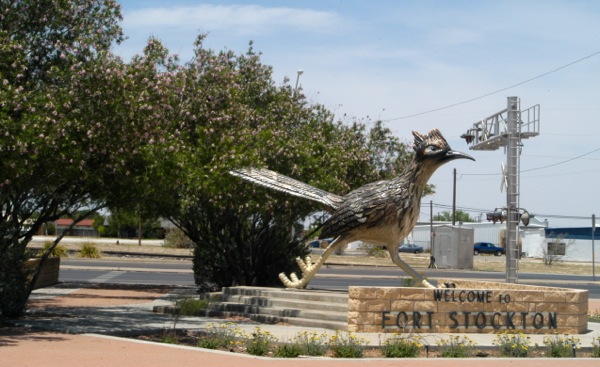
The Roadrunner in Ft. Stockton, Texas seems to suggest I get right back on that road to El Paso.

Coyote or not, the Roadrunner seems to suggest I get right back on that road to El Paso.

I’ve now been back in Worcester for a month, but the blogs from Road Trip 2014 just keep on coming  at Verge Magazine. Since I’ve agreed to not duplicate material between blogs, here I’ll only provide the link to my latest piece for Verge – “The Vulnerability Trip.”

Much more to come here in the coming months – but in the meantime I recommend Verge as an excellent source of insight about service and study abroad.

Down the road … if only the road to Starbucks.


Dave Eggers, Glide, and Unconditional Love

22 Jul
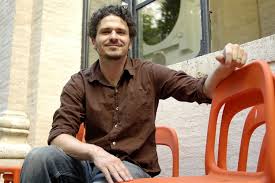
Dave Eggers, writer and advocate. (Photo from Huffington Post.)

Dave Eggers, writer and advocate. (Photo from Huffington Post.)

Dave Eggers has long been one of my favorite American writers. His innovative, funny and moving memoir, A Heartbreaking Work of Staggering Genius, was a finalist for the Pulitzer. His first novel, You Shall Know Our Velocity, was about an attempt to give money to deserving people around the globe. His second novel – What is the What: The Autobiography of Valentino Achak Deng – was a finalist for the National Book Critics Circle Award for Fiction. He wrote the screenplay for Where The Wild Things Are. He’s founded magazines in print and on-line, chronicled injustice in nonfiction, and even founded scholarship programs.

I’m not writing about any that.

Instead, I’m focusing on two paragraphs of a preface Eggers wrote on behalf of Cecil Williams and Janice Mirikitani, for their latest book, Beyond the Possible. Williams and Mirikitani have appeared in this blog recently; the couple have been at the helm of Glide in San Francisco, blending their spiritual conviction and artistic talent with inspired leadership and social outreach. Glide is legendary not only for its Sunday morning celebrations, but for its extensive outreach among the homeless and others on a wide variety of fronts in San Francisco’s Tenderloin. If you visit glide.org, you’ll see that two of the key phrases for Glide are “radical inclusiveness” and, even more daunting, “love unconditionally.”

In the preface, titled “Unconditional Love,” Eggers springboards off a Glide sermon to pose the question, “If a church can keep its doors open and lights on, accepting all at all times, could we? Could an individual person keep his or her own lights on, their arms and doors open, at all times?”

Eggers’ answer? “It’s hard, that’s for sure. It’s really damned hard. There’s always someone who annoys us. For some, there are Republicans. There are white people, brown people, black people, Asians. There is always someone who is in our way or whose ancestors oppressed our ancestors, or stands for something we don’t like, or seems to be standing in the path of progress. The wealthy. The homeless. Tourists. Industrialists. Real estate developers. Hippies. It doesn’t matter, but you know what I mean. Wherever you are, there is someone who is unwelcome.”

I came to Glide after almost three months on the road, much of it a journey not only across America, but at least a little deeper into efforts to help those in poverty. In that limited voluntourist way, I’d worked with the homeless in Tucson and Santa Barbara before I even got to San Francisco. Just whistle stops, but enough to make an impression. In all that time, working alongside veterans, I got marginally more at ease with relating to the homeless moving through the food line; I could joke and make conversation matter-of-factly.

Yet as I cracked open Beyond The Possible, I knew I was still just working on the homeless part. And here Eggers was, reminding me that once I got past all the fears waiting to ambush me from somewhere in my white middle-class subconscious, once I got past the popular prejudices that the homeless are all mentally ill drug addicts and/or alcoholics who reek of the streets, once I got past the fact that the particular person I was handing a food tray to might be all of those things, and nonetheless still worthy of respect and kindness, once I got past ALL of that – well, then, I was going to have to turn around and love an insensitive, entitled person who hadn’t learned any of those lessons and didn’t care to learn any of them, and who, seemingly secure in their willful ignorance, would happily slash funding for the programs where I volunteered.

Eggers is right. Unconditional love is a tall order. I don’t think anyone I know would say they’ve even come close, even for a single day.

But does that mean we shouldn’t try? For, Eggers concludes, “there is Glide, with its dozens of empowerment programs, its doors open and its lights on. There is Glide, built by Cecil and Janice and nurtured into the future by the Marks and the pastors, by the staff, by the young people, and by the thousands of members who are poor and rich, black and white and brown, well-fed and hungry, clean and unclean, on their way up and on their way down, devout or full of doubt – all welcome, all equally necessary, all equally valid, all offered Unconditional Love. It’s a radical idea, but the only one that makes any sense at all.”

photo1695

On the Verge

11 Jul


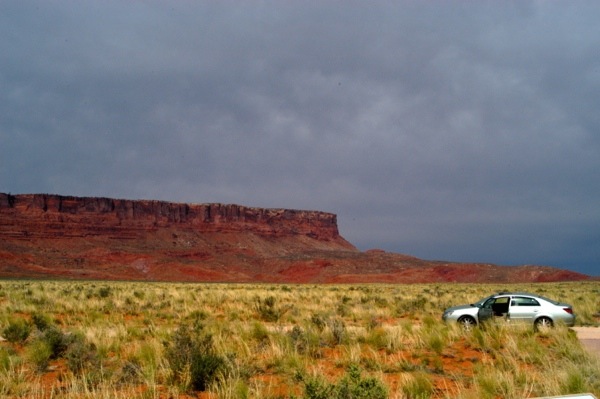
Car door stays open when shooting Vermillion Cliffs on the run.

Car door stays open when shooting Vermillion Cliffs on the run.

While blogging at Serving the Story on my community service road  trip, I’ve also been blogging about my journey for the good folks at Verge Magazine — a site I highly recommend if you are contemplating blending travel and volunteerism.

Verge recently posted two blogs from me. The first — the third in my series for them – is about the balancing of volunteerism and sight-seeing, including a crazed stretch of driving involving Tucson, the Grand Canyon, Bryce Canyon, and Los Angeles. The next blog concerns the power of word of mouth when you’re on the road volunteering. If you get to the bottom of the first blog, you’ll see a link to the next one.

Meanwhile, I press on to Pine Ridge Reservation in South Dakota — but I have other stories to tell in this space first. Until then …

Life-limiting, life-affirming

7 Jul
Kathleen with angel in the sanctuary at George Mark Children's House.

Kathleen with angel in the sanctuary at George Mark Children’s House.

Editor’s Note: Serving the Story’s community service road trip continues in the San Francisco Bay area. The names of the children mentioned below have been changed to protect privacy.

Anna proclaims she’s a “movie buff”, so I ask for some guidance about a movie she’s planning to see soon – the new Transformers flick. I confess to her that when I went to the first Transformers movie, I couldn’t tell an Autobot from a Deceptacon; when the boss

Autobot – “Optimus Prime,” she interjects for my benefit – gave a speech at movie’s end about a brave Autobot who had died in battle, I was so confused, I didn’t even know it had happened.

She tries to help me out, speaking in emphatic and rhythmic bursts, with plenty of opinion thrown in for good measure.

In other words, a natural comedian. She explains how when it comes to picking out evil robots, if someone has “airplane wings sticking out of the sides of their head,” well, that’s a pretty good indication.

“You look them in the face,” she says, “and you’ll know which ones are evil.”

The hallway in which we sit is as quiet as a Michael Bay movie is loud. Plenty of light splashes through the windows of the George Mark Children’s House, which feels not only homey, but somehow better than home. Spacious rooms, playful animal statues, toys and games for children of every developmental level. My favorite room is Great Vibes, in which kids can play with lights, colors and vibrations in ways I can’t even describe here – except to say it’s like every children’s interactive exhibit I’ve seen in any museum, all in one cozy room.

There’s even Max, a black and tan King Charles Spaniel who comes waggling up with his master, Jeff Simon. As she pets him, she complains about not having a dog – but not for the reasons of most youth.

“If I were alone at the house and I died,” she says, “the dog could go next door and tell my aunt.”

Jeff seems to roll with this statement with no shock. He’s been coming here once a week for years, so he knows the ropes. “Sometimes I walk out and I’m excited about an interaction we had,” he’ll tell me later, on the patio. “Other times … I had one experience where we visited two kids and within an hour both kids had passed away. Both of them were kids we had seen a lot – which was terribly unfortunate and sad – but I was happy that he had time with them.”

Max and master Jeff take break from their rounds at George Mark Children's House.

Max and master Jeff take break from rounds at George Mark Children’s House.

This positive turn is characteristic of everyone I see at George Mark, and it doesn’t come off as a fake glossing over of the very real struggles of severely ill children and their families. Indeed, it’s the very challenges faced by families that makes the work at George Mark Children’s House so meaningful.

“People say, ‘how can you be in this environment day after day after day?’” Becky Randall, volunteer manager, had told me earlier that morning. “But you know how much we are helping these families. And, you know what? There’s nowhere I’d rather be.”

I believe her, just as I believe Ken Sommer, who had joined us for our morning talk. The director of advancement for George Mark, has worked in some challenging non-profits. An aspiring rock promoter who intead wound up in the arts, he eventually sought the gravity of the San Francisco Tenderloin district, working for both Glide Memorial Methodist– where I volunteered yesterday – and Tenderloin Development Corporation, which worked to house the homeless.

“Organizations like Glide and TDC do incredible work – I just don’t know if I could go back to doing that,” he told me, as we talked about the bleakness of what one saw walking in those neighborhoods. “Granted, I work for an organization that deals with sick and dying kids, and their families, and that’s equally tough, but this place feels like a celebration of life, as odd as it sounds. We give the gift of time to these families and walk with them through these incredibly difficult situations and help them make the best of those difficult situations. So it feeds my soul.”

“Mine, too,” Becky added.

Yet, strangely, typically only five of eight beds at George Mark are full. Ken suspects that this is partly due to misconception: The organization is thought of as a hospice for children, when “end of life” is only one of three kinds of service it provides. The house also offers “transitional care” – helping families adapt to their new medical circumstances after a hospital stay – and “respite care” – simply taking in an ill child to give families a much-needed break. What the children in every category have in common is a “life-limiting” illness – but that life might still take someone into their early 20s before passing. Thus, there are children, and families, who are in and out of George Mark for many years; even after the child’s passing, families often return for remembrance celebrations and other events.

But there are limits. For the 55-65 volunteers who put in weekly four-hour shifts interacting with the children, boundaries are important. As much as families might press for personal contact information or even such routine self-disclosure as showing pictures of their own kids, volunteers have to limit their contact to their hours at the house. But within those four hours, volunteers pay close attention to the needs of both patient and family.

Becky introduces me to one of those volunteers, Kathleen Phillips, as she sits talking with Anna in the hallway. I get to shadow her for much of her shift. In her first career, Kathleen wasn’t a nurse – in fact, she was the vice president of finance for the Oakland A’s. She left that job to raise kids. Once her children hit their teenage years, though, Kathleen told a friend, Kathy Nicholson Hull, that she’d like to start volunteering somewhere.

“She said, ‘Have I got a job for you!’”
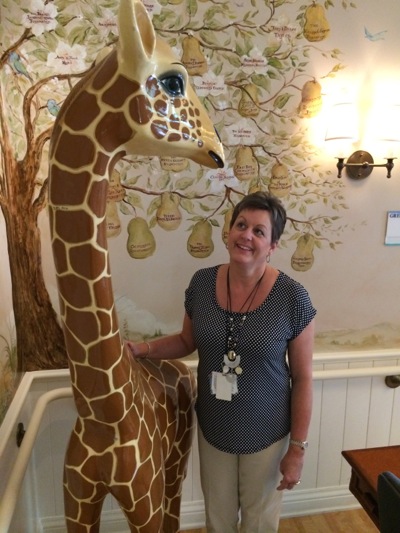
Becky Randall was a veteran volunteer before she became volunteer manager.

Becky Randall was a veteran volunteer before she became volunteer manager.

It turned out Hull, a clinical psychologist, was partnering with pediatric oncologist Barbara Beach to start George Mark. The house would be named for Hull’s brothers – George had died at age 30, Mark at age 16. It would be nine months before George Mark opened its doors in March, 2004 – making Kathleen one of the first volunteers.

In the decade since, Kathleen has spent time with “hundreds” of patients. Each shift she carefully reviews the file on the child; diagnoses are not included, but scores of other key pieces of information are, right down to what things they seem to enjoy.

Reading from a folder, she tells me that this one “likes the pacifier, likes being read to, looking at colorful books … she has a lot of likes, which is good. Kids, a lot of them like the cause-and-effect activities, like whack-a-mole.”

Many are nonverbal, and might have very limited use of their limbs. Kathleen might use hand-over-hand techniques. For instance, placing her hand over the child’s, she and the child can draw a picture together even if the child cannot move the pen on his or her own. Even when a child is restricted to a bed, the bed can be rolled into the patio and garden so he or she can enjoy some fresh air.

As we converse, Kathleen is gently pushing a dark-haired boy in a wheelchair from room to room; his head lolls back against a head brace, he doesn’t speak, and I never catch his eyes engaging my own, but those eyes stay open, and he sometimes emits a long low laugh. When he does, Kathleen gently talks with him. Other times, they may just sit quietly together.

Watching, the time they spend may seem almost idyllic. Talking, playing, sometimes just sitting quietly. Or working out intuitively things that might feel good for a child – Kathleen says she gets a response from some by running a long narrow leaf under the child’s nose. But worlds of complexity lie under those interactions. That’s why the volunteers who work with the children have a weekend-long intensive training, followed by a minimum of three mentoring shifts shadowing a veteran such as Kathleen. (Some ask for even more shifts before starting on their own.)

Much of the training is about specific techniques; there is also a lot of role playing, acting out particular scenarios. Some concerns how to be helpful with the siblings – and what to say, or not say, to them.

“A sibling might turn to you and say, ‘Do you think my sister or brother is going to die?’ Becky told me. “And you have to just turn it around and say, ‘Do you think your brother or sister is going to die?’ You have to be really careful in how you interact with families, because every family is different, every family has their own way to deal with child’s illness. So you have to put own personal feelings aside and work with what’s going on in the moment.”

Because families are often so preoccupied with the sick child, sometimes the volunteer can be the sounding board for the sibling. “The siblings are really important here, because sometimes they can fall through cracks,” Kathleen tells me. “They get to do a whole bunch of stuff. Once I spent my whole shift with siblings. We had so much fun, just playing, inside, outside, running around.”

Kathleen remembers one girl who others said seemed determined not to talk; she simply sat and watched TV. But when Kathleen visited with her, the child opened up. “She said she felt really guilty because she’d rather be in school than here, but she didn’t want to say that, because she didn’t want her parents to think she was a really bad person, or for her brother to think she was a really bad person.

“So sometimes it’ll just come out. You’ll have a moment going and a kid will come out with something.”

In addition to such shrewd listening ability, what qualities are cultivated in a George Mark volunteer?

“Patience,” Kathleen tells me. “Life outside here with you own kids is like ‘come on, let’s get this done, let’s do that done.’ Here it’s a much different pace. It takes someone who has compassion – and someone who has a sense of humor. [Anna’s] funny; she’s kind of boy crazy, so she can say some really funny things.

“Just don’t be boring. I just act whatever age they are. Just to be physically active helps, because you can go down slides with them.”

Meanwhile, the very gravity of the situations faced by families make volunteers feel glad to have helped them. Ken tells of a child with cystic fibrosis who’d spent 48 of 52 weeks in intensive care before coming to George Mark – where he surprised his doctors by recovering enough to be eligible for a lung transplant. He received that transplant, and even though he still has cystic fibrosis, he’s this “18-year-old dude” who spoke at the organization’s gala.

But even when there aren’t such surprising turnarounds, the work feels anything but sad. “This isn’t a place of sadness, it’s a place of joy,” Kathleen says. “It’s just really nice that families get to spend time with child here and not in a hospital.”

And it’s nice for the volunteers, too. I take my late lunch with Kathleen the hallway. By now Anna is back from a shower. Susie, perhaps two years oaf age, has shown up in one of those rolling rings. John, who looks like he’s in his early teens but is in his 20s, continues to rest in his wheelchair.

Kathleen sits in a chair, keeping an eye on all three while Anna and I keep talking movies and dogs. Then Kathleen gently laughs. “Susie’s blowing kisses.” The child silently smacks her lips at Kathleen. I laugh, and the girl turns to me – so I play the game as well, smacking my lips. The sweetest moment is the delay – the second or two that passes before the child deigns to return the favor. It’s her sole gesture of connection to me, rising out of a mysterious world she, as of now anyway, cannot put into words. Maybe she never will.

I strive to let myself go further and further into this moment – just the three kids, and Kathleen, and the nurse behind a nearby counter. It is, indeed, profound and joyful, and, even though I don’t have kids, I can imagine doing this and even, once hooked, needing to do this. But then, almost five hours into my visit, something welling up inside, tells me it’s time to go.

Following the example of the George Mark volunteers, I manage to screen out the sadness long enough to write notes at a Starbucks and do my clothes at a coin-op called Laundry Land, where a guy named Julio distracts me with his story, one of being an immigrant and having a family here that his mother down in Mexico can’t come visit. His story, touching as it is, is actually a relief.

But soon Julio is gone, and my clothes are done, and in the parking lot, even as I’m stuffing my clean clothes into the trunk, it all catches up to me. The homeless in San Francisco yesterday, the children today. Something splits open. Like the little girl, I can’t put what I’m feeling into words. One of those times when pain and numbness seem to coexist, even conspire, taking you into a fog. The world around me seems changed, even strange.

Knowing I’m useless for the evening, I retreat to the familiar in an unfamiliar town – I go see a movie. I get a ticket for a comedy, but as I buy my popcorn, I keep hearing Anna’s voice. I decide to see if she’s right, even if that means going back for the 3D glasses and taking in the Transformers in all their 17-percent approval rating glory.

This time I see what she means, and I see why she likes it. In this world, the evil and the good are clearly defined, their actions logical and obvious. The opposite of the inexplicable threats of genes and nature and random chance, the pain inflicted on kids like herself for no reason at all.

Driving past George Mark Children’s House the next morning on way out of town, I want to swing up the lane and give Anna a sneak preview. Then I remember: She was scheduled to go home last night.

Like the volunteers chafing over the boundaries, I wish I could send Anna an email. Taking even that small action would mean a lot to me, and maybe a little something to her. This impulse must be part of what keeps volunteers such as Kathleen coming back week after week, month after month. And even though I know such work isn’t for everyone, as I left San Leandro, all I could think was, “How could you not?”