Archive | Uncategorized RSS feed for this section

Sewing the story

25 Jun

Maude White Bull stitching to Gunsmoke.

The week I returned from Pine Ridge Reservation, still re-acclimating from a week away from mass media, I contemplated which big-screen movie would best ease my entry back into pop culture.

The least jarring, I decided, would be Crooked Arrows.

The coincidence, after all, almost amounted to a sign from the Great Spirit. Coming back from my time among the Lakota Sioux Nation, I find an actual film about Native Americans, consisting almost entirely of Native Americans, playing across town from my apartment. Then there was the sport the kids were playing: I mean, if you see just one lacrosse movie this year …

So on a Thursday afternoon, just five days removed from the South Dakota plains, I joined the crowd – if three can constitute a crowd – at a late-afternoon matinee of Crooked Arrows. To be fair, I have to admit that I found some obvious similarities between Pine Ridge and the film – most notably the message of self-empowerment that can come through rediscovering and recommitting to your true cultural and spiritual identity, while rejecting the racist stereotypes projected upon you by outsiders.

One of the Crooked Arrows.

But for the most part, Crooked Arrows seemed about as far removed from my Pine Ridge experience as, say, Men In Black. When it came to setting, lush New York woods replaced Western plains, modest but decent homes replaced FEMA trailers, and roofs withstood wind without the aid of truck tires to keep them from bowing. The kids were well-fed. While alcoholism, suicide, diabetes, and unemployment are rampant at Pine Ridge, those things didn’t exist in this film’s universe.

Those are just the differences in content – the most striking contrast came in the shape of story itself.

Crooked Arrows, after all, is a typical clichéd youth sports movie: Crooked Arrows, like The Bad News Bears or The Mighty Ducks, features a rogue adult who is dragged into coaching a team of misfits. Despite many a comic debacle, coach and players somehow save each other. Demons are defeated and lessons are learned, and all this new wisdom and character is rewarded, as it usually is, both on and off the field. Hope grows, and that hope is well-founded.

Which is, in a way, fine.

Obviously, it would be as ludicrous to hold Crooked Arrows to the standards of sober-minded, socially relevant realism. These movies, geared toward the young, should offer laughter and hope. It would be nice if plot holes weren’t big enough to build a casino in – but what of it? Not every sports underdog story can be Hoosiers, and Hoosiers itself is no Hoop Dreams.

Everyone needs some catharsis now and then.

Assumption’s Justine and Kristen unload the lumber.

Just the same, experiencing the reassurance of typical Hollywood story got me contemplating the more disquieting stories I experienced in Pine Ridge. What comes to mind is our last day of construction, for Maude White Bull up in Wanblee, about a two-hour drive from Re-Member’s base of operations.

We came there to rip out the front and back steps, replacing them with new ones that were much safer. While the Disney version of this story would culminate in a sprawling quaint porch painted in bright colors, our mission was to make do with what we had – mixing mostly new lumber with old pieces that still seemed sound; the roof mounted over the front steps would have to remain for another visit by another crew. While some pieces of lumber were treated to protect from water damage, other pieces were not. Would our new work be stained with some kind of protective water seal? Perhaps. But money was tight for both the home-owner and for Re-Member, hustling all over to help folks with the most basic needs. As we worked, one staffer shrugged at the limitations with a resigned look. “Today the priority is just giving her and her family a safe way to get in and out of her house,” he said. “Hopefully we can come back and do more later.”

But our host had one thing about half the people on the rez lack – and that thing was indoor plumbing. Since the old steps disappeared after I entered, I had to wait patiently in the living room for the carpenters to create my exit. Which was fine. It gave me time to watch the construction of something as artistically dazzling as our porch was not – a Lakota star quilt, one of cheerful sky blue and rich yellow.

The surface, stretched taut, contained the traditional Lakota morning star pattern – symbolizing new beginnings – as well as scissors, needles, and the remote for the TV, currently showing Gunsmoke. (“I like any Western,” Maude said, although I guessed there were a lot of Westerns she didn’t.)
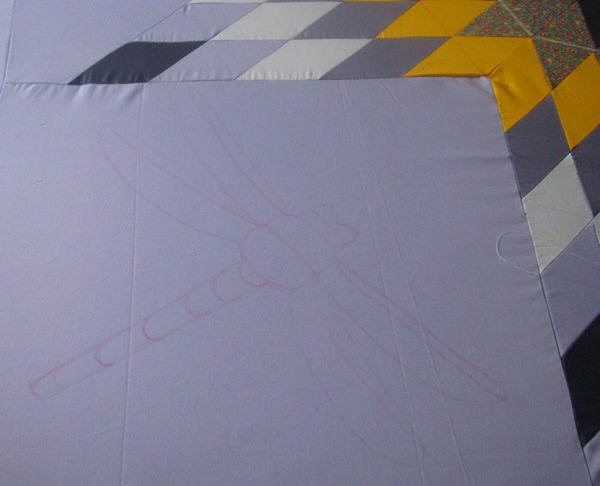
Outline for dragonfly to come.

One of the blank spaces toward the corners bore a tracing to be filled by the end of the day – a dragonfly, a symbol of mature, lasting change. According to Jessica Palmer’s Animal Wisdom, the Lakota believed the dragonfly could dodge hailstones, which was why dragonfly images were on their shields.

As she worked, I scanned the wall above her head, filled with family photos, including many of a young man in uniform.

“Is this your son?”

“Yes.” Then she volunteered the rest. That he served in Afghanistan, that he sustained wounds there, that he was in a military hospital with a spinal injury.              “We’re making this quilt for him,” she said.

The rest of the day we came and went, the colorful artistry taking form in the living room a sharp contrast to our own handiwork. During one idle moment, I tell our supervisor, Jerry, what I’d learned. But he, of course, knew more of her story – and the stories of so many others along the way.
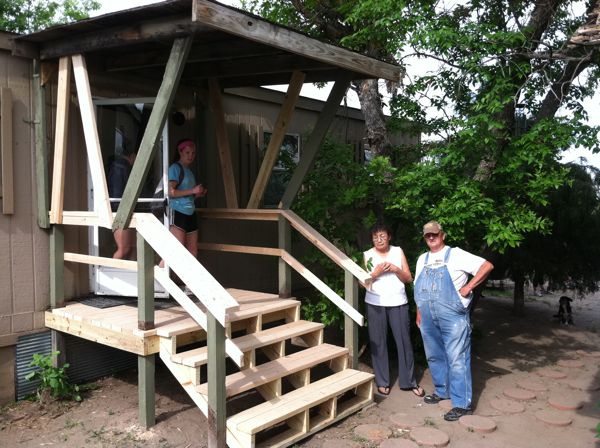
Quilter and carpenter.

Once, he told me, his crew called to tell a woman they were building her porch that day; she told him to come on, but that she would be away, as she had something to do away from home.

She arrived just as they were finishing, and burst into tears as she thanked the workers, telling them it was the kindest thing anyone had done for her.

The thing she had to do that day?

Burying her son.

“Things like that,” he said, “make you glad you can do anything at all to help.”

It’s never enough, of course. Not the porches. Not the steps. Not even, in all its hard-earned glory, the star quilt – itself a tradition the Lakota adopted only after the white man ended their access to buffalo hides, as well as the hunt itself. This is Pine Ridge, not Crooked Arrows. If I struggle with how to end this particular story – and I do – it’s because there are no tidy resolutions.

But it would also be unrealistic to end in despair. For woven into this account are the stories of well-meaning college volunteers who began their week even worse at carpentry than the film’s young people were at lacrosse. The steps – like the roofs, the outhouses, the holes for the outhouses – are their own kind of triumph. Yet the stories of volunteers on the outside seemed almost Disney-esque compared to the narrative unfolding within: The story of the mother who couldn’t give her son the mythical power to dodge the projectiles of war – but could fuse her love for her son and her art into a quilt that would outlast our porches by decades. The story of the Lakota women who keep on keeping on – creating a place in a world of seemingly limited possibilities for both charity and artistry.

Our host only took a break near the end of her day, when she came out to test her steps. Unlike the movies, there was no ceremony, no applause, no speech – she seemed like a woman who lets her needle do the talking. I didn’t even get to see the completion of the dragonfly.

But I saw Maude White Bull descend our handiwork with a smile, seemingly finding her footing in this world a little surer. And I saw her climb back – back to the morning star, back to the dragonfly, back to weaving the story that never quite ends.
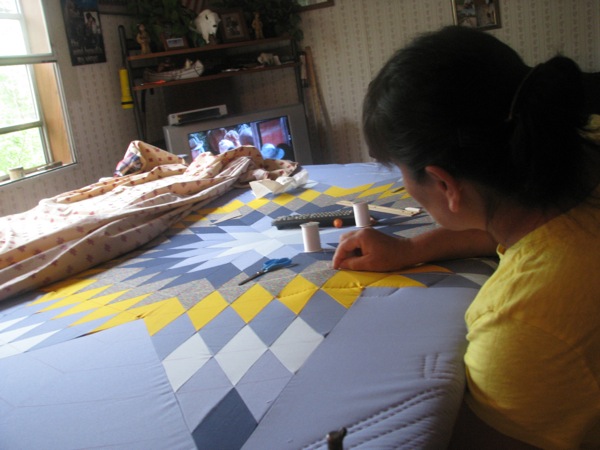
Morningstar, symbol of new possibilities.
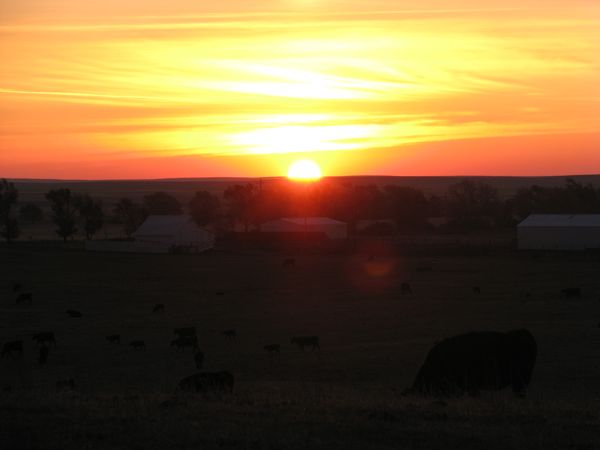
Awakenings

11 Jun

Sunday reservation sunrise seen from Re-Member.

When the pre-dawn light filters into the bunk room, I fumble my way into my clothes, through my stealthiest ever bathroom routine – only 20 feet and some thin curtains separate bathroom sinks from the bunks where the other volunteers still slumber – and out the door into a cacophony of bird song.

My watch says 5:10 in the morning – a good four hours before I’d be out the door back in Massachusetts. But the spectacle of sunrise on the reservation renders the rituals of coffee and yoga unnecessary.

Ted, the executive director of Re-Member, had told me last night that dawns here are joyfully noisy – and he turns out to be right. Along with the distinctive song of the western meadowlarks – those yellow-breasted musicians I will hear almost every hour of every day this week – a pack of coyotes howling and bark. Below the higher notes of the coyotes and birds comes the bass of the mooing cattle – while they never acquire a rhythm, there are at least a hundred head in the rolling pasture. It’s over them that the sun emerges – a naked ball of fiery orange that then covers itself in some flimsy strips of cloud.

I shuffle down the drive to the gravel road, along the fence separating me from the angus, thickly built even for cows. When I look the other way, a couple of Appaloosa horses come intently galloping over, along with a gray mare and another couple of friends. While they study me as a potential bearer of oats, one starts to slide behind the mare – only to get a quick pop from her rear right hoof.

Not this morning, dear.

Cows look down as I walk the gravel road.

It beats the hell out of the yard waste facility, which is my morning view back home – at least, until the spring foliage crowds it out. Don’t get me wrong: I love the dense woods that crowd my third story balcony, the limbs that have crept to within ten feet of the rail, the festival of songbirds that flit to and from my feeder every day back in New England. But I can’t help but marvel at how Pine Ridge Reservation is so wide open, both visually and sonically – lack of human structures and noise seems to amplify the revels of nature.

I chance a path that cuts diagonally from the gravel road to the bench near the hilltop, despite the dampness of the prairie grass and – as someone will point out later – the chance of encountering a rattlesnake. A Northern harrier hawk – my first ever sighting of one – pops out of the grass ahead, swooping low and elegantly as it scans for prey.

A couple of hours later, when Ted enters the common area to address the masses, I want to share my nature-inspired joy, but his earnest demeanor as he settles behind the podium holds me back. He is about the deliver the Wisdom of the Elders. Within five minutes, his talk shifts my mood from big country bliss to anger and sorrow at what has transpired here.

As I listen, my mood shifts in the same way it had last night.  Between last night and this morning, we absorb the following: the 370 broken treaties and the slaughter of Native Americans to the low life expectancy (he lists 47 for men, 54 for women) and the roughly 50 percent who don’t have electricity. Because Lakota hospitality dictates taking in family and friends regardless of resources, “there are no homeless,” he said. “But you might find 15-20 people in one house.” (Two days later, Jerry, one of our drivers will point out a modest blue house Re-Member had renovated for a family; it had the miracle of heat, so soon 24 people were sleeping there, four in the bathroom.)

This morning’s Wisdom of the Elders goes back in time to the 1800s, reciting the sad history of Wounded Knee Creek, where cavalry had rounded up Lakota men, women, and children – and slaughtered them. Sioux such as Big Foot – on his way to confer with Sitting Bull about escalating tensions – were intercepted by cavalry and led to Wounded Knee.

Ted, right, and friend look out from hilltop cemetery.

In Ted’s story, on the morning of December 29th, 1890, instead of food, the Lakota were given last rites; soon afterward, the shooting began, going on for two hours. (I will read different versions of how the shooting started.) Then, as Ted describes it, cavalry were sent on horseback for five miles in every direction, rounding up the women and children sent fleeing through the tree line; the women were raped and killed, the children shot in the head. A blizzard delayed burial for days; finally the frozen bodies were tossed into a mass grave; one estimate I read places the death toll at 146 Lakota and about 25 soldiers. Cavalry might have seen this as vengeance for the defeat at Little Big Horn – itself spurred by a white attack –the incident also came out of white attempts to prevent the Lakota from practicing ghost-dancing, a religious ritual that while restoring pride in their culture, posed a threat to the status quo white authorities wished to reinforce.

So it was that a nation founded on the principle of religious freedom was willing to kill others who practiced it.

Some would say it’s more complicated than that, but as Native American history indicates time and again, the most absolute principles suddenly become relativistic when they get in the way of greed. Worse, the injustice remains after the gold is gone. The Lakota wouldn’t regain the right to practice their rituals remained in place until the late 1970s.

I have come into Wisdom of the Elders knowing much of this, and how I feel about it, which is, of course, both angry and sympathetic.

That’s why I’m here.

Yet being here deepens the feelings – and will keep deepening them for days to come. The earnest request to “unplug” from cell phones and computers intensifies that experience – taking away the distractions we use to distance ourselves from unpleasant realities. Instead, as the bus takes us north to Wounded Knee, people either talk with each other or just stare at the countryside. Finally, we slide over onto a widened road shoulder and disembark.

We share the shoulder with the Lakota, with their dogs and their children, wares spread on the hoods of their cars and trucks. We wave as we walk across the highway and up the curved path to the cross-bedecked arch – the entrance to the mass grave at Wounded Knee. At the gate, a local whose name I never catch gives a talk about the fateful day – “they called it a battle, but it was a massacre” – before letting us into the cemetery.

In the middle, a long rectangular fence marks the mass grave itself, but as others circle inside, I stay outside, lingering at tombstones erected for Lakota who have passed in the years since Wounded Knee. I find the 1919 marker for Lost Bird – a girl who, as an infant, was found crying amid the bodies piled in the mass grave. She was rescued by a white soldier and raised in that world, only to commit suicide at the age of 29.

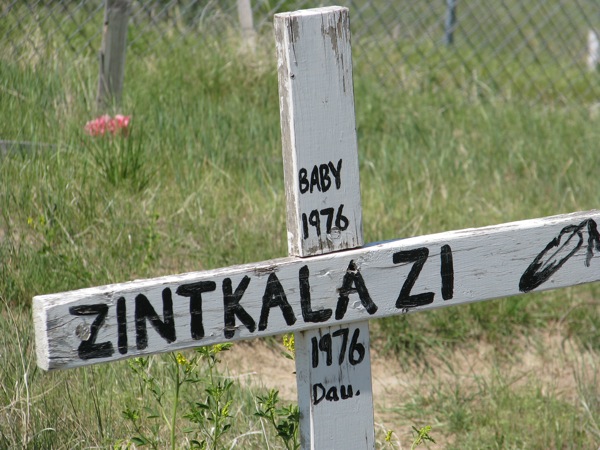
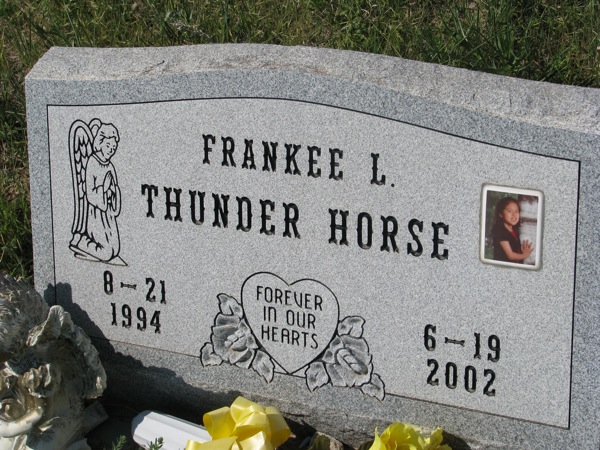
Normally I would revel more in the love of language, as well as a slight case of name-envy: There is something provocative about being named Spotted Bear, Respects Nothing, Little Moon, Her Many Horses – or Thunder Horse. But Frankee Thunder Horse died before the age of eight; a picture  is included in the polished, elegant tombstone. Meanwhile, Zitkala Zi, who died as an infant, was only afforded a crude white cross. I don’t know the story of either child, but their presence calls to mind those lowered life expectancies, especially the heightened rates of infant mortality and suicide by the young on the rez, numbers fed by the high rates of sexual abuse and alcoholism, the crowded living conditions which make protecting children harder. Not to mention the simple lack of hope, of a vision of better future.

Which is one reason that when we descend the hill, we spend way too much on dream catchers and medicine bags. (After what we’ve heard and seen, can white Americans really pay too much?) Our drivers let us mingle with the locals; we talk about how they craft their souvenirs, we banter with their children, we pet their dogs, wandering free as any good rez dog does. When I line up students for a photo in front of the Wounded Knee Massacre plaque, I suggest they not smile – but a few can’t help it.

From Wounded Knee we go to Porcupine, where we eat sandwiches in the back yard of a teacher’s apartment; she actually lives in Wisconsin, but has spent a year here teaching primary school. Her apartment includes a bird’s-eye view photo of students and staff standing in the Porcupine School Parking Lot, in the shape of an eagle. “It’s a different animal each year,” she tells me.

“Did they ever do a Porcupine?”

“I don’t know,” she says.

Lakota man sells his wares across from Wounded Knee.

We agree that a porcupine would be a particularly difficult animal to shape into clearly recognizable form. I suspect the same will prove true of summing up our experience this week. On one hand, Bill, a particularly funny and amiable member of the Re-Member staff, is earnest long enough to point out that the hand sanitizer we were using was actually drunk here for its alcohol content – possibly a symptom of the intersection of rampant alcoholism and poverty, as well as Pine Ridge, larger than Connecticut, prohibiting alcohol.

On the other hand, it’s a sunny and pleasant day; a few hundred feet away,  Lakota of various ages are enjoying a friendly batting practice on a nice softball diamond. Still father away, someone’s cranking up the Eagles, the same two songs over and over again – “Take It Easy” and “Already Gone.”

Soon we’re gone ourselves – to the Badlands. We turn off at the park visiting center, but don’t stop, just drive by butte after butte, crater after crater, until the bus lets us out into the heat of the day. We hike across a valley and scamper up a hill of cracked dry earth, from which a tableau of volcanic ash and diatomaceous earth sprawl away under a cloudless sky.

Justin seeks his meditative spot.

Then we work our way back down again, and hike even deeper into the hills, finally ascending a slight rise where David, one of our leaders, calls us to a stop. He explains that this is what they call the Cathedral, a bowl created by arid hills rising up in every direction. He explains that this is a time for us to spread out and settle down in our own separate spots, where we should meditate quietly, bearing in mind that this Cathedral, like others, amplifies every noise. “When you see me rise and go,” he says, “it will be time for you to. Just keep me in sight.”

I climb part way up a hill to my left, lie down amid dry earth and grass, prop one foot on a knob of earth that protrudes like a saddle horn. I meditate every day, even if I skipped this day, so I feel that I know how to do this. How to let go. How to be in the here and now.

But not this here. Not this now.

Sure, I take the prescribed long breaths, try shutting my eyes, listening for wind or scrapes or rustles. Over my eyes I slide down the bill of my cap – the one featuring the white whale who, in Melville’s novel, sunk the Pequod, a ship named after yet another doomed tribe. I reflect on the contrast of the reservation so far – the joyous splendor of dawn, the sobering history of the morning, the joy of the people we’ve met by the road shoulder who, like the hardy grasses that break up these barren badlands, keep on keeping on.

But no matter how long I lie, what I cannot do, at least for more than a few seconds, is keep my eyes closed.

Rapid City, Slow Ride

2 Jun

The trip down: One of many Badlands buttes.

We stand in the small baggage claim area of the Rapid City airport, awaiting the few bags that were checked. We’re not exactly the pioneers rolling westward in their Conestogas, but the night flight has taken its toll; it’s after midnight Eastern as we approach the rental van desk.

Having started the day negotiating enormous crowds and endless ticket counters at Boston’s Logan Airport, here in Rapid City I’m naturally expecting to stand in the rain outside on some concrete island, breathing in the fumes of a dozen vans before boarding out own, getting soaked until our flesh falls apart like so much soggy tissue paper.

Instead, the guy standing behind the counter – a young man with long blond hair and beard – simply says, “OK, follow me”, walks outside the door, and points to the van, sitting right at the curb.

Even more hospitably, the guy then asks me what kind of music we’d like to hear on the way to the hotel.

“Shock us,” I say, feeling adventurous.

“Really?” He looks until I nod.

And he does. What he pops in is, of all things, Paul Anka. Surprising enough in and of itself, but it’s not even Anka’s hits from the ‘60s and ‘70s, or a compilation of his commercial jingles. Instead, it’s the considerably older Anka – who decided the new millennium was crying for an album called Rock Swings, consisting of big band jazz covers of rock ‘n’ roll anthems.

Anka’s a pop genius, so I shouldn’t be surprised that Van Halen’s “Jump” sort of works as a big band arrangement, once you suppress the image of David Lee Roth jumping around in sequins. Then our driver ups the ante – the next selection he picks is Anka crooning Nirvana’s “Smells Like Teen Spirit” – which proves that grunge rock was indeed  the appropriate genre in which to perform the song. When Anka croons “on and on and on,” the existential alienation is for some reason lost in translation.

We’re swinging onto I-90 – the same interstate that, more than 1900 miles away, took us to the airport in Boston eight hours ago – when the driver asks why we’ve come to Rapid City.

“We’re going to Pine Ridge Reservation to do some volunteer work.”

“Got your passports?”

“Why?”

“You’ve going to another country.”

This warning of strangeness, from the man who just had me listen to Paul Anka cover Kurt Cobain. I don’t get to ask him why – maybe I don’t want to know – but the statistics I’ve read bear him out. According to one source, the average male on Pine Ridge Reservation dies at age 48, the typical woman at 52. The infant mortality rate is five times the national average, amputation rates due to diabetes is three to four times higher, death rate due to diabetes is three times. Unemployment is at 80 percent. The per capita income in Shannon County is $6,286.

Our van for the trip down.

Numbers aside, when it comes to our direct experience over this next week, will the rez really seem like another country?

After all, like a lot of people, my journey through adulthood has been one of encountering and overcoming alienation when encountering people different from myself – and feel it’s my moral obligation to do so. I like to think that by age 54 I’m pretty good at checking my assumptions at the door – and at believing that when you engage people without imposing preconceptions, you generally find far more commonalities than differences. (Although, for all I know, the people I encounter might secretly think I suck at it.)

Besides, the Oglala Lakota we’re bound to meet will be those friendly to Re-Member volunteers, individuals who either share the vision or at least see the upside of being friendly to us. But this last reassuring aspect introduces a contradiction in my ambitions for our week among the Lakota.

On one hand, I want come out affirming that the rez isn’t so different that one should think twice about volunteering there himself or herself: I want to say that we should all go there, repay them in some small way, no matter how inadequate, for the horrific violence and injustice we have heaped on them.

On the other hand, given the depth of poverty and the segregation of the rez, if it doesn’t feel like another country, did we just fail to look hard enough?

All I can say for now is that as the next day, as the Re-Member caravan takes us by van from our Rapid City hotel down into the reservation, there were no sentry gates or immigration booths – just a continuous gentle rolling series of mostly tree-less ridges from which it seems you can see forever. (I’ll learn later that in spots you can see thirty miles each way.)

There are signs of where we are, of course, from the humble and scattered homes to the names rooted in place – porcupines not only provide the quills for use in native crafts, but also the name of a town so tiny, you can’t even call it a crossroads: It pleases me to see that instead of calling its sports teams such stereotypical names as Braves or Warriors, Porcupine High’s sign declares:  “Home of the Quills!”

The only alien moment is when we roll through the Badlands – a national park within the ridge of near-arid, white volcanic ash ridges and buttes, spectacular in its starkness, as close as I’ll come to driving across the surface of the moon. Although I also get a start when I glimpse, across a field in the corner of a pasture, a seemingly life-size green statue of a brontosaurus.

Dinosaur lurking off the highway.

“I have no idea why that’s there,” said our driver, despite being a fount of information on any other geographical feature I’ve asked about.

Eventually we pass KILI, the reservation radio station we are listening to – but the music is familiar pop and rock songs, and the Lakota disc jockey actually feels familiar to me, the way radio should be – reflecting the voices of locals, not some national syndicated format. Unlike our Rapid City airport driver last night, today’s driver, David, is not from around here. A Michigan native who majors in sociology at Western Michigan when he’s not on staff out  here, is used to a wider diversity of choices on the dial. “Out here the radio is country, country, country … classic rock … and country,” he tells me.

“So you’ve learned to like country?”

“No.”

His only alternative to the radio is the CD player, which he tries for part of the journey south.

Thankfully, it’s the Red Hot Chili Peppers.

“Bloodsugarsexmagik?” I guess on the album title.

“No, a hits CD,” David said. “It’s been stuck in the player for four years now. No one can get it out.”

Oh well. It beats four years of Paul Anka covering “Black Hole Sun.”

Besides, isn’t the rez supposed to move to a slower rhythm? With a tone of stark alienation, the Peppers plaintively invoke the familiar chorus “with birds I share this lonely view”; a few miles later, I spy a buzzard riding a ridge, going nowhere fast.

Medicine bag protects van in the Badlands.

Walleyed perspectives

19 May

OK, so I know that in the last blog I had declared myself fully in the spirit of being sans keyboard during our mission trip to Pine Ridge Reservation in South Dakota. That this would aid greatly in my immersion in the immediacy of the experience, rather on the work site or in cross-cultural discussions.

But as of yet, we’re still at the Day’s Inn in Rapid City, waiting for the van to pick us up — so the only immersion that’s occurred was me in the motel hot tub, in cargo pants at that. (Improvisation is at the heart of every SEND trip.)

And the computer is sitting here in the lobby, with a sign saying Adults Only, and I figure I am one — and I’ve got time to kill while my cargo pants are in the hotel dryer.

Besides, I want to tell you about last night.

So I was sitting in Northern Lights, a little Minneapolis airport grille with a massive wood carving of howling wolves out front, when the lady to my left overheard me ordering the walleye sandwich.

She expressed her approval, and I explained that back east the fish sandwich options were centered more on halibut, cod and scrod.

She then volunteered that she had just been in Panama City, as her t-shirt indicated, and she’d had grouper for the first time, at a place called Captain Anderson’s.

Which, as coincidence would have it, was the first place where I had grouper. I remember this because of who I was with (fellow church camp counselors) and how much I liked the texture of the fish. (More than I would turn out to like my first walleye.)

Then I volunteered that, in my childhood, Panama City was the site of the first Land family beach vacation — and that  I had thought the Panama Canal was there. I was so sure of this, I didn’t ask my folks and thus received no clarification on this issue — I just craned my neck at every waterway we crossed,  wondering if this was what all the fuss was about.

Of course, this geopolitical naivete is excusable in an eight-year-old; maybe it was a victory that I’d even heard of it.

Adult naivete, however, is more vexing. Especially in myself.

My new friend and I continued to talk; it turned out she was from Sioux Falls, South Dakota, which was back in the 1970s some kind of sister city to Tuscaloosa, Alabama — resulting in kids from my high school going to Sioux Falls and vice versa.

While coincidence made conversation easier, my new acquaintance was clearly warm and hospitable and open, grateful and blessed that she and her sisters — all 80 or close to it — still had each other’s company. She was proud and appreciative that our college group was coming to do volunteer work in her home state.

But when I explained that we weren’t going to Mt. Rushmore, as far as I knew, she seemed puzzled. I explained that we here to work, but she still seemed to feel this a major oversight. (And I myself had asked at some point in the last few weeks if that was on the list.)

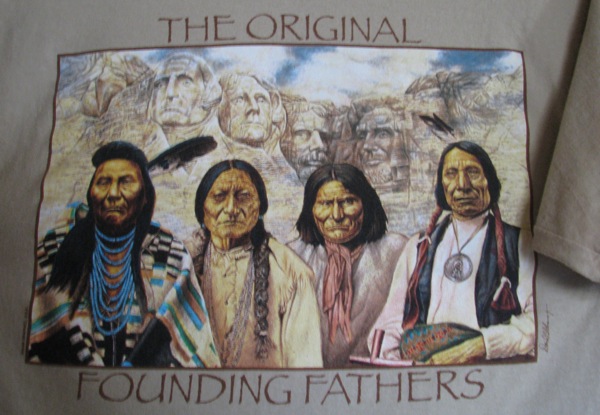
Listening to her annoyance on our behalf,  I came face to face with my own naivete. Mt. Rushmore is in the Black Hills, which the U.S. negotiated the Lakota away from in pushing them to settlements to the south in the less fertile badlands. After shoving them onto reservations in much more stern environments, white America then decided to take a side of a mountain and carve into it a bunch of white presidents.

No one from the res has said as much, but it seems logical enough. It would seem antithetical, in the least, to have a week of cultural immersion become a prequel to Mt. Rushmore. It would probably serve as a sure sign that we hadn’t, in the end, learned very much.

Of course, now that I’ve put this notion out there, watch Re-Member surprise us with a trip to Mt. Rushmore.

Oh well. At least I know better than to look for the Grand Canyon.

Let alone the Panama Canal.

Nary Food Nor Laptop

16 May

Lise Keeney with the burger
she couldn’t have.

One recent morning I arose to face my harshest judge: The scale. It confirmed that, thanks to  burger, fries and Skinny Cow English Toffee Crunch popsicles — the latter of which wouldn’t have been so bad had I not had SIX of them — I still weighed the same as the day before, and the day before that, and …

A half hour later, after settling down in my easy chair with a cup of coffee and a Smart Ones English biscuit breakfast sandwich – cost $2.99  – I called up Facebook and caught an update from Lise Keeney, a former Assumption Writing and Mass Communications star now working in New York City.

Lise was informing her followers that, for one week, she was taking on the Live Below the Line challenge. This innovative approach to raising awareness and funds to combat poverty lay in a simple behavior modification challenge – try to eat on $1.50 a day for an entire work week.

Why $1.50? As the website explains:

“The challenge is set at $1.50 a day, because this is the current equivalent of the accepted global figure used to define extreme poverty. This was set by the World Bank as US$1.25 per day in 2005. Basically, if you live on less than that every day, you’re recognized internationally as living in extreme poverty. …

” ‘It’s not that bad,’ you might say – ‘$1.50 goes a lot further in developing countries’. Unfortunately not. The $1.50 figure represents the amount someone living in extreme poverty in the U.S. would have to live on.

“And for people who live in extreme poverty that $1.50 has to cover far more than food and drink – we’re talking everything – health, housing, transport, food, education… It’s impossible to imagine, but that’s the reality for an incredible number of people.

“Gandhi said that ‘Poverty is the worst form of violence’ – and we agree.”

As do I.

Of course, despite the gravity of the issue, Lise’s challenge was not without its humorous side. As she wrote me midway through her semi-fast, “I am absolutely. starving. I also can’t think or look at beans without feeling physically ill … It’s amazing to see how much thinking you do about food when you can’t have it/are limited to what you can eat. Walking past pizza places and smelling the melty cheese is so tough!”

Following Lise’s quest – and even though her fast is over, you can still go to her page at Live Below the Line and donate in her name – I naturally asked myself: “What can I give up that would be equivalent to food for Lise?”

So, OK, the honest answer is: “FOOD!”

Second, however, might just be my laptop computer. (Setting aside, of course, loved ones of the more human variety.) I don’t mean this because of Facebook, or Twitter, or the fact my fantasy baseball team is in first place for the first time since Reagan was president. I mean this because I am a compulsive note-taker and journal writer: Even the slowest of days offers some anecdote, earnest or humorous, that  I witnessed or learned of through others.

And when I’m traveling, well, forget it.

Tonight I mean that literally. For I just confirmed that in addition to other things I’ll sacrifice on my upcoming SEND trip to Pine Ridge Reservation in South Dakota, I will not be allowed to bring my computer.

No blog entries in the heat of inspiration (there won’t be an internet connection anyway). No typed diary entries that become cooler and calmer versions blogs of the future. Nothing but notebooks in which I, the worst hand-writer in America, will slowly scribble a few legible words, hoping I remember the entire story in all its richness of detail upon my return to the New England balcony where I write these words.

I recognize that this is a trivial complaint in the grand scheme of things. We will be working next week on a reservation of disenfranchised Lakota, struggling with per capita incomes of approximately $4,000, unemployment rates of 80 to 90 percent, and a life expectancy rate that’s the lowest in the U.S., and the second lowest in the Western Hemisphere. Small wonder, then, that there’s also an 80 percent rate of alcoholism and a teen suicide rate that’s four times the national average. Admittedly, I’m paraphrasing from the binder I received from Re-Member, the organization that will be hosting us, but I’ve heard similar numbers in mainstream media reports. At least from my cultural perspective — and I think most people’s — it’s a bleak reality, a world unto itself within our own borders.

Being a born writer, my first instinct in the face of something so compelling and so important is, of course, to write about it. One could even argue that, given my relative ineptitude at more physical skills, writing is my way to serve. But of course writing is one more way of distancing oneself from the immediacy of experience – as, of course, are cell phones, which Re-Member also forbids. One leaps to process into words an experience you haven’t yet fully engaged or absorbed, let alone truly understood. I’m wondering if, a week from now, students will come to see this as the most important thing they learned.

My only journalistic security blanket is that I have finagled my way into being the group’s designated photographer.

Of course, the lens can be almost as distancing as the laptop.

Oh well. With any luck, the memory card will fill the first day.

You can see now that I’m starting to sell myself on this computer-less proposition. Thanks in part to the inspiration of a student past. Hey, if Lise Keeney can live on $1.50 a day …

See y’all on the other side.

Storm and Redemption

1 May

Yesterday afternoon, I was celebrating the end of another semester of classes with colleagues in the Physics Lab, which offers the ideal combination of a full fridge for the beer and long counters for the chips. We were having a grand time sharing a wide range of topics – most interestingly the century-old tradition of tying cameras to homing pigeons and having the fowl take shots from the, well, bird’s eye view – when a friend said something even more surprising.

“So April 27th was the anniversary of the tornado,” she said.

“How did you know?” I asked.

“It was all over the Weather Channel Friday.”

Of course it would be. Even as I watched all the confused footage that night a little more than a year ago, it hit me that my hometown, in a matter of an hour, had surreally become the latest American town to be defined by a natural disaster. I’ve devoted numerous entries here to volunteer efforts to help Tuscaloosa, Alabama recover from a tornado that killed, at last count, 53 people. The path of devastation will scar both landscapes and lives for years to come.

I spent much of this April 27th scanning The Tuscaloosa News, which had just won a Pulitzer for its tornado coverage, reading quality general summary and first-person accounts, along with a myth-busting column in which they’d refuted a wide range of rumors, including that of either a dog or baby (it varies from story to story) dropping out of the tornado, alive and healthy, in a city an hour away.

I also checked the various references on Facebook pages.

Amid all these posts, I found not only sorrow, but redemption. Consider two posts by my sister, Mary Leach.

The day before the anniversary: “A year ago today I was driving by sights that I have known all my life, not knowing that I would never see them again.”

Or on Sunday, two days after the anniversary.

“This time last year we went to church. We walked past National Guardsmen with machine guns, we sat in the dark with no AC. We sat with church members who had lost everything, nothing, and all points in between. We cried, we prayed, we grieved, but we were there. It remains the most powerful worship service I was ever a part of, before or since.”

Out of such mutual vulnerability and mutual faith, ordinary human beings can band together to accomplish extraordinary things. Not that it’s easy. Six weeks after the tornado, in my first visit after the tornado, I sat in my old church’s makeshift sanctuary, listening to a preacher warn us about the spiritual challenges ahead. He compared the spiritual high of the Pentecost to that of the early weeks of selfless volunteerism, the ways in which people came together in the wake of the storm … and the long hard slog that is faith after the ecstasy. “And so here we are, brothers and sisters, we are witnesses, martyrs, and the euphoria’s quickly draining, and the short-term workers are going home … and soon, it will seem as if Christ is no longer here as well.” He paused then, added an unscripted remark. “And it is going to be hot!

And it was hot, almost hot enough to make me pass out as I made my own clumsy efforts doing debris removal – a process that, while necessary, made once lush landscapes just that much emptier. But next time down, six months later with a SEND mission group from Assumption College, new homes were springing up. Including, of course, the one our students worked on. I double-checked this weekend with our Habitat supervisor down in Tuscaloosa, and Dewayne Searcy told me that the Tuscaloosa Habitat is starting its 17th house since the storm – a staggering achievement.

I could end this by wondering why it takes a natural disaster for everyone – me included – to achieve such levels of energized compassion, or speculate on what we all we could achieve by applying such intensity to a broader agenda of service. But, if it’s not already too late, I’d rather resist the aesthetic need for a tidy ending.

Instead, I’ll end on one last testimonial by Mary, the one she posted on the anniversary itself.

“ ‘It was the best of times. It was the worst of times.’”-Charles Dickens

“It was beyond dreadful, but it was also beyond wonderful. There was a spirit in the air during those days and weeks that is impossible to describe. For just a moment there was no black or white, rich or poor, Christian or otherwise. There was help and be helped, love and be loved. I saw God everywhere I looked, dressed in skin. As awful as it was, I wouldn’t have missed it for the world.”

Sudhir, Po & the Power of Juxtaposition

14 Apr

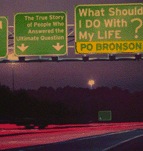
As I pore through the Po Bronson book I’ve assigned my service-learning students, I wonder how my students will connect to the people being profiled – if only because I have a hard time connecting myself.

Some of Bronson’s profile subjects have lived careers out of some other universe, breathing air so rarified, I’d suffocate in seconds. One, Choejor Dondup, gets a letter from the Dalai Lama, telling him his real name is Za Rinpoche – which translates to “The Dharma King.” Another, a Harvard MBA and Boston investment banker by the name of Don Linn, turns his business acumen to running his in-laws’ fish farm in Mississippi. A Duke graduate by the name of Carl Kurlander hit it big when, at age 24, he wrote the screenplay for St. Elmo’s Fire and became wired into the Hollywood writing scene – his big dilemma is moving back to Pittsburgh to take a teaching job, which he heroically does.

Indeed, the collective achievements of the folks in What Should I Do With My Life? are almost as daunting as the question itself. They certainly make me want to reboot my own life from time to time.

Po Bronson

But I don’t have the luxury of dwelling on such things, if only because, even as I’m teaching Bronson for one community service course, I’m reading Sudhir Alladi Venkatesh for another. Off The Books carries the subtitle The Underground Economy of the Urban Poor, and what you get is exactly that – a close reporting of the complex exchanges and relationships that lends some order to the underground economy involving everyone from prostitutes and drug dealers to back alley mechanics and pastors. Many are hustling from day to day for simple survival, in a state of mutual vulnerability and mutual threat; they’re less worried about what they should do with their lives than where they can sleep tonight without being raped or robbed. Unlike Bronson with his reflective profiles, Venkatesh’s text is more dispassionate, preoccupied with reporting and analyzing the complexity of economic relationships over decades of urban history.  But there is enough flesh and blood, fear and anger, coming through the prose to feel a little less sympathy for Bronson’s heroes as the size up their choices.

At least, after all, they have some.

Reading these two books side by side, week after week, is simultaneously clarifying and unsettling. Even though Bronson interviews nary a millionaire – in fact, many folks are, at best, lower middle class – the contrast between the lives Americans lead in these two books is shocking.

What to take away from such juxtapositions?

The easy response is that the people in Bronson’s book seem naïve and self-centered by comparison, oblivious to their relatively blessed place in the greater scheme of things. Of course, Bronson sees that objection coming from a mile away. “Of all the psychological stumbling blocks that keep people from finding themselves, the most common problem is that people feel guilty for simply taking the question seriously,” Bronson writes in the chapter “The Umbrella of Freedom: Anyone Can Find This Important.”

As Bronson goes on to note,  “So many people I interviewed around the country felt guilty for obsessing about what kind of work they should do. It felt self-indulgent. They would say things like, ‘Poor people, they don’t get to choose. And they’re still happy. New immigrants, they’re ecstatic to have any job at all. You don’t see any of them stressing about who they are. They want to do well.’”

Bronson, of course, disagrees. Not only does he find it “terribly perverse” in this logic: Why should we live like poor people when poor people don’t want to live like poor people? But Bronson notes that even immigrants know life is about a lot more than money: “They routinely fight challenges to identity and self-esteem in the course of trying to work their way to better jobs. Not to mention the challenges of raising children and building a community.” Bronson includes his share of people who came from modest beginnings or have fairly pedestrian jobs – as well as those whose tough life choices included a commitment to serving others.

Sudhir Alladi Venkatesh.
(Photo by Melanie Dunlea/Creative Photographers.)

Meanwhile, it’s clear in Venkatesh’s pages that even as people participate out of necessity in the underground economy, they are often fueled by ideals of making the community better and taking care of the individuals in it, whether the cared for are church ladies or gang members. He describes three women (Marlene, Eunice and Bird) who came together to fight for their neighborhood despite considerable differences – one is a fervent churchgoer, another a prostitute. They have put themselves out front in not only trying to clean up the litter each week, but also in negotiating with gangs over dealers over when and how to use the park. They are clearly insisting on making a meaningful impact on the world around them, even as the forces arrayed against them invite them every day to give in.

Obviously, I am leaning here toward collapsing the distinctions between the worlds of Bronson and Venkatesh. But that, too, would be foolish. The books reflect very different realities, as vivid in contrast as the city I drive through twice a day as I head from my suburban campus through poverty-stricken areas and back out again to my condominium facing the woods.

There is no tidy resolution to this juxtaposition, no one-lesson-works-for-all ending. Bronson himself disdains such endings – he warns there’s no “one-size-fits-all” answer to What Should I Do With My Life?  We’re on shaky ground any time we reduce an individual’s complex experience to a single lesson; I impose no moral on the story of anyone in either book.

But from Bronson I do take one “extractable lesson” about life: Think bigger. From Venkatesh? In thinking bigger, include thinking of others, moving in a world I drive through every day, yet blithely ignore.

When Bronson was asked whether his book is “about life, or about careers,” Bronson would answer simply: “It’s about people who’ve dared to be honest with themselves.”

Even though the two authors don’t know it, Bronson and Venkatesh figure to keep working together to keep me on my toes.

Simple Eloquence and Eboo Patel

5 Apr

Eboo Patel, as photographed by Nubar Alexanian

Ever the English professor, as I sat Monday listening to Eboo Patel speak at Assumption College, I found myself drifting from what he was saying – about how to reduce the hate and violence in the world through training the young in religious pluralism – to how very well the man was saying it.

The founder and executive director of the Chicago-based Interfaith Youth Core, Patel makes 50 appearances a year to raise awareness, so it figures he would be good at it.

But this good? Without once glancing down at a script – if, indeed, there was one – Patel shared his stories and insights in perfectly formed and jargon-free sentences, an eloquence as plain as bread. The structure was just as elegant: He masterfully wove historical incidents and studies with his personal journey, one that took him through plenty of anger and doubt before arriving at a stronger sense of his own Islamic faith – and the way he wished to serve.

It was all so much better than the paragraph I just wrote. The one time when, in response to a question, Patel did stumble into a clunky phrase, he stopped and smiled.

“I have to find a way to say that that’s more rhythmic,” he said, drawing laughter, the loudest of which one was probably mine.

Of course, with no deeper intellectual or spiritual substance, all those perfectly articulated sentences and anecdotes fall apart like wet tissue paper. But Patel delivers more than his share, whether in person or in book form, which you can experience by picking up a copy of  Acts of Faith: The Story of an American Muslim, the Struggle for the Soul of a Generation.

Don’t get me wrong. Patel isn’t striving for some fanciful literary high-wire act. There is no dazzlingly poetic prose replete with lyricism and stream of consciousness. Thankfully, there also aren’t passages of academic density: Patel, who has a doctorate, nevertheless sidesteps the kind of academic discourse that, through its very abstraction, threatens to reach no one who hasn’t been to graduate school.

As he plainly puts it in the introduction: “This is a book about how some young people become champions of religious pluralism while others become foot soldiers of religious totalitarianism. Its thesis is simple: influences matter, programs count, mentors make a difference, institutions leave their mark.”

Message at Elgin, Illinois interfaith event
packaging food for the hungry of Haiti.

Readers drawn to hearts-in-their-throats fare – say, a novelistic protagonist suffering abject victimhood, striving to survive against a brutal backdrop of genocide and starvation – will find Patel’s raising in suburban Chicago slightly less gripping. But in a way that’s Patel’s point: Young people right here in the United States suffer discrimination based on religion, as well as race, gender and class. The vast alienation they experience many of them prime targets for totalitarians, some Bible-based white supremacists, some Koran-based Islamic extremists. And, of course, other stripes of demagogues as well, each willfully ignoring the traditions of love, acceptance and service of their own religions –focusing instead on the aspects that promote anger and judgment, hate and suspicion.

Patel’s personal story includes all of the above: In the book, he battles not only the hatred of others, but his own anger and fear. He shares wrestlings with times he could’ve acted and didn’t – and the even thornier question of, once you decide to act, figuring out how.

He finds his own answer in grasping the wisdom of his own faith, even as he strives to engage in conversation with all. In one sign of an honest story teller, Patel freely acknowledges that he’s privileging the positive stories of pluralism over more negative narratives that suggest we still have a very long way to go. By emphasizing the positive stories of progress, the “conversation continues.”

One prime example came when a student Monday asked Patel a question about service that occurs without a clear religious context.

“First,” he said, “whatever leads you to serve is terrific! … But what I would encourage is to reflect on how what you’re doing today connects to what has gone on before you.

“If you are working on a house for Habitat for Humanity, how might what you are feeling in your heart be like what was in the heart of a certain carpenter 2000 years ago.”

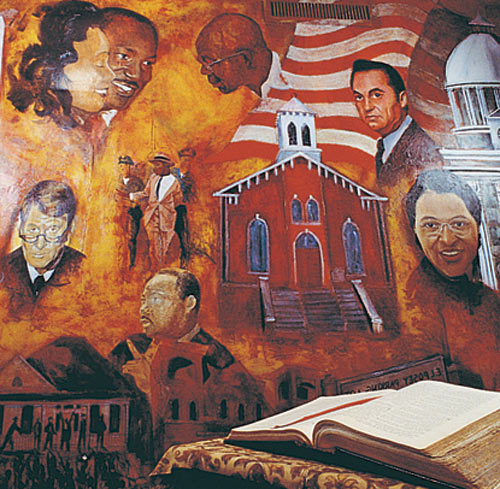
Mural in Dexter Avenue King Memorial basement, painted by deacon John W. Feagin in 1980.

So simply eloquent, this appeal to focus on the love at the heart of our faiths and our service, to the spirit that runs beneath language itself, even if it needs language to clarify and amplify. Listening, my own mind leaped back, if not 2000 years, at least 20 – to Montgomery, Alabama and the basement of Dexter Avenue-King Baptist Church. Sitting next to the wall mural that commemorated the heroes of the Civil Rights Movement, in the same room where Rev. Martin Luther King and other brave souls planned the Montgomery Bus Boycott, a group of friends sought the advice of Rev. Murray Branch, who had taught Rev. King in seminary and now occupied his old pulpit. More relevant for us, Rev. Branch served on the board of Habitat for Humanity International. We were striving to start the first affiliate in Montgomery.

Rev. Branch, speaking with the same gentle and positive manner to which Patel aspires, made his biggest contribution to my own growth as a volunteer that night. The issue was not how to construct a house, but how to construct a sentence. “It’s important to remember that we’re not building houses for people; we’re building houses with people,” Rev. Branch said, in that soft voice that ironically gave him so much gravitas. “It’s doing with, not doing for.”

A simple difference in prepositions, but it says so much about the spiritual place from which service should spring. Even as Patel himself acknowledges, the other way of telling the story has validity – we are in a sense doing something for someone – but Rev. Branch’s version spoke to a more spiritually enlightened and less pretentious way to serve. We shouldn’t be condescendingly reaching down to help the little person, but extending a hand on level ground. Some might call that a fiction, but there are times when it’s a necessary one.

When, on my best days, I manage to act in that spirit, it’s because of that simple lesson in the implications of prepositions – given to us by anunassuming mentor of one of the 20th century’s great orators. “Doing with, not for” might not be “I have a dream,” but the phrases share the power of clarifying simplicity.

As it happened, Patel’s talk went on to touch on Rev. King and  Dexter Avenue Baptist. So during the book signing, I was moved to share with Patel my memory of Rev. Branch. “It’s so hard,” I told him, “to focus not only on what we say, but how we say it.”

Patel leaned back from the book he was signing and laughed.

“There are a million things I wish I could take back.”

Dexter Avenue King Memorial Baptist

The Experiment’s On Me

24 Mar

Tuesday as I drove to campus, I could feel my muscles tensing; my body and mind were getting ready to explode out of the blocks into a track meet of a week.

To make the metaphor more specific, try high hurdles. More hurdles, in fact, than I could count.

There was a proposal to write … followed by the Thursday meeting in which I would pitch the proposal … followed by hosting a Thursday colloquium in which our community service learning students shared their experiences before an audience of students, faculty, and administrators.

Not to mention a school newspaper meeting followed by a dormitory writing group. Or teaching a class on the HBO series The Wire, followed by sitting through a night showing of this week’s episode.

Then, oh yeah, what some would rather narrowly define as my “actual job” – the teaching, grading, and advising of students.

And, like a more hellish version of one of those special TV offers, “that’s not all!” With the above, I also get three probably hour-long discussions with colleagues from other disciplines, all regarding Community Service Learning, the program that I direct at Assumption College.

Walking to my office Tuesday – watching enviously as students lolled in the first warm weather of spring – I told myself that a wiser man, more steeped in the ways of time management, would know when to say no.

Or at least postpone. Focus on doing fewer things better. In a week like this, weren’t these three chats – with an ethicist, a graphic artist, and a psychologist – ill-timed luxuries that this English professor couldn’t afford?

This question lingered an hour later, during Ill-Timed Conversation No. 1, which involved my teaching partner, sociologist Rich Gendron, and Philosophy professor Josh Shmikler. The subject was Josh’s guest appearance in Literature of Social Responsibility, a dual Sociology/English course in which students experience both traditional texts and community service through the dual lenses of  sociology and literature. This year Rich and I chose to build the course around the Home Box Office series The Wire; when Josh heard about the course last fall, he’d written to express his interest, and we’d invited him to come speak about ethical dimensions of the series.

An idea, of course, that I loved – if only this particular discussion of ethical dimensions wasn’t taking place an hour before class – a complicated session about the violent and disturbing second section of Richard Wright’s Native Son. Still, the deeper we delved into the dimensions of Josh’s ideas on The Wire, the more I quit looking at my watch. It didn’t even matter that our conclusion – that Josh should move his lecture back from this week until next month – gave me one more class to teach this week. I plunged into our 75-minute class feeding off the fresh energy of our philosophical colleague. I infused my lesson with that fire: It felt like one of my best lessons of the year.

I had little time to rest on my laurels – I forced myself through an hour of grading until it was time for Ill-Timed Conversation No.  2. This commenced when Graphic Design professor, Patty Harris, walked in to discuss the possibilities of putting one of her courses to work for non-profits, many of whom need upgrades to their websites. For the second time that day, I felt the profound pleasure of watching the wheels turn in the mind of a colleague from another discipline. Imaginative and innovative, Patty kept questioning and brainstorming until my original idea – little more than a hunch – became her own conception, so much more comprehensive than anything I had in mind.

Now it was well after 5 p.m. Tuesday, and I am seldom productive past 8 at night. But I surprised myself. I worked on and off until midnight, writing the proposal and grading, planning and networking. The same wave of energy swept me through Wednesday’s and Thursday’s classes, grading and advising – as well as my Provost meeting and our CSL student colloquium, in which students shared their CSL experiences (an entire blog unto itself).

When Friday finally rolled around, I didn’t have much left in the tank for Ill-Timed Conversation No. 3, with another prospective CSL professor, Sarah Cavanagh. Still, I perked up as she explained her work in “positive psychology” – which includes a blog in Martha Stewart’s web universe – and how that could lead to a course in which psychology students worked at after-school programs.

I made the natural assumption that her students, like my own charges in both sociology and journalism, would be practicing their skills on observing the clientele and staff at the agencies.

Then, finally, I got what she was really talking about – the students would be reporting on the effects of volunteering … on themselves! “The students would be the subjects,” she said, smiling.

Of course! It should’ve been obvious – charities generally strive to remind us that service is a two-way ministry – but for the third time this week, a colleague in another discipline had given me that eureka moment of seeing a familiar concept in a startling new light. I walked away with a deep satisfaction, and more intellectual energy to carry into my last two classes of the week.

But the biggest insight didn’t come until Saturday morning – after my first good night’s sleep of the week. That’s when I realized the students weren’t the only subjects of experiments in positive psychology.

It turned out I, too, was a subject.

Every one of those supposedly ill-timed conversations turned out to be just what I needed – an extra dose of enthusiasm, passion, and imagination, all serving to lift my performance to a higher level.

Which probably explains why Friday, instead of taking a break, I emailed my friend who teaches Environmental Science.

Wouldn’t he like to chat about his discipline and service learning?

The experiment continues.

Conscious Evolution

17 Mar

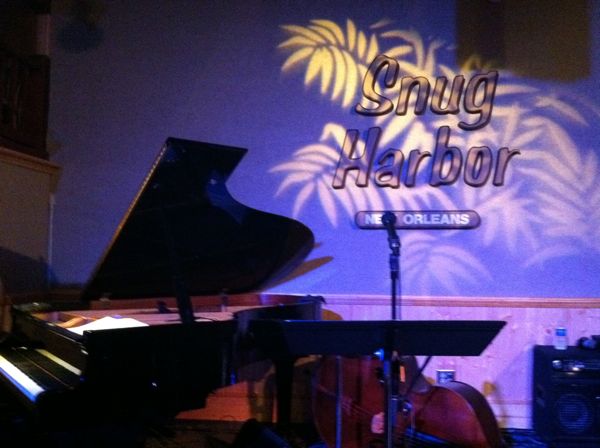
I settled into my stage-side seat at Snug Harbor, ordered an Abita Amber  and admired the palm-tree outline projected onto the wall .

I let out a sigh of satisfaction.

I was feeling a bit proud of myself. On my first full day of this visit to New Orleans, I’d moderated a panel on medieval literature at the annual convention of Sigma Tau Delta, the national English honorary for undergraduates. What makes this less impressive to my readers – but more impressive to me – was that I did it without knowing a whole lot about medieval literature.

But I knew enough to know a good paper when I heard one, and just such a paper had been delivered by Stephanie Giguere, one of three Assumption College students I was escorting. The escorting a few hours later was of a less intellectual variety – I walked Stephanie, Erin Sullivan and Caitlin Schneider to Mother’s for a taste of New Orleans cuisine, then led them back up St. Charles, beneath railings and trees still sporting its share of beads, relics of Mardi Gras just ended. Once the students, mature seniors all, were oriented, I did what any wise faculty escort does – I got out of their way.

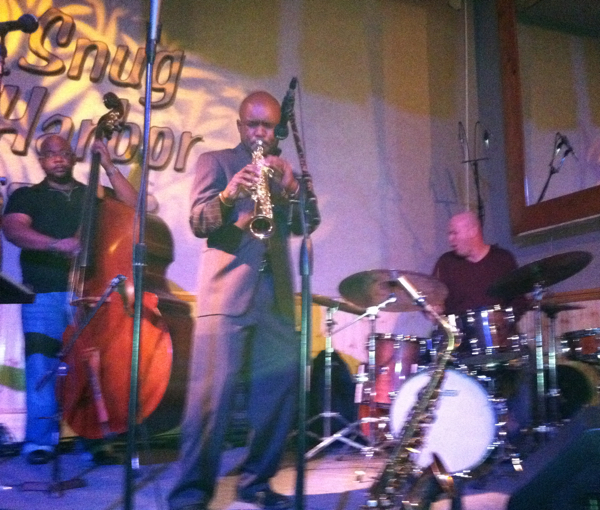
Now, after a brisk walk of a mile or so, I’ve docked at Snug Harbor, a quiet and intimate jazz club recommended by a friend. Never has a music venue been named more perfectly: The place is “snug” to the point of intimate, with perhaps 50 chairs positioned loosely around small tables, so that one can turn around to talk with fellow listeners. The downstairs space in which I sit is smaller than the main room of Nu Café, a coffee shop I frequent back in Worcester – and that includes the stage. There’s a balcony, but it consists of a single row of chairs rimming a railing.

As for the “harbor,” this feels like the musical port in the storm I’ve been craving  – a place where I could gather with others who want to quietly appreciate some exploratory jazz, away from the stupid faux hedonism of Bourbon Street. Here I also might meet some folks who are actually from New Orleans. I turned to my left and got acquainted with an older couple who had come all the way from Canada’s Northwest Territories. I started to say how, in eighth grade, I’d done a presentation on the Northwest Territories, and had a great fondness for their people, their major exports and their natural resources – but suffice it to say I’d been on surer ground explaining Stephanie’s paper.

In contrast, a dark-haired younger woman behind them turned out to be New Orleans tried and true – and, even better, she knew Khari Lee and the rest of the band. She teaches with them at the New Orleans Center for the Creative Arts, where she instructs younger kids from diverse backgrounds, “getting them ready for Khari.”  Given what some have told me about the struggles of New Orleans, it’s good to hear NOCCA is thriving – some kids even move to the city to be part of the program. My new acquaintance reminds me of the service done every day by those who teach arts – or any subject, really – in primary and secondary schools, most of whom, despite considerable obstacles, manage to keep their passion for both subject and service alive.

One way they keep it alive, of course, is to make time for their artistic growth. This concert, I learned, celebrated the release of Conscious Evolution, a collection of original works by Lee and his band mates in what they’ve chosen to call the New Creative Collective. “These are great musicians,” she said. “And they’re nice guys, which isn’t always the case.”

Soon enough the musicians arrived: Michael Pellera on piano, David Pulphus on bass, Geoff Clapp on drums and percussion, Ed Anderson on trumpet. For the first composition or two, during moments of personal amazement, I occasionally checked the responses of my new acquaintances – one staring intently, one smiling broadly, one listening with eyes closed. But soon their faces dropped away, leaving only the musicians and, when I closed my own eyes, their music. I slouch my way through too many events in life, but these guys have me bending forward, elbows on knees, fascinated.

Earlier in the day, Stephanie’s paper had posed the question of whether, in The Canterbury Tales, language itself can move someone not closer, but farther from an experience of the sacred. But the instrumental compositions of Conscious Evolution circumvented that problem. These prayerful moments – when words themselves drop away and there is only the searching and merging of musicians, rising together to the challenge of a passage – are why I love listening to jazz. No distracting – and usually disappointing – lyrics; no rigid formulaic patterns or musical clichés.

By definition, I can’t put what I felt that night into words – the only reference point was the last concert in which I felt that way, the sudden flashback to a moment five years ago at Mechanics Hall, when Dave Brubeck, and musicians he’d played with for decades, took me to a similarly ecstatic moment.

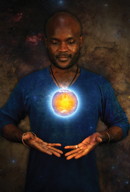
Lee in album cover by Angela Ortiz

When Khari Lee  did speak, he did so with a mixture of humor and joy.

“I think of conscious evolution as a way we can move into the world in which we want to live, the place we imagine living – a world in which everyone has what they need.” Then he laughs. “You know, every house has a garden, and the kids are all playing outside … and no neighborhoods are sketchy …”

While this dare to imagine is genuine, he delivered his vision with a knowing smile; the audience, which included a good many friends, laughed along with him. This is post-Katrina New Orleans, and folks here know evolutions are hard-earned. But the music had opened me to the spirit of the dream. While less tangible than a house or a soup kitchen, this music (like all art) is its own kind of service – providing moments of transcendent ecstasy. Like all manifestations of spiritual evolution, these moments re-energize us to go back into the world and keep trying to make a difference.

Of course, music teachers like Lee are helping the next generation of New Orleans natives experience the same.

At show’s end, before pressing his hands together at his chest and bowing as if to say Namaste, Lee expressed a similar sentiment: “I want to thank everyone. What you think, matters. What you do, matters. All the good stuff that’s happening, it takes more than one person to make it happen – whether you’re building a house … or doing a dance.”

For more on the music of Khari Allen Lee and the New Creative Collective, check out khariallenlee.com.