Archive | Uncategorized RSS feed for this section

What A Difference A Week Makes

25 Sep

Assumption’s Brittany Wilson, Paul Belsito and Marisa Reis (foreground)
with Tuscaloosa First Presbyterian pastor Charlie Durham and tornado survivor Dana Dowling.

When Katerina Reilly remembers the tomato fields of Immokalee, FL, one of her most vivid memories isn’t about what she did for others in her one week – but what the tomato pickers did month after month.

“It felt really important to see them running to busses in the morning hoping to get work, and to see them at the end covered with gunk,” said Reilly, speaking to a packed auditorium at Assumption College on Wednesday night, Sept. 19. “Each bucket they fill holds 50 pounds of tomatoes, so you can imagine how heavy that is.”

The Assumption student is no stranger to manual labor.

“I feel it’s really important to do something with my hands. Audrey Hepburn said one hand is for yourself and the other is to help others.”

Reilly’s audience was made up of people determined to do the same. She and many other community service veterans were there to share stories about their experiences in Students Exploring New Destinations (SEND). The program, started in 2006, gives Assumption students the opportunity to put in weeks of service in such far-flung places as Ecuador and Baltimore, South Dakota and Florida. Multiple trips are offered in the Northeast, but even those trips get students out of New England: Past places include the poverty-stricken New Jersey cities of Trenton and Camden, as well as the Bronx. (And, of course, more.)

Run by Campus Ministry’s Vinnie Sullivan-Jacques, SEND takes applications each fall and then conducts interviews. The application deadline this year is Oct. 5. Last year 125 students applied for 105 slots. Students raise some money for their trip, but Campus Ministry covers the rest.

Sullivan-Jacques, who himself found a similar trip important when he was an undergraduate, listed three reasons to do SEND.

“One is to put your faith in action,” he said, while stressing that “it doesn’t matter where you are in your faith.” One can still participate and have a meaningful experience serving others.

Sullivan-Jacques also cited the chance to form bonds with new people and to explore places different from what you’re used to.

Yethulsa Fingfing would heartily agree with the latter.

“A lot of people want to go outside the United States to experience another culture and another spiritual world, but they don’t realize you can do that right in your own backyard,” said Fingfing, reflecting on her profound experience last May at Pine Ridge Reservation in South Dakota. “What I learned there was so different from what I learned in third grade about Pilgrims and Indians.”

Yethulsa (left) and fellow Assumption student Justin
learning Lakota words for various body parts.

Having been fortunate enough to accompany Fingfing on that trip, I recall in particular her relentless questions at night discussions and her open disgust at the hypocrisy of our nation’s mistreatment of Native Americans. Yet Wednesday night she was quick to acknowledge the positive energy that radiates despite the sadness and frustration, the inspiration of residents and volunteers.

Turning to her co-presenter, Alyssa Lombardi, Fingfing laughed. “I didn’t even know you last year, and now you’re my homey!”

Katarina found the lighthearted side of that bonding in the Florida trip, apparent even on the trip down. “We were a nutty group and we couldn’t stop laughing,” Katarina said.

Meanwhile, Colleen Putzel found a remarkable friendliness in Ecuador.

“People will tell you their life story and they’ll start crying,” said Putzel, speaking of a community where people make less than $3 a day. “They’re so open in how they talk to you.”

Listening, I was determined not to intrude on the students’ time on stage, but it was hard to resist sharing myself. This year I’ve experienced two SEND trips: One as the official escort to Pine Ridge, the other as host to the group which came to my hometown of Tuscaloosa, Alabama, helping rebuild after the April 27, 2011 tornado that killed 54 people. Had I spoken, I would have shared how they also helped me build something – that being a profound link between my New England present and my Deep South past. I would have shared all the admiration and gratitude the locals expressed to me after the group left – evidence that, despite the transitory in-and-out nature of the experience, they each may have left deeper impressions than they will ever know. I would have shared that those SEND groups gave me two of the most joyous weeks in my 12 years at Assumption College.

But even that wouldn’t have come close to covering the rich range of what my SEND experiences were about – a rhetorical problem faced by every speaker on Wednesday night. “You can never understand what can happen in one week unless you experience it for yourself,” said Will Rein, speaking of his Baltimore experience.

His opening line reflected that reality.

“Oh man,” he said, shaking his head. “These trips …”
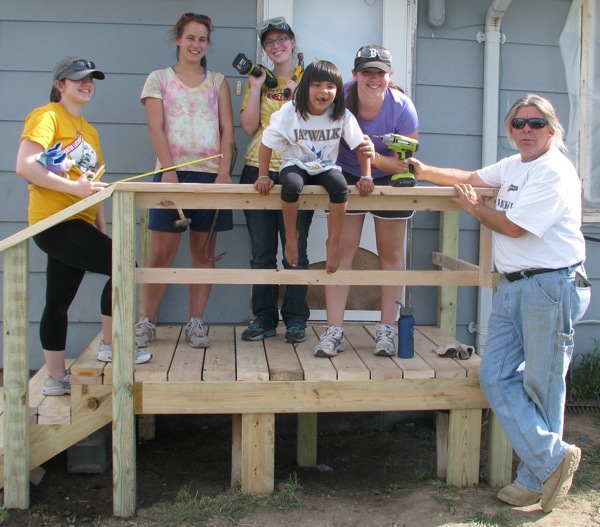
Lakota girl breaks in brand new porch with those who built it.

On Curiosity, Confidence … and Eustace Conway

4 Sep

Eustace Conway as pictured on Gilbert’s biography.

Eustace Conway likes to tell the story of how, one winter in the North Carolina mountains, he shot a deer, only to find it still clinging to life. Conway decided to end the deer’s suffering by taking a knife and puncturing its neck – only to have the deer fight its way back to its feet, thrusting its eight-point rack at his attacker. As Conway tells it, man and deer wrestled ferociously until it finally died; covered in its blood, Conway thanked the deer for the sacrifice it had made, so that he might go on living.

“And that is what I call feeling connected to your groceries!” Conway told a crowd of several hundred students on Tuesday, August 28th, at Assumption College.

Those students shouldn’t have been stunned: They’d read at least parts of The Last American Man, Elizabeth Gilbert’s book about Conway, including a stirring version of the above anecdote. But Conway – long-haired, bearded and tall, talking without notes as he paces back and forth – has a way of making an impression. It doesn’t hurt that this advocate of living close to nature has taken some wild risks to test his survival capabilities, and managed some bizarre exploits along the way, from crossing the country twice via horse – once riding the horse, and once with a buggy – to founding Turtle Island, the patch of North Carolina wilderness where those who are hardy and idealistic enough tackle the humbling challenge of living as Conway does. (Most quit in frustration.)

While Conway acknowledges that he struggles when it comes to making compromises with those who wish to emulate him, he keeps trying because his theme of connection cuts both ways: While Conway derives some of his intense sense of purpose from living as close to nature as possible, he also sees it as his destiny to persuade others to do the same. Hence the public speaking, hence the telephone, hence the television show Mountain Men – in which he appears, even as he ridicules its lack of realism. (The producers wanted to film him peeing uphill, he told Assumption students.)

But while “connection” was a key word for Conway, about halfway through his talk I jotted down two other “c” words – ones I’m not sure he even uttered in the talk. Those words: “Curiosity & Confidence!” I scribbled them down just as it hit me  that Conway was basically unfolding a narrative of American self-education: Even as Emerson valued Thoreau for the latter’s ability to actually build a canoe (rather than just write about one), I admire Conway’s cycle of reading about some wilderness skill and then trying it himself, and then reading more so he could understand the deeper context – and then trying even more.

Eustace Conway is experiential education personified.

Which is why he shows up here, in a blog devoted to stories of service. Sure, there are other good reasons for him to fit here: Conway sees his lifestyle as one that cuts against the “me now” way we treat the environment, as well as an endorsement of kinder social and foreign policies in which we are more respectful of others. But as an advocate of community service learning, it’s his combination of curiosity and confidence I most want students to bring to their service.

The curiosity, of course, to explore how they fit into the broader context of not only nature, but also of community, locally, nationally, and globally. How are the lives of others different from our own? What can we learn and apply from all those differences? What do we have to give? What would we get back in the process of giving it? In what ways might others surprise us?

In what ways might we surprise ourselves?

The second of which brings us to confidence – the belief that in service we might be capable of far more than we ever guessed. I don’t just mean this in terms of noble self-sacrifice, but also in terms of skill sets. The community service narratives I read at the ends of each semester recount dozens of instances in which students felt distrustful of their own abilities, whether they were going to tutor children of immigrants or clear trails, engage ex-convicts or work on a farm. Sometimes those volunteer engagements lead to career choices, based on the affirming of abilities they never knew they had. And, upon learning their new capabilities, they have a few less excuses for not taking their service further.

Of course, sometimes volunteers find out what they’re not suited for – or at least what they’re not ready for yet. Like the many dropouts from Conway’s Turtle Island, they may leave frustrated at how the reality fell short of the idealized vision – just as Conway winds up frustrated at his own inability to relate to the people whom he’s trying to reach. But hopefully even disillusioning volunteer experiences help us chose more wisely in the long run, without renouncing the commitment to serve.

There is something to be said for situations – and for people – who push us out of our comfort zones into a broader awareness. Eustace Conway is one of those people – and I find inspiration in both his successes and his frustrations. I try not to set myself up for quite so much frustration – Gilbert depicts a man whose ambition is unattainable. “People used to say to Eustace, ‘if you touch only one life, you’ve had an effect on the world!’ But Eustace was never satisfied with that. It was his intent to alter the very destiny of humanity …” While that seems spiritually foolish, a surefire setting up of one’s self for failure, it guarantees that he has touched, mostly likely, a thousand such lives over the years.

Gilbert goes on to share the example of a young man named Dave, and how Conway shared with him a message of “mindfulness” in which you should “Revere your senses; don’t degrade them with drugs, with depression, with willful oblivion. Try to notice something new every day. … You can never become a real man if you have a careless and destructive attitude … but maturity will follow mindfulness even as day follows night.”

When that young man tearfully announced that he thought he should leave Turtle Island and go home, he found Conway comforting, offering compassion and advice that he still found valuable 15 years later. “He told me I was free to go home … And I did go home, but when I got there, I found that something had changed in me. And the rest of my life was changed.”

The Blind Man and the Mountain

28 Aug

The Blind Man and the Mountain.

A profound moment while climbing Mt. Monadnock.

The Blind Man and the Mountain

28 Aug

My view from rock face perch most of the way up White Cross Trail (as far as I know).

Sweating profusely only 20 minutes into my ascent of Mt. Monadnock, I forced my way up the steep White Cross Trail – so crowded with rock and root in one stretch, there was no place where my feet could find three consecutive strides of level dirt. Plus, the altitude was getting to me – and it was about to get worse, given that the summit was 3,165 feet, about six times the altitude of Worcester.

Early on, a sign had warned me that most hiking accidents happen on the trip back down – but as I sat and wheezed on a trail-side boulder, I decided most heart attacks must happen on the way up.

As I took a swig of water and unfolded the map – a lame attempt to appear as if I were stopping for some reason other than abject physical humiliation – I couldn’t help but compare myself to the other hikers. The 12-year-olds with miraculously low centers of gravity, the college age guy who absent-mindedly jumped down from one rock to the next even as he was texting, the group of young people who tried to fix a peeling sole by chewing and applying gum to the girl’s shoe, wildly applauding when, for at least a few minutes, it worked. I delighted in their youthful exuberance even as I sensed the limitations of my own 54-year-old body, felt the worry that I’m losing a race against time.

Then, as I slid on my backpack and stood up to assess the obstacle course that led up to the next ridge, I saw the three men. Scores of hikers had already passed on their way down, many of them in waves, seeming to splash down through the rocks like a stream of water, branching off individually through every gap in the rocks, only to rejoin somewhere downstream. But these men moved differently. They stuck in a tighter formation, conferring as they went about what lay ahead – unusual for their twenty-something age, as was the telescopic walking stick, usually a staple of older folk trying to spare their knees.

A minute passed before I realized it wasn’t a normal hiking stick – it was the red and white cane of a blind man.

Which the middle one – stocky, with thick dark hair – obviously was. On either side, his companions were lightly touching one arm or the other, letting him know what was coming with each succeeding step downward. I had been told the ascent could take almost two hours and the descent about half that, on trails that force most to keep their eyes mostly on the ground. Assuming they made the summit, who knows how long it took to arrive on the clear rocky top, take in the view that one of them wouldn’t even see? What happened then? What went on within the mind, heart and soul of the blind mountain climber? Was he once sighted, so he could reconstruct a shadowy memory of what the country might look like? Did he feel heart and lungs expand in the thinner air, spirits lift with his altitude, wind on his skin? Did his pride dwarf his regrets? Or, in my most mind-blowing thought, maybe this wasn’t even a first for him – maybe they did this on a monthly basis. Even then, it had to be a far more intense experience than my own.

Only a minute ago I was trying to cover for my exhaustion, but now I have to conceal my fascination instead. For the sake of subtlety, I continued my hike toward them, then stepped aside to let them pass. There was no meeting of eyes, no small talk, no reassurances about how I too, would make it to the top. No one on the trail wanted to divert the trio’s attention from the task at hand.

I wish I could say that their achievement inspired me to the summit that day, but I wasn’t just working against gravity – there was the additional resistance of a work-related party awaiting back in Worcester. I did hike until I got the satisfaction of a grand view; as I perched atop a rock face, I thought again of the blind climber; but as much as I urgently wanted him to see what I was seeing, but I still felt much more awe than pity. And as I descended, I thought of his companions – of the love, devotion and patience of their service, the ways that, in helping their friend test his limits, they might also have been testing their own. My own path downward was so much easier than their own. Responsible only for myself, both hands free, I could grab a tree trunk here or a boulder there, my only real job was to think of myself and my own path down. Of course, this is one reason hikers take to the woods – to escape communal obligation, recharging in the solitude for a return to community. But this particularly hike, I found less individualism than community in the woods – the example of the three men, the blind mountain climber and his friends, seemed more daunting than the peak itself.

I know I’ll finish climbing Mt. Monadnock – but would I ever climb it the way they climbed it? I can think of a half-dozen reasons why not, all manner of excuses about lack of capabilities and/or confidence. But these men could’ve made similar excuses – and didn’t.  I was still mulling their example later when, looking up from studying a tricky hop, I found I was catching up to them.

I dared not interrupt, but neither did I pass. At least not right away. Instead I hung a few steps behind them, hoping that through some miracle, my strides would fall into rhythm with their own.

One of the easier stretches.

Assumption and Nelson Place

22 Aug

A mess so big, but not so tall – Worcester Telegram & Gazette – telegram.com.

See this link for photo and caption regarding Assumption College students helping with a cleanup at Nelson Place School.

On Barbara and butterflies

21 Aug

On Barbara and butterflies. A tribute to Barbara J. Walker, butterfly enthusiast and advocate for the importance of the natural world.

On Barbara and butterflies

21 Aug

Butterfly hitches ride on Barbara Walker’s shoulder. (Photo by Sue Cloutier.)

Thunder rumbled somewhere to the south as I hiked through the drizzle and drip of the Blue Well Trail, under its sheltering but soggy canopy of lush green limbs. I’m so addicted to my Broad Meadow Brook Audubon hike that I ignore the ominous echoes of the story; I tell myself that while lightning might strike a tree any moment, at least here a stray bolt would have so many trees to choose from.

Much better than hiking, say, through the open field the power lines that run adjacent to this trail.

I suspect this logic is profoundly flawed, but any rationale that propels me through the natural world – pushing my bodily limits, feeling my breath rise and fall, the blood pound through my heart – helps me connect to both my own physical existence and to my place in the broader scheme of creation. I pay attention to the rain-slicked roots and rocks, but I keep pushing forward, if only to keep my heart rate up.  And since one sure way of keeping one’s heart rate up is to tap into the fear of electrocution, I eventually do up the ante, cross back onto Power Line Trail.

After all, even in the rain, I must have my usual mid-hike contemplation on what I think of as the distinctive Barbara Walker Butterfly Bench, featuring a few painted butterflies, befitting since a plaque states that the bench was “In Memory of Barbara Walker / Who Loved Finding Butterflies in This Field.” Now the bench is damp, but so am I, so I settle down, take off my soaked hat for a minute, enjoy the commanding view of the tall golden rod and Queen Anne’s lace in the field defined by the power lines. A nearby sign calls this spot Barbara’s Meadow, and goes on to call her a “quiet advocate for the land and all its creatures” who “loved and cared for special place which nourishes butterflies.”

Butterfly bench where I rest on many a hike. (My photo.)

I don’t know who Barbara Walker is, but I imagine this “quiet advocate” had more sense than to cavort beneath power lines in a thunderstorm. I also imagine her as someone who sees, hears and even smells what I do not, who would take in what I see before me with an observational skill and depth of understanding that would make me seem dear and blind by comparison. I wonder about her every time I pass the bench, but somehow have come away knowing even less about her as I do about butterflies, which is saying something.

This, however, is my day to remedy at least some of my ignorance – for back at the Visitor Center, Broad Meadow Brook Audubon is defying the weather itself, holding its fifth annual Barbara J. Walker Butterfly Festival. So after I slosh my way through the remaining hour of my hike, I pantingly climb up the lawn – past the butterfly face-painting and numerous other booths – and ask someone at to the counter if there was a friend of Barbara around. Within five minutes I’m hunkered down with Rick Walker, who met Barbara Martel when “I was 13 and she was 11 –seven years later, we were married.” They would stay married for 39 years, until cancer claimed her life on March 29, 2008. She was only in the hospital for a few days, and practically right up until the end, her life was immersed in both enjoying and advocating for nature: The couple had just done nature-related trips to Amelia Island in Florida and out to New Mexico, observing birds and butterflies; at the time of her death, she was helping create the festival that, unknown to her, would come to bear her name.

Within a few months, Rick and others had built the bench out of recycled wood, placing it in Barbara’s favorite observation spot.

“She would sit in that area, in the shade there at the edge of the field, and watch for Checkerspots. She would sit on her duffel bag or her backpack and just observe. It was a good vantage point to see what was going on all over the meadow.”

I tell Rick while I love the bench, I can’t sit still that long.

“Neither could she! But if there was activity, if there were butterflies, if she knew it was time to see spring azures, then she could sit there for 30 minutes waiting to see spring azures. Otherwise she would wait 10 minutes and move on to another spot.”

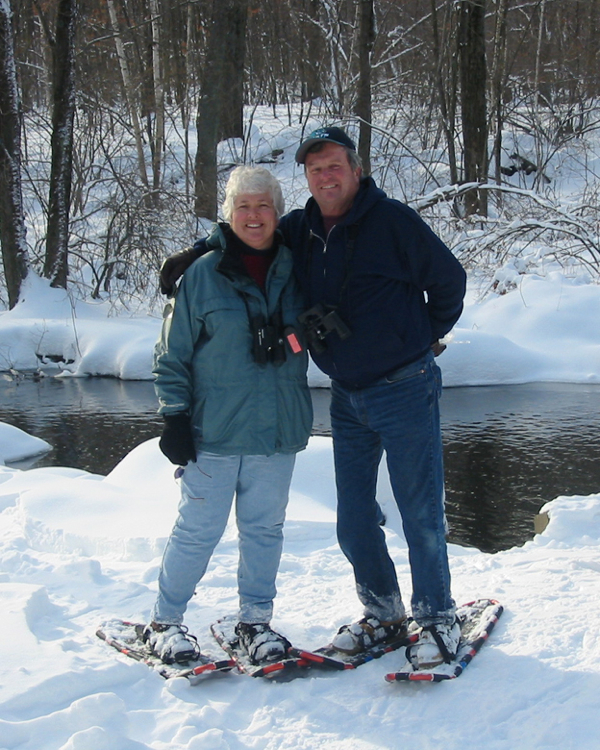
Barbara and Rick snowshoeing at Broadmeadow Brook. (Photo from Mike Walker’s blog.)

Of course, one doesn’t get a bench, let alone a meadow, named for you just because you enjoy the place. Walker ultimately got involved in protecting the places she loved, and she had an ideal skill set for the work.

“It didn’t hurt that she was a microbiologist,” said Rick, who proudly told of the 12 publications she contributed to as a lab technician for the University of Massachusetts Medical School. He described how she – often with his help – would collect specimens to measure the health of Troiano Brook and the marsh where the water flowed into the sanctuary; during the hours of down time between the start and the conclusion of a lab experiment, she would go to the sanctuary and find out what she could. “As goes the brook, so goes the rest of the sanctuary,” Rick said.

Barbara Walker also was involved in the six months of research that went into the decision to cut away the woody plants under the power lines, mowing down the vegetation to two inches high; the choice upset birders who enjoyed warblers and other birds who nested there, but was better in the long run for butterfly habitats to flourish.

For this and other reasons, when I mentioned the sign calling her a “quiet advocate,” her husband had to laugh. He indicated that son Michael  and daughter Kerry would set me straight on that score.

“When we saw that on the sign we all got a smile out of that. You can ask her children; their mother could be anything but quiet when she was passionate about something.”

Meanwhile, Rick and Barbara’s children would develop their own passion for both volunteerism and the outdoors. Mike Walker’s blog Northern Harrier – at Blogspot.com – provides years’ worth of images and words bearing testimony to the natural world and his family’s engagement with it.

Listening to our conversation, friend Elise Barry, also a butterfly enthusiast, remembered something else about Barbara.

“Her face would just flight up when she was chasing a butterfly and then she found it,” Elise said as Rick nodded in agreement. “Her face would light up, and then so would everyone else’s. It was contagious!”

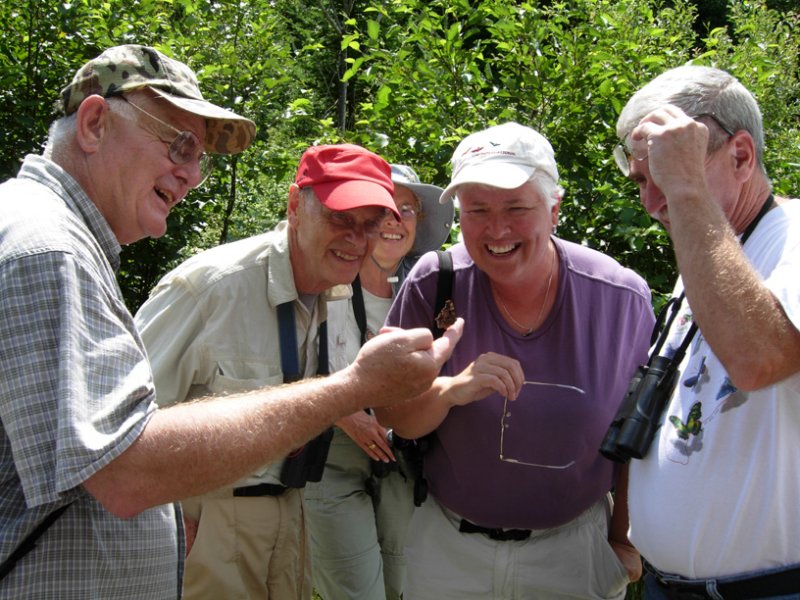
Barbara and friends marvel at a butterfly. (Photo from Mike Walker blog.)

Some of us are drawn to forms of service devoted more directly to problems humans face beyond the woods and fields – challenges such as poverty, addiction, discrimination, and violence. But losing our problems and prejudices in the natural world can provide both spiritual and physical health for those caught up in the gears of manmade calamities – and grant us the wisdom and generosity to create a more compassionate world.

Even a cynic such as George Orwell saw redemption there, as indicated in his hilarious and compelling essay, “Some Thoughts on the Ordinary Toad.”

“I think that by retaining one’s childhood love of such things as trees, fishes, butterflies and—to return to my first instance—toads, one makes a peaceful and decent future a little more probable, and that by preaching the doctrine that nothing is to be admired except steel and concrete, one merely makes it a little surer that human beings will have no outlet for their surplus energy except in hatred and leader-worship.”

Then there’s Rachel Carson, whom Michael Walker quoted shortly after his mother’s passing. The quote is from a plaque his mother lingered over on a visit to

the Cape Cod Museum of Natural History – Barbara Walker liked it so much, she asked her son to photograph it. In the passage, Carson is reflecting on how her and fellow observers felt after observing Monarch butterflies on their journey – and the lack of sadness knowing there would be no return.

“But it occurred to me this afternoon, remembering, that it had been a happy spectacle, that we had felt no sadness when we spoke of the fact that there would be no return. And rightly-for when any living thing has come to the end of its life cycle we accept that end as natural. For the Monarch, that cycle is measured in a known span of months.

“For ourselves, the measure is something else, the span of which we cannot know. But the thought is the same, when that intangible cycle has run its course it is a natural and not unhappy thing that life comes to an end. That is what those brightly fluttering bits of life taught me this morning. I found deep happiness in it –so, I hope, may you.”

And I have, indeed, found my measure of deep happiness at Broadmeadow Brook – thanks to the Barbara Walkers of the world.

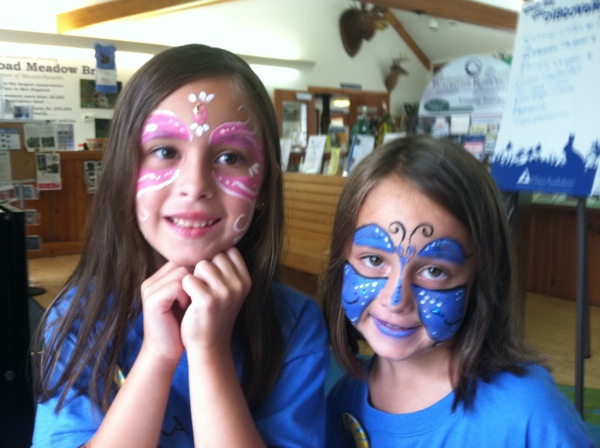
Butterfly faces at this year’s festival. (My photo.)

Stained Glass Sunlight

11 Aug

Stained glass lining sides of Covenant Presbyterian sanctuary.
(Photo by Michelle Lepianka Carter, The Tuscaloosa News.)

Back in June of 2011, on my first Sunday in Tuscaloosa after the tornado, I went to church with Mom. She normally would have stopped by Krispy Kreme to pick up donuts for fellowship hour – but there was no Krispy Kreme. The building was gone, along with so many other stores and homes in what locals had taken to calling Ground Zero – the intersection of 15th and McFarland, which the EF4 tornado with winds of up to 190 miles per hour had churned through six week earlier. The death toll from the April 27 storm would eventually settle at 54 in Tuscaloosa – more than 200 in the state of Alabama – but on this Sunday in June, we’ve yet to reach that total. We drove through the decimated zone, then past an oddly pristine shopping mall that might’ve been anywhere, then, eventually, to Covenant Presbyterian.

While the Central Church of Christ two blocks down had been decimated, the church I’d grown up in had taken more of a glancing blow: We lost our dominant front and back stained glass windows, as well as part of the roof. Instead, the new sanctuary was the old one, the space I grew up thinking of as the fellowship hall. We sat in folding chairs on what was once a basketball court, the pulpit a portable lectern, the altar a utility table, the backdrop vacuum-matted pictures of the old stained glass window and the free-standing white steeple (which actually survived).

The preacher, Rick Olson, connected the church’s existential predicament around the prescribed lectionary theme for the seventh Sunday after Easter – also known as Ascension Sunday, when Jesus, already crucified and risen, appeared to his grieving followers. Rev. Olson focused on how the disciples, faced with this miracle, could only think to ask when the past kingdom of Israel would be restored. “They’re still on that restoring the glories of Israel kick, that re-establishing of the Davidic Kingdom thing. … Here he replies – one imagines with a sigh – that it’s not for them to know the times or periods that God has set – these things are God’s to set, you know, God is in charge – but that they’ll receive the power of the Holy Spirit – the Holy Ghost power – not too long from now …”

The connection was so obvious, he almost didn’t have to make it – folks already knew better than to expect the old kingdom, Tuscaloosa as it existed before 4:43 p.m. on April 27th, to be restored. This is a town which “will take all kinds of time to heal, and which will never be the way we remember it.”

But the part that would stick with me most was what Rev. Olson said next. He compared the spiritual high of the Pentecost to the spiritual transcendence of the early weeks of selfless volunteerism, the ways in which people came together in the wake of the storm … and the long hard slog that is faith after the ecstasy. “And so here we are, brothers and sisters, we are witnesses, martyrs, and the euphoria’s quickly draining, and the short-term workers are going home … and soon, it will seem as if Christ is no longer here as well.”

Whether you consider yourself a Christian or a Buddhist or a Muslim, or simply an atheist with a social conscience, my guess is that you can see in this sermon both the joys and challenges of serving of others. I certainly have seen both the highs and the lows in my few all-too-short visits to my hometown this past year.

Last year on that first post-storm visit, the vast wasteland stretching across my hometown was shocking and humbling, suggesting no human effort could be enough to bring the city back. But then again, I reminded myself at the time, isn’t that true of any social problem, even those not as dramatically visible as a disaster area? And against the dramatic backdrop of vast empty space, the heroism and generosity of volunteers – coming from all over the country – was dramatized as well. The heat of August in Worcester seems like a spring morning compared to a summer in Tuscaloosa – and along with everything else, the tornado also robbed folks of their shade.

Yet the workers came. Came even from Worcester, from Assumption College, where I teach. Last January I watched our students work hard to help finish a house sponsored, as it turned out, by my father’s church. As chronicled in earlier pieces on this blog, our New England students wrapped themselves in my Alabama culture, and felt the joy of connection and wholeness as they gathered around a table in my mother’s kitchens, celebrating a great week with Dewayne Searcy, the Habitat for Humanity foreman with whom we worked, and Paul Belsito, who coordinated community and government relations coordinator in our college president’s office.

Rick South and Tony Casas, of Berg Studios, install stain glass window panes.
(Photo by Michelle Lepianka Carter, The Tuscaloosa News.)

I thought about the highs of that time last month, on a Monday morning when I was again hanging in my mother’s kitchen. And I thought of the changes since, the time the pastor warned us about, the time when the consistency of commitment and faith and perseverance have to drive us forward. I had just learned Dewayne Searcy was no longer with Habitat for Humanity. A few weeks earlier, Paul Belsito had left Assumption for his next opportunity. Even the pastor had moved on, to a church up north. Most of the students had graduated – it would, of course, be disconcerting if they hadn’t. People come together in times of crisis, but then they part ways, moving to the the longer rhythms of their individual and communal lives.

But in the year since I heard that sermon, Habitat for Humanity Tuscaloosa had finished 13 houses in the 14 months since the tornado, with six others close to completion. Meanwhile, Dewayne was working toward starting a tornado safe room business, while back in Massachusetts, Paul was doing for Hanover Insurance Group  the kind of community relations work that he did so well at Assumption. As for the college, it was sending another student group to Tuscaloosa in 2013 – who knows what new connections will be made with the second wave of  students. Judging by the first crew, something special is bound to emerge from the visitors to come.

The church? Well, later that July Monday, I shook off the transience blues long enough to drive Mom and my sister Nancy through the damage zone – now much clearer of debris, with new houses popping up in every direction – to the church.  The secretary let us into the old sanctuary, which had not been used in the 14 months since the storm.

The last time I had seen the sanctuary, back in January, construction was a long way from finished. The windows were boarded up; the space was bereft of pews, pulpit, and altar. In their place, two workers were hollering at each other about some construction issue; metal scaffolding had risen up to the choir loft, and spare lumber was spread across the floor where pews were. Now the pews and carpet were back, the plywood for the most part removed – and, miracle of miracles, the stained glass was back.

What I had loved about our stained glass was that it resisted the temptation to tell a literal story – there are no images of Jesus or Mary, no triptychs of Biblical scenes, no imposing of a particular narrative on the spiritual experience. Instead, our stained glass consisted of roughly fist-sized pieces of widely varying colors and shapes, some more jagged, some more round. Any one piece defied easy definition, but, like all those disparate volunteers, somehow they came together as a whole, lining the left and right walls of the otherwise dark sanctuary, funneling our vision toward the dominant window up front.

That window had more yellows than I had remembered – and the old pieces, which Mom and other volunteers had helped pack and store last summer, had been stripped of more than 40 years of residue. Cleaner and brighter, this time around they chose not to sink each tile an inch deep into the molding; instead, each piece was embedded level with the surrounding surface, making the reds, blues, yellows and purples pop out all the more. The church might feel as if it’s journeyed through the valley of the shadow on occasion, but the sanctuary, at least, would be brighter than ever. And that mattered, somehow.

I watched as my sister lingered on the altar where she’d said her wedding vows. She stared quietly upward at the window, with its metal cross backed by a diverse interplay of color. Some old pieces were gone, but new pieces had taken their place. Then my sister and I joined our mother. We walked quietly and back down the aisle, the sunlight from all those oddly shaped pieces of glass lighting our path.

My sister on the altar beneath the new window.

Support your Local Newspaper

3 Aug

Back in the 1980s in Montgomery, Alabama, I wound up becoming the first development chair for a new Habitat for Humanity affiliate.

On the off chance that this sounds impressive, it wasn’t. The interview process was less than rigorous. At a preliminary meeting, our leader asked a dozen or so of us to spread out into small groups, each devoted to one of the components of any Habitat affiliate. My social work skill set was even more suspect than my carpentry repertoire, so she obviously wasn’t going to steer me toward the Family Selection and Building corners.

“Why don’t you go to Development?” she said, sweetly.

Settling in my corner with two or three others, I then turned around to ask the question on all of our minds.

“Hey Jan. What does Development do?”

“Fundraising,” she said.

I had never done fundraising, but neither had the rest of us. So – perhaps just because I was a newspaper reporter who knew a lot of people … or because no one else wanted to … or because I was tall – I wound up chairing it. Even though the self-help philosophy of Habitat sells itself, I wasn’t terribly good at fundraising – and we were all doing it in our spare time. Often the precious time we put into a single event seemed far out of proportion to the money raised, worrying us all about our ability to house even a few families.

Then one day I got a piece of mail, from a return address I didn’t recognize. It was a $3,000 check – which amounted to about an eighth of a house. The letter was from a local attorney we had never contacted. He was donating because he’d read an endorsement on the editorial page of the local paper – an editorial I didn’t even know was being written. Zero time and energy spent on our part, and three grand to show for our lack of effort.

I find myself thinking back to that local editorial writer a lot this summer – if only because three major newspapers in my home state announced plans to eliminate their editorial departments. The news gets worse. Newhouse Newspapers, a division of Advance Publications, is cutting four newspapers so severely, one wonders if the word “paper” still accurately describes the product. In Birmingham, Huntsville and Mobile, Newhouse papers are going down to three print editions a week, with daily editions continuing on-line . Even more stunning, Newhouse is making the same move with the Times-Picayune. Some argue that New Orleans, having lost so much of its advertising base after Hurricane Katrina, is a special case. But at the same time, one remembers its Pulitzers for coverage – short-term and long-term – of Katrina and its aftermath. (Besides, a New Orleans newspaper without a restaurant critic? What’s next to go? The Jazz Festival?)

Those of us who mostly consume news on-line might respond by saying it doesn’t have to be the end of the world if the same news product is delivered on internet – but layoffs of more than a hundred journalists suggest that the coverage of communities surely will suffer. Of course, a reader has to be able to afford internet service and a computer to take advantage of what is there.

Others might argue that it could never happen here, in a paper owned by the New York Times, in a city the size of Worcester. They should keep in mind that the newspapers in New Orleans, Birmingham, and Mobile are all based in larger communities – New Orleans is almost twice our size, according to the 2010 census – and boast larger circulations than the 74,563 (combining print and digital) that the Telegram & Gazette reported this past spring.

Of course, the news isn’t all bad. The May 2 Telegram & Gazette article reported that  overall readership “held steady” and online readership is growing, combining for 384,751 Worcester County residents, or 62 percent of people 18 and older. Part of a recent dip in paid circulation had to do with anticipated changes in requirements by the Audit Bureau of Circulations. Meanwhile, the newspaper reports about 40,000 on-line accounts for people who can read up to 10 on-line articles a month, which helps in the eyes of advertisers.

Our local newspaper is also working on creative ways to adapt to changes, even as it also strives to serve the community in ways that go beyond what’s on the pages we’re reading every day. As part of a committee working on an education-related project,  I’ve been a direct witness to both the newspaper’s dynamic  leadership and their new offices at 100 Front Street. Meanwhile, as the textbooks tell our journalism students, all of those internet entities are still going to need journalists to provide the content for all those web sites – no matter how much some web publications might water that content down.

What can we do? Obviously, subscribe – digitally, if not in print – and think of your subscription as more than a self-indulgence.

Instead, see the act of subscribing as a form of community service. When one thinks of the myriad ways a local paper fosters connections, disseminates information and dissects debates no one outside our city is going to bother to cover, it’s clear that print journalism is practically as worthy of support as the charities it covers. After all, I wouldn’t know about some of those agencies – or the needs they address – without the newspaper reporting it first. Nor would I feel the same sense of connection to my community as a whole – the ritual of reading affirms that I’m part of the town which I drive about every day. Nor would I bring the same critical intelligence to the needs of the community, or what I can do to help.

Yes, I do gulp when I read the argument above, which verges on equating the still viable business of newspaper journalism with a charity. It brings to mind images of starving journalists – specifically guys in my fantasy baseball league, which began in the newsroom of a paper that no longer exists – staring at me with imploring eyes from direct-mail fundraising letters, asking me to sponsor them for 17 cents a day. I don’t think any of them want to be viewed that way – but one of them was among the casualties of the Newhouse layoffs.

I mean, have things gotten so bad for the printed word that the average citizen should merge his budget line for subscriptions into the one for charitable donationbs?

I don’t think so. But I will assert this: As each of us think about where to best allocate our scant community dollars, the newspaper – with its ability to educate the public about every community need and every non-profit agency, in far more depth than the average newscast – is worthy of some serious consideration.

Besides, how much time can you spend reading one of those ubiquitous charity give-away tote bags? Sure, they’re handy for the beach or for books or for environmentally correct grocery shopping. But no tote bag would’ve told me the latest developments regarding construction of the new homeless shelter on Queen Street, or the passing of a friend’s relative, or Westborough Food Pantry’s innovative fundraising drive, in which fake Olympic torches are placed in people’s yards.

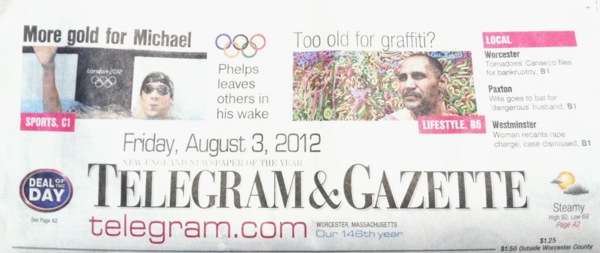
According to Wednesday’s Telegram & Gazette, victims in the Food Pantry scheme find along with the torch instructions to first donate to the Food Bank, then pass the torch to another unsuspecting neighbor. One resident, Marcy Lippold, said that she and her daughter Illana “giggled like crazy this afternoon positioning the torch and hiding around their front yard.”

If only I’d read that story back in my Habitat days …

Creative compassion

21 Jul

Banner at July 16th ACE Open House.

Back in the 1970s, Millard Fuller had a simple but elegant idea – a program in which people could earn decent homes through a combination of interest-free, low-cost mortgage payments and sweat equity labor.

More than 500,000 homes later, Habitat for Humanity is going strong, both in the United States and around the world.

A tall gangly guy with a down-home manner, Millard was a dynamic and imaginative entrepreneur who’d become a millionaire in business with Morris Dees. Then he and wife Linda left their business to work for the less fortunate, ultimately going overseas to Zaire as a missionary and creating what would become Habitat – while Dees stayed back in Montgomery and created the Southern Poverty Law Center, which, among other things, investigated and sued white supremacy organizations on behalf of victims, trying to drain racist organizations of its cash reserves.

When people start slinging the community service vocabulary about, we talk a lot about “compassion” and “love” and “justice” – the big obvious principles that help inspire us to action. But the reason that the stories of Fuller and Dees intrigue me is because of other virtues – specifically creativity and imagination, opportunism and optimism. In my own life, it’s easy to see compassion and creativity as separate aspects of my life – writing over here, service over there. But whenever I start to fall for that fallacy, something happens somewhere that reminds me of how intertwined imagination and advocacy can be.

This week I was reminded of two such stories right here in Worcester. On Monday July 16th, African Community Education, now six years old, celebrated the end of its first year in its new location, at 24 Chatham Street. A little more than 24 hours later, the city declared July 17th as Friends of Newton Hill Day, in honor of the 10-year-old organization dedicated to maintaining and improving the wooded hill across from Elm Park.

Student-led African dance demonstration.

ACE owes its founding to Kaska Yawo, who, only seven years ago, escaped the violence in Liberia. Within a year, Yawo began working to address the needs of the refugees and children of refugees in Worcester. Since African children were thrown into the public school system by age, rather than by their experience with English, Yawo pushed for the creation of ACE to help bridge the gap. Now 32 ACE children have graduated from high school; many of them are now in college.

The Monday open house was a collaboration of those young people from Africa and the folks from Worcester who taught them; visitors toured colorful classrooms and offices, as well as a gym in which kids performed their own blend of dances from East, West and South Africa. After an awards ceremony, an audience of more than 50 heard from ACE students Regina Moore – who designed the cheerful and smart series of ACE t-shirts over the years – and David Sarpee, now a student at Quinsigamond Community College.

As Sarpee stated in various handouts, “The ACE program became my second home. I was there every day, even if I didn’t have homework. My vocabulary increased and my grades improved so fast that my teachers thought I was cheating. But I was just working as hard as I could.”

Newton Hill, of course, has an open house seven days a week – all you have to do is walk into the woodland from Pleasant, June, or Park streets. Wind up the hill in easy gradual circles, or get your heart racing quickly with a straight shot to the top. You can bird watch or dog walk or, for that matter, play disc golf. It’s all a dramatic contrast to 11 years ago, before FNH, when the woods featured fewer trails, all of which were overgrown and strewn with trash. Then Rick Miller took his kids there and, appalled, decided to create an organization, building a coalition of many whose lives were touched by the hill.

I could write much more about either organization – and probably will. But for now, I just want to pay tribute to the Kaska Yawos and Rick Millers of the world – and all those willing to roll up their sleeves to turn a good idea into a redemptive reality.

Rick Miller amid one of his Newton Hill spinoff projects – selling firewood created by clearing off trails.